Berthe Morisot was born in France (1841-1895) and exhibited with the Impressionists (then a group of painters who’d been rejected by the elite) in 1864). These artists included Paul Cézanne, Edgar Degas, Claude Monet, Camille Pissarro, Pierre-Auguste Renoir and Alfred Sisley. Before that she had exhibited in the Salon de Paris (1874).
Berthe was married to Eugène Manet, the brother of her friend and colleague Édouard Manet, but who himself was an artist. Berthe was unique in still painting throughout her marriage. Most women artists, like one of her sisters, who herself was an excellent artist, gave up art once married to look after husband and children. It was the done thing in those days.
As part of the ticket price there was an downloaded App to accompany the exhibition. You just had to remember your earphones!
Alongside Berthe’s own paintings were art works she had copied, taking a segment of that painting and giving it her own style.
This is Berthe’s husband looking through a window
One of these paintings was the Blue Boy by Thomas Gainsborough. Here she uses a girl instead of a boy, and sets it in a domestic scene.
All the blues. Excuse the reflection, this one was under glass.
Morisot used to go out early to paint, around six in the morning. She used the same models, wearing the same dresses each time, to capture the scene.
Berthe travelled to England and in the above picture is a letter she wrote talking about the places she visited, including the Isle of Wight, St Leonard’s and Worthing.
This is another painting where Berthe copied a section of another artist’s picture to create her own.
There were many paintings of her daughter, Julie Manet. The one below is in pastel.
I took this photo to show the different styles of pastels. This is not by Berthe (Sorry I can’t remember who it’s by). It sat alongside the pastel of Julie Manet but it is still a pastel. I was amazed at the detail, how smooth. I needed to go close to this because it looked like paint. The white mark on the crease near the shoulder confirmed it!
Julie Manet
I admire Berthe’s use of white in her paintings to emphasise drapery, and in this, the curtain behind the girl.
Again here, those light touches.
Berthe painted this picture of her daughter wearing mourning clothes. She lost her father at the age of fourteen and the empty chair was his. Tragically, Berthe died just two years later.
What a sad note to end on. I wanted to know what happened to Julie. I was pleased to find that Julie was an artist, diarist, and poet. I found this wonderful article about the Morisot’s, and especially Julie, in the Irish Times, which includes paintings. She lived with her cousins and married Ernest Rouart in a double wedding with her cousin Jeannie. Fascinating story. Worth a read.
I gave my friend a list of art exhibitions on in London and asked her to choose. With the prospect of dodgy weather, being indoors sounded like a good option. As it turned out, the day wasn’t too bad at all weather-wise, and the exhibition she chose was excellent.
Winslow Homer (1836-1910) was an American Realist painter of landscapes and best known for his marine paintings. The exhibition at The National Gallery is called Forces of Nature. The paintings here include scenes from the American civil war and life after slavery for black people (not such a good life with all the restrictions about what they could and could not do). There was a lot in this exhibition that made us think that sadly, not a lot has changed in the world.
It is always helpful to know what is behind a particular artwork, but I got the feeling that Winslow Homer didn’t like explaining. So, do art critiques guess?! Homer used a lot of symbolism in his art, which is common with artists, and has been for hundreds of years. Homer worked in oil and watercolour, but it was his oil paintings that we were drawn to the most.
Winslow Homer’s depiction of light is well done. His use of white against dark backgrounds really brings his work to life. His sea paintings are stunning. He loves stormy seas and has a knack with the brush of creating the waves and splash against rocks. We both enjoyed this exhibition and learning about this artist who neither of us had really come across before.
In Trafalgar Square we got to see the new art work on the fourth plinth. It rather fitted in with the exhibition we had just seen. Entitled Antelope, the work is by Samson Kabalu, and you can read about it here.
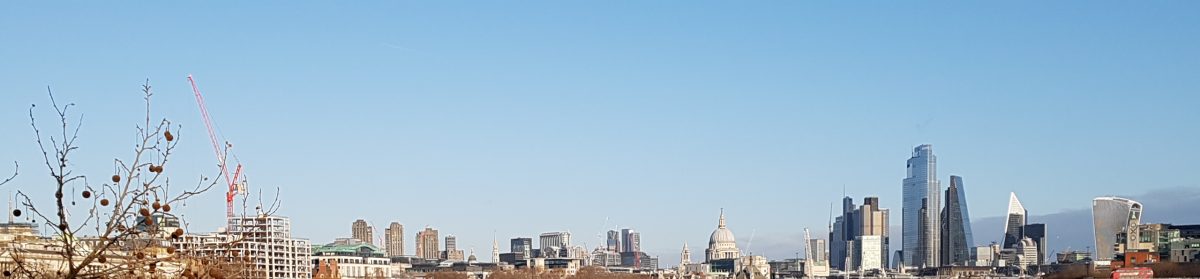
One cannot write a blog without a photo of the River Thames! Always a delight whatever time and season.
A short walk in the October sunshine
My local park
Yesterday morning dawned with blue sky that said ‘come and walk under me’! So I did. Just a local walk in places I know well and frequented many times during Covid lockdown.
I love to photograph leaves against sunlight and the changing seasons. Autumn is a great time for photographers with so many wonderful colours. Even the road where I live is alive with vibrant tones of gold, yellow and red.
A tree in the road where I liveIn the parkDoesn’t this make you think of Christmas?Long shadows in the parkA walk known as the BeelineLike by dog walkers, joggers and there is a cycle lane (right)Sunday football on the fieldThis is actually a footpath leading to the busy A3 bypass but it could be in the countryside.Dandelion head
On the last day of our holiday in the Lake District, we set off to walk to Brantwood from our hotel. We borrowed one of HF Holidays’ self-guided walk maps which was well laid out with instructions as well as the map itself.
Please excuse the blurry photo
The walk was easy and beautiful. We knew the weather forecast was iffy, but we went prepared. It was warm and soon there was sunshine, though looking across the water, mist and dark skies surrounded the mountains. This made for some atmospheric photography.
Looking across Coniston Water
We were in Swallows & Amazons country. I’d missed out on all this when I was a child (I have now bought a DVD film adaptation of the book, which I’ve yet to watch).
Can there be a better view than this?
We arrived at Brantwood just as the drizzle started. A good time to go inside the house! Maybe this is a good time to explain about the house. John Ruskin bought and moved here in his 50’s. Ruskin was a well-known art critic and water colourist. He had an interest in geology, encouraged by his father.
Ruskin was a very complicated man brought up by a dominating, over zealous Christian mother. She schooled him and ruled him. He had few friends, but did have contact with his cousins. When he left for University, his mother went with him to rooms nearby. Imagine that!
Later he did the ‘Grand Tour’ and was aware that some buildings were being changed as they were renovated, so Ruskin set about sketching these before they disappeared. He influenced the Pre-Raphaelite Brotherhood and became a great supporter of their art, meeting them about once a month for discussions. Ruskin also lectured and would walk up and down the stage as he spoke. He was even known to dress up as a bird or animal! He was a harsh critic of things he did not approve of, yet his vision was forward thinking. He stood up women and the ordinary man, and thought art should be for everyone, not just the upper classes.
In love, he was not successful. He had a liking for young women, perhaps for their innocence and looks. In his teens he met Effie Gray (a distant cousin), and married her, but the marriage was never consummated. A lot has been written about this relationship (films have been made about it too!). When Ruskin took John Everett Millais with him and Effie to the Scotland, the two young people were attracted to one another. Millais painted Ruskin’s portrait (though most of this was painted in a studio). See painting here.
Effie and John Ruskin divorced, and Effie married John Millais and had a large family. Ruskin never spoke about Effie again, not even in his writings, and he wrote a lot! His final romantic interest was with Rose La Touche in his thrirties She was 17. The relationship lasted 17 years before Rose died. Ruskin never got over this.
Living at the house in Brantwood was his cousin Joan Severn who was Ruskin’s housekeeper until he died in 1900. Joan was married to artist Arthur Severn and they and their children lived in another part of the house.
View from Drawing Room
I can see why Ruskin loved this house, elevated as it is, with views across the water and surrounded by 250 acres of gardens and woodland. Ruskin and Joan created seven distinct gardens stretching from the lake shore and jetty to the fell top. They are lush with springy moss, beautiful flowers and little nooks. Such a peaceful place to sit to have lunch.
The house consists of the hall, dining room, study, drawing room with annexe, the Blue Gallery and the shop. Upstairs is Ruskin’s bedroom where he built a turret, and the ideas room, which was originally a bedroom and where Ruskin slept after his breakdown.
Ruskin suffered from depression and had several breakdowns in his later years. Joan nursed him through them all and stuck with him despite his rages. In his writings, he admitted he could not have managed without Joan.
In the annexe there is a lovely photograph album with photos of Ruskin, Joan and her family, along with visitors to the house. It was a delight to view.
Drawing Room. On the piano is a piece Ruskin composed. I had no idea he had composed music.StudyStudy where Ruskin worked with his secretaries (he had three)Dining RoomDining Room. The painting is of Ruskin aged 3
Ruskin’s bedroom. These are copies or prints of Turner’s paintings. The originals were sold.
The Turret. I can just imagine myself sitting here with a book and cuppa!
The ideas room, formerly a bedroom
Ideas room
Ruskin’s carriage. I can just see him coming along those narrow lanes in this!Even back in Ruskin’s day he was aware things were changing. He was so close to nature that he noticed the little things others didn’t. He was vocal about what he saw, but I expect his warnings fell on deaf ears. Not much has changed!
Lush is the only word I can use about the gardens
Ruskin’s seat
The houseThe gallery with an exhibition about the author of Swallows & Amazons.
Before we leave the house (there is a lovely cafe here, by the way. It’s in a separate building), I must just tell you about the all important toilets. They are some of the nicest and colourful I have ever seen. Just take a look at the photo below.
Toilet facilities
We decided to walk down to the jetty. Ferries call in here and we thought we might catch one back to Coniston. To find the jetty, we walked through more of Ruskin’s gardens. Vegetable grow here and countless flowers. It is so pretty.
Gardens leading to the jetty
The jetty with ferry departing.The steam yacht Gondola
We were told the Gondola didn’t stop here on our tour, but it seems it stops by request. I don’t know what happened between us booking this holiday and being told the yacht wasn’t stopping, but hey-ho, we caught it for the ten minute trip back to Coniston! And guess who was standing at the jetty at Coniston? Our group and Phil, the leader, waiting for their lake tour! I think that round was to us!
The workingsArrival in ConistonA bit grey and overcast. Coniston
To complete the day (and my pilgrimage, because this is what this day was for me), I wanted to see Ruskin’s grave. The town of Coniston is about a mile from where our hotel is, and this was the first time we had been down here. I know there is a Ruskin Museum, but we never made it there. But we did find Ruskin’s grave and the grave of Donald Campbell who died on Coniston Water trying to break the world water speed.
John Ruskin’s grave, St Andrew’s Church, Coniston
St Andrew’s Church
Grave of Douglas Campbell is in the New Graveyard off the main road
On the walk back to the hotel
This was terrific day. I would happily visit the house again if I’m back that way. The house and gardens were beyond my expectations and I was thrilled to have finally seen where John Ruskin lived in later life. I hope you have enjoyed it too.
A friend and I have been going along to the Summer Exhibition for some years now. There is always something provocative, stunning and surprising to see. What I particularly like is the contrast of art, from prints to watercolour, mixed media, installations, models, oil. You get the whole spectrum. Some of it is beautiful and some is downright terrible! But that’s only my opinion.
There were many art pieces highlighting climate change
What is art? That’s the question that keeps raising its ugly head. Well, I have learned that anything can be art, and if the artist says it is art, then it is. I’ve come to believe that over the years. I also think that anything in creative arts that provokes a response (whether good or bad) has done its job.
Cairn: Sea-worn concrete by Ever Grainger. Is it art? Well, I liked the quirkiness of it.
FL01 by Nathaniel Rackowe
At the Summer Exhibition, works are chosen by various people. I’m always fascinated to see what Grayson Perry has chosen. His selections are in two rooms, the walls of which are painted bright yellow. I loved it, but my friend found it sickly!
One of the Grayson Perry rooms
Who lives in a house like this?
One Kilobyte by Amin SadeghyAcciona Ombu, Madrid by Lord Foster of Thames Bank RA
There is something about model buildings that remind me of dolls houses and Diorama (a miniature three-dimensional scene in which models of figures are set against a background). Sometimes these come displayed in boxes, like a world in a box. I just love them. I always look forward to seeing what is on display at the Summer Exhibition each year.
New Tank by Nicola Bealing
There are 1465 exhibits. Some baffled us, a few we wondered why someone who was a member of the RA would draw/paint something a school child would do. What are the judges seeing in those? The exhibits I have chosen to photograph (and there are more than I have posted here) are ones that I either liked, found clever or ‘spoke’ to me. But even I couldn’t take photos of everything. I thought this year was better than the previous year. My friend disagreed! But disagreeing is fine. We all have our own opinions. We still enjoy our day out.
Espirit D’Art by Bob and Roberta Smith RA
The piece above sums up my feelings about art well, which is why I like it. Do I need any other reason?
Another general shot of works chosen by Grayson Perry
When I took the above photo, my friend (probably despairing of me) said ‘What are you taking now?’ I was drawn to Mass Extinction Includes You by Nick Fieldhouse because what he says is true. But also I wanted another general view.
A Car Owning Democracy by Chris Orr RA
One Blood by Dick Jewel
The photo of the above art work doesn’t do it justice as I couldn’t get a clear shot with all the reflection off the glass. What I like about this is the different cultures, religions, races, all brothers and sisters together.
We All Go A Bit….by Marie PepI Used to Love You by Kevin Knowles
What is it about dolls that can look scary? Well, certainly dismembered ones. Remember Toy Story?
Beekeeper (Girl) II by Yinka Shonibare RA
Yinka Shonibare has had exhibits in most (if not all) the Summer Exhibitions I’ve been to. I like her work. The above is one of four exhibits by her this year.
Because You’re Worth It? II (Slaves of Fashion Series) by The Singh TwinsGeneral View
I couldn’t find the artist to this, but I like it! I couldn’t take the whole thing in one shot, so I did it in two. Quirky eh?
Dante’s Inferno – Canto 3 (just guessing by Leonardo Frigo. I love this.
Church of the Lateral Flow Saints by Matt Wickham. Brilliant!
The Summer Exhibition is on until 21st August. I’m sure every one of you would find something different that appeals. My choice would not be for everyone, but I hope it gives you a flavour. You can also view all (or most?) online here. I’ve just had a bit of shock when I saw online that something I thought had just been left there was actually a piece of art! See the exhibit here! Back to that question…what is art?
I didn’t know a great deal about Cornelia Parker‘s work other than the piece featured above, and Thirty Pieces of Silver, but I thought this might be my sort of thing. It very much was. It held for me the same wow factor as the exhibition by Antony Gormley I’d seen a few years ago.
What did I like about these works? Well, ultimately I love the way the artist thinks and how she re-purposes objects. I think you need to read the information to each piece to appreciate what she is doing. I certainly did. I also like the way the suspended art pieces create shadows on the walls.
The Kiss
The Kiss is in the main entrance hall (where you buy tickets). She rather likes string! I like the way the string wraps around the couple, binding them further together.
Thirty pieces of Silver (a quote borrowed from the BIble) is a work that took the artist around car-boot sales, markets and auctions collecting silver plate. Even friends and family donated items. All of them were steamrollered over before being assembled into thirty separate piles and suspended a few inches above the ground. They hover, twirling slightly as air moves around them.
Thirty Pieces of Silver
Cornelia takes items, breaks them, shoots them, uses remains and sets them under glass, like the sawn-off shotgun and residue in the photo below.
Shared Fate (Oliver)
The Oliver Twist doll in the above photo was cut in half by the guillotine used to behead Marie Antionette (guillotine is in the Chambers of Horrors). Cornelia was also able to visit Customs & Excise UK and persuaded them to give her certain objects for her to repurpose, including the incinerated remains of some cocaine in the next photo!
Exhaled CocaineCold Dark Matter: An Exploded View
I took many photos of Cold Dark Matter. It is possibly my favourite of the whole exhibition. This once garden shed was blown up using Semtex by the Army School of Ammunition. The artist pressed the plunger! The soldiers then helped her collect the pieces from the field. In one of the Art History classes I attended, we touched on pyrotechnic art, and I became rather fascinated with it. Although the artists we looked at used their explosions to destroy their art as part of the art, I much prefer Cornelia Parker’s idea of using the pieces afterwards. The shadow effect created in these displays fascinated me (I love photographing shadows).
Forgive me another view of Cold Dark Matter
As soon as I saw these framed items, I thought Turin Shroud. I read everything I could find about the Turin Shroud when I was younger. Indeed, I was right about this. The artist used paper and a hot poker (I think it was) to create the burn marks that are like the Turin Shroud, which was rescued from a fire, leaving similar marks on folds of the cloth.
Black Path
The artist worked in Bunhill Fields in London and took casts from the path where William Blake is buried for the above artwork.
Poison and Antidote (read the caption below)This is what remains when a vinyl record is made from making the grooves. As someone who has kept all my lovely vinyl records I love this!Perpetual Canon – another steamroller exhibit!Island
In Island, the glass is painted with white brushstrokes of cliff chalk. The artist says ‘(The structure)… becomes enclosed, inward looking, a vulnerable domain, a little England with a cliff-face veil.’ The greenhouse sits on worn encaustic tiles from the Houses of Parliament.
War RoomWar Room (detail)
I should say that in War Room every empty mould represents a life lost, but not everyone. It really makes you think.
Magna Carta
The artist printed off the Wikipedia page and then asked people to embroider the work! Wow!
Magna Carta (can’t get it all in on well on one photo shot)
As well as the installations and framed items, there are two video rooms. One of the films, War Machine shows Remembrance Day poppies being machine made. I wondered if this was in the Poppy Factory in Richmond, which I went to many years ago with a group from church, but it was a different factory. However, we did see poppies being made this way, as well as ex-veterans making them by hand. We also had the opportunity of making one of our own (which I still have), and to write on a wooden cross the name of a someone serving in the war who didn’t come back. I was able to do that for my uncle and his cross was later set out with others in Parliament Square.
The exhibition is on until 16th October. I hope I have inspired you to see it for yourself.
Now, I must admit, I have never been a big fan of Churchill. I’ve never forgiven him for ruining a whole day due to his state funeral. I was coming up to ten years old, and all I remember of that day is sombre music on the radio, and there was nothing, I mean nothing else to do. So depressing! The world stopped, and I thought, who is this man that can do this?
View across the lake
Okay, I’ve got that out of my system, but as a nearly ten year old, I didn’t really understand (or want to know) who this man was, but that day haunted me, and I’ve obviously never got over it! Second thing – I only associated Churchill with war, which seemed to obsess my parents’ generation. I realise now, of course, how much it affected them. There was still rationing when my brother was born. When the air-raid siren on top of the local police station was tested (which I remember as a child), how my mum hated it. Thirdly, I have been to Chartwell before with my mum and dad, many years ago, but I barely remember it, and I wonder if that too has been blotted out of my mind due to my prejudice against him! I remember standing in the garden, and that’s all. So, why, you might ask, did I recently visit? Well, a friend was keen, and I never refuse a day out!
There is actually a well – the Chart Well!
Has my opinion changed? I have become more sympathetic, and I love the fact that he was such a family man. I’m never going to be his biggest fan, but I can live with it! Maybe I have laid the ghost to rest.
The front of the house isn’t as impressive as the side or back.
Chartwell had been owned by the Churchill family since 1922. It was only in 1964, a year before he died, that he moved to his flat in London, due to ill health. You can read more about Churchill here. Of course, there is more to Churchill than just war. He was Prime Minister. I learned that he switched political parties, he suffered from depression and the only thing to help with that was painting. And he was a family man. In the gardens is a cute brick built playhouse he had built for his children.
The brick built playhouse in the gardensPlanting is still not complete. During lockdown, The National Trust lost money and could not afford plants, so there are still bare beds in some places.Another view of the houseView from the Pink Terrace (house)
The house has beautiful rooms, and the views are spectacular. Who ever said Kent is flat? There are some very hilly parts to Kent. I expected very masculine rooms where Churchill worked and plotted the way war was going, but I was surprised by how homely it all felt. It wasn’t all leather and wood! I also marvelled at how industrious Churchill was – how many books he wrote and how many pictures he painted. How did he have time?
Lady Churchill’s sitting roomHall and stairsDrawing roomLibraryAnother library viewSecretaries Office (I think)Dining RoomKitchenKitchen
There is a museum with a lot about Churchill’s life, especially his the military life and all the organisations he was a member of. There is a whole case of uniforms and, of course, his cigars.
The famous cigars
Outside the gardens is Churchill’s studio. At first he had only a small studio, part of the workmen’s cottages. He put windows on the roof to add more light. Now this is the exhibition space for his many paintings. Churchill did not start to paint until he was 41. Encouraged by his sister-in-law, it became a lifelong hobby, and he took his box of paints and canvasses with him when abroad. Some of the paintings are unfinished, like professional artist’s sketches, and sometimes he went back and started again. Here you can compare the unfinished with the finished. They are remarkable paintings. Churchill never painted for profit or to display. This was something he did for himself. Around the garden and grounds there are seats placed where Churchill would sit to paint. And what views there are to paint at Chartwell.
The studio – everything here is Churchill’s
The National Trust acquired Chartwell eighteen years after Churchill’s death. These days there is a super cafe, National Trust Shop, secondhand bookshop and the all important toilets. There are lovely walks you can take into the woodlands. My friend and I took one of these paths and came across swathes of bluebells. Looking back at the house from there, you can see why Churchill loved this place so much.
A view of the house from across the lakeBluebell heavenOne of Churchill’s chairs
I loved the house and studio, and the surrounding gardens and countryside are beautiful. The house has a lovely feel about it, a good atmosphere, homely. This must have been a place to relax in away from London and all politics and war for Churchill. A place of family, and his beloved painting. We heard a talk in the studio about Churchill’s art, and he was friends with Sir William Nicholson (father of Ben Nicholson who worked with and married Barbara Hepworth). In fact, Sir William was Churchill’s mentor, but when Nicholson suggested using a more muted palette, Churchill decided to stick with what he liked. I admire him for that. You can see both artists’ pictures of the view of the swimming pool – I much prefer Churchill’s! It made me smile because Sir William’s son, Ben did the same with ‘primitive’ artist Alfred Wallis, but Wallis also went his own way!
I believe my heart belongs to this place. Winchester ticks all my boxes, so it was great to be back in this lovely city again. I had bought a ticket for two events. The first was Extraordinary Everyday: The Art and Design of Eric Ravilious, and the second was Lux Murualis, a light show at Winchester Cathedral. But first there was lunch at The Refectory, which is always a treat. Here I gatecrashed someone’s table as there were no free spaces. I ended up chatting to a man, who is training to be a Priest and was spending twelve weeks at the Cathedral. Isn’t it funny how some people you click with? We discussed everything under the sun in the hour and half we sat together.
Off to the exhibition (no photos allowed, but do look at this website to see the art of Eric Ravilious. A quick low-down. Eric grew up in Sussex, one of his art tutors was Paul Nash (another painter whose work I adore). They were both war artists and friends. Eric died while at war. His aircraft never returned. Just think what he could have achieved if he had survived? Eric was a painter, engraver, illustrator and designer. His range is incredible. I spent an hour studying his painting closely, looking at his brushstrokes, trying to see how he achieved the effect. His designs for plates and bowls are quite fun and I would dearly love to own one of his works.
Outside The Arc, home of the Eric Ravilious exhibition
I can remember sitting on a hillside with a friend just outside Rottingdean in Sussex, on a walk Eric Ravilious might have taken, and looking at the patchwork fields. I said to my friend, ‘This looks just like an Eric Ravilious painting.’ And it really was. I could see his work all around me.
After the exhibition I went for a wander through the city and down to the Deanery Secondhand Bookshop. Unfortunately. it was closed. So I ended up in Waterstones bookshop instead (as you do!).
The main shopping precinct, WinchesterCathedral
More wandering took me back up through the City to The Great Hall, which was closed the last time I was there. There were parts of it I couldn’t remember, and through talking to the lady in the gift shop, I realised it was pre-2017 when I was last in there! This is a lovely place and is all that remains above ground of Winchester Castle. The hall has been used for all sorts of things, including the assize courts, county offices and more recently for filming such things at The Crown and Wolf Hall. The myth of Arthur and the Round Table dominates here, and the table is around eight hundred years old! Built in 1222 and 1235 it is part of the castle started by William the Conqueror. Outside there is Queen Eleanor’s Garden, a peaceful place to sit. The long gallery holds more information about the hall and castle through the ages and leads to the gift shop.
The Great HallJudges chairsThe Round Table, almost 800 years oldThe Great HallQueen Eleanor’s GardenAnother view of the gardenCastle passageways
I can see the old castle passageways outside. Part of this is open again now, though you can only go so far before there are gates looking into a very dark underworld! Creepy.
By now, it was time for afternoon tea. I had a leisurely break over a toasted teacake and tea and caught up with some reading. It was too early to go to the Cathedral for the light show, but I decide to go for a quick walk down to the River Itchen, and ended up walking to where the Water Meadows begin. By then it was 5.45pm and hardly anyone was around. Standing there by the river, the blackbirds were singing their hearts out as dusk began to fall. It was magical. Enjoy my little video.
I arrived at the Cathedral and joined the queue for the light show. Looking at the windows, I could already see lights flickering inside. Excitement was building. Finally, I was in. Wow! Every part of the cathedral had moving projections and music. I ended up taking lots of photos and videos. It was amazing. The theme was science, so there were projections of skeletons, muscles, double helix, faces of scientists through the ages flashing up. The main part of the cathedral (nave) was quite stunning. I sat down and took in the whole range of images. I was there about an hour before I reluctantly left and wound my way to the station for the train home.
Just one video I took during this amazing evening.
The light show was only on for a week, so it is over now. I know a few cathedrals have done similar things, and this was really wonderful. It was a perfect day. Even the weather was good. I don’t think it will be long before I am back in Winchester again.
Inside the CathedralOutside the Cathedral while inside it’s all still going on!
A bus ride took me to my starting point at Tolworth Court Farm Fields. I wrote about this place last summer when I first visited with a friend. Today, it was rather windy across those fields, and I was still no nearer working which field I was in, and I didn’t end up quite where I thought I would (direction not being my strong point). In fact it was a day of wrong turnings, but wrong turnings can lead to interesting discoveries.
The sun was trying to break through the clouds. I was out early and met mostly dog walkers. Underfoot the fields were a quagmire. Mud soon caked my shoes, and I had to watch where I was walking.
The start of my walkTolworth Court Farm Fields
Eventually I found the river, and here was my first error. I turned right instead of left. I was heading along the Bonesgate Stream, not the Hogsmill. If I had followed that track I would have ended up nearer Chessington. There is nothing wrong with Chessington. In fact, I have crossed the Bonesgate on a previous walk through Chessington and Ashtead a couple of years ago. But this wasn’t my plan today. So retraced my steps. But before I move on I will tell you a little about the Bonesgate Stream. One part of it rises in Horton Country Park and the other in Chessington Wood. It joins the Hogsmill at Tolworth Court Farm. The Hogsmill is, of course, a tributary of the River Thames, and it meets the Thames at Kingston at Clattern Bridge, built in 1175, and is one of the oldest bridges in England.
The Bonesgate StreamOne of many bridges
Back on the right track I found where the two rivers meet and followed the Hogsmill. Again, I thought I knew where I was and where I would come out. But no! I have walked this river before in two sections in the past – Toworth to the source at Ewell, and Tolworth to Kingston where it feeds into the Thames – yet none of it seemed familiar!
I came out on a dual carriageway and crossed over by the lights. It took me a little while to locate the way back to the path, but from the bridge (which turnes out to be Tolworth Court Bridge!) there is an excellent view of the river.
The Hogsmill River from the bridge
This was a lovely path, and I was following a group of walkers who had probably walked from Ewell.
I thought this was a bridge at first but there is a pipe running over the river.
By now the sun was out and, being more sheltered, I wasn’t buffeted by the wind. On this stretch it passes by Surbiton Raceway (GoKarts), and I felt this section was familiar.
Hogsmill RiverThe Hogsmill Pub (Toby Carvery)
And here was my second confusion. The path ended on a main road with the Hogsmill Pub on the corner. I crossed, but it wasn’t long before I realised I was walking away from the river. I doubled back and consulted Google Maps. The only way to follow the river was to walk along the main road. The road had no pavement either side. It is a twisty turny road, and I felt rather unsafe walking along it. On the left Wimpey Homes are building new houses and apartments. Twice I came off and walked down pathways hoping to get back to the river. One turning led only to a health club, and the other was a private road, but at least there were some gorgeous ponies in a field to make friends with.
Ahhh! Time to stop and say hello
I finally found the path back to the river and saw my second heron of the day. Trying to take a photo of it proved difficult. Only my bridge camera could get that close, but even that refused to focus on anything but the foilage around it! And then it flew. Below is the best shot (nothing to write home about!)
Spot the bird
I was now definitely on familiar ground and walking across Six Acre Meadow. This is famous for John Millais‘s painting Ophelia. The setting is here, though the model for Ophelia (Lizzie Siddel) was painted in a house lying in a bath of water lit by candles to try and keep her warm. That didn’t work. She got hypothermia!
I recenty found out that another Pre-Raphaelite painter, William Holman Hunt, also painted here. There is a great booklet that can be bought from Kingston Museum all about the Hogsmill River and the link to the Pre-Raphaelite artists.
Six Acre MeadowUnder the railway bridge by The Hogsmill RIverHogsmill River
I was on the final stretch I had planned for today. My exit point was St John’s Church, Old Malden. But before we leave this lovely river behind, I would like to direct you to the excellent website of Paul Talling where you can find the history of this river and some lovely photos of the whole route. Do take a look.
The pathway to the church of St John’sSt John’s, Old MaldenChurchyard at St John’sThe pond at The Plough, Old Malden
John Constable was born in Suffolk in 1776, and was admitted as a student to the RA in 1799. He exhibited at the Royal Academy, especially the Annual Exhibition, for a number of years before he gained full membership to the establishment. Constable became an associate member in 1819, but it was not until 1829 that full membership was his, and even then it was a close run thing. He won by just a single vote.
Brighton
Constable married Maria Bicknell in 1816 and in 1819 he moved his family to Hampstead, due to the ill health of his wife. The most famous of his paintings, The Hey Wain (1824) was not on show in the exhibition. It received a gold award from the Paris Salon.
Constable frequently moved his family to Brighton, again due to Maria’s ill health. The last of these visits came in 1828, an extended stay. In late November Maria died of TB. It is said Constable wore mourning clothes for the rest of his life.
Stonehenge
In 1831 Constable taught at the RA, and in 1832 there was the famous stand-off at the Annual Exhibition with Turner, who reportedly upstaged Constable’s The Opening of Waterloo Bridge (on show at the exhibition) by adding a blob of red paint to his own Helvoetsluys.
Constable taught Life Class in the Painting School at the RA in March 1837, but unexpectedly died on 1st April. He was buried alongside Maria at St John-at-Hampstead. Arundel Mill and Castle which Constable had been working on was posthumously exhibited at the Royal Academy that year. Although not quite finished, I could not tell. It looks complete to me!
Arundel Mill and Castle
It was interesting to see Constable’s preparatory sketches, both pencil and oil alongside the finished painting. He worked mainly in oil, but later also watercolour.
This was a very enjoyable exhibition. I believe I have seen the house he lived in when in Hampstead. Somewhere in my archive of photos, I have a shot of the blue plaque outside it.
This exhibition is currently on show at The British Museum until 30th January 2022. The drawings (103 recently acquired) were drawn between 1820-1840 were meant for an encyclopedia entitled The Great Picture Book of Everything. However, the book was never published. The pictures depict creation stories, myths, religion and Japanese subjects. Many of the drawings feature flowers, medicinal herbs, animals and birds and people wearing traditional clothing from countries such as China, Mongolia and Vietnam.
The invention of paper making
There are also cabinets where are there are open books to view and another with ‘tools of the trade’ of printing pictures from wood blocks, including a video demonstration.
Tools of the trade for block printing
Of course, Hokusai is best known for his painting Under the Wave, more commonly known as just The Wave. There were many versions of this, and a video tells the story of how so many came to be produced. There are two versions on the wall with a ‘spot the difference’ instruction.
The Wave – Spot the difference
The drawings in the exhibition are small and you need to get up close to see all the detail. If might be worth taking a magnifying glass with you! How Hokusai managed to get so much detail into such small drawings I do not know. The majority of the drawings are black and white, but as you come out of the exhibition you enter the Japan Room and there are some coloured paintings of Hokusai’s there, along with various paintings by other Japanese artists. The room has many other exhibits, such as swords, costumes, ceramics and a portable shrine.
Hokusai – Japan RoomPortable Shrine – Japan RoomJapanese Tea Room
After the exhibition, I headed down Charing Cross Road and had lunch in Foyles cafe before exploring all five floors of the book shop! I don’t know how I came out of there without buying a book.
Foyles Book Shop
From there, I walked to the River Thames, crossing to the other side, and walked along the embankment to Vauxhall, stopping for a cup of tea at the flat of my son and his girlfriend. It was a chance to take a few more photos of London – do I need an excuse?
China TownChristmas is coming – Charing Cross, towards Embankment Tube stationRiver ThamesLambeth BridgeOutside the International Maritime Organisation, LambethFormer Royal Doulton Factory buildingDecoration – Former Royal Doulton Factory


 My London+