The day dawned grey and unpromising. It didn’t disappoint in that regard. By late morning there was drizzle in the air. Nevertheless, there were things to see and see them I was!
St Augustine’s Abbey lies just beyond the City walls, but is only a short walk and one busy road to cross. Founded in 598 after St Augustine converted the King of Kent to Christianity. Augustine’s mission was to convert all Anglos-Saxons in Britain from paganism. The Abbey went on to be one of the finest and most influential in Europe. The extent of the building is amazing. I was particularly taken with the crypt. I also found a church dedicated to Saint Pancras and that took me all the way back to London and St Pancras Old Church in Kings Cross/St Pancas where I visited only a few weeks ago. I love it when history comes together.
St Augustine’s AbbeyIt has wow factor!Tombs of the kings and archbishopsThe tombs have been covered over (roof) to keep safe
I decided to find out a little about this lesser known Saint. He was a Roman citizen who converted to Christianity and was beheaded for his faith at the age of fourteen in around 305. There are shrines to him in various countries. If you would like to read more about him go here.
St Pancras Church linked to shrines all over the world and to St Pancras Old Church, LondonThe original church remainsNote the red bricks. These are Roman and the church was Anglo-Saxon. Must be one of just a few remaining sites. One of the highlights for me.One of my favourite views across the ruins looking towards Canterbury Cathedral
The Crypt seemed to be one of the most intact places, and I could almost visualise what it must have looked like. There felt to be something special here.
The cryptChapel to St ThomasChapel to the Blessed Virgin MaryThe crypt
Outside the gate to the Abbey is a plan of a pilgrimage from here which is interesting. I wonder how many pilgrims have taken this route?
The Pilgrims’ Way
From the Abbey, I walked to St Martin’s Church, which can be found further up the road (signposted well). Unfortunately it was shut, but I was able to walk around the outside and take photographs. This, as you will note from the first photo below, is the oldest church in the English-speaking world! That is some claim.
First base of St Augustine
Inside the church there is a statue of Bertha, wife of King Æthelberht, who St Augustine converted to Christianity. You may remember that Bertha was already a Christian, and it was her condition of marriage that he convert! Nice to see a woman with power!
EntranceOutside of the church you see different stone work.
The church has been added to, as was common, but the oldest part is Anglo-Saxon. From the outside it isn’t obvious which it is, but if you look at the website you can access videos about the walls and about Bertha and how the King restored the church for her.
St Martin’s, St Augustine’s Abbey and Canterbury Cathedral are all part of UNESCO World Heritage Site. I wonder how many cities have three such sites!
I’m assuming the red brick is the oldest, but I’m guessing!St Martin’s
After my visits I headed back into the city. The weather was closing in, so it was a quick walk around and before heading back to the hotel.
Eastbridge Hospital (note how the door and outer walls have sunk into the ground!
I headed into The Beany again to view the art galleries I missed last time. This artist impressed me with his use of cardboard (he paints as well). He likes to use recycled material in his work.
Rough Sea – John HorneA few purchases! The Greyfriar came from the Eastbridge Gardens shop. The gardens were closed due to the storm (they had trees down), but at least the shop was open, and I couldn’t resist this little chappie!
Part 4 (the final one) is on its way. There is another storm coming and I have another mad idea!
This blog post is dedicated to my friend John, who died last week. He was an avid reader of my blog, and he said it kept him going during Covid lockdowns. I will miss him very much. RIP.
I have been to St Albans twice before. The first time I hardly remember, the second time with my church, when we had a service in the chapel in the Cathedral. This time, I was determined to see all the Roman remains. I checked to make sure everything was open, and I didn’t have to pre-book (yes they were, apart from the Clock Tower which opens again in March, and no I didn’t have to pre-book anything).
Clock Tower
I took the easier route for me and time-wise I don’t think it was much different from getting into London first. I’d always fancied taking the Thames Link train from Wimbledon. You used to be able to go direct from there to St Albans, but now you have to change at Blackfriars. However, it was an interesting journey. The train stopped at places I had never been through, and some I had never heard of! I guess the journey is slow because it stops so many times, but then someone said it’s not the destination, it’s the journey. I’d say both!
At Blackfriars I had to change platforms. Knowing I had about three minutes transfer time, I asked for directions rather than scramble about trying to work it out on my own. From here the train crosses the River Thames (Blackfriars station is actually on a bridge over the Thames!) to City Thames Link, which I didn’t know existed! You can get out here for St Paul’s Cathedral. West Hampstead (City Thames Link) is the final stop before the train picks up speed and you head into the countryside to St Albans City. The day was wall-to-wall sunshine.
Verulamium Park – the lake and bridge
My first point of call was Verulamium Park. Verulamium is the name Romans gave to St Albans and is the third largest Roman settlement in England, the other two being London and Colchester. I know the Romans were a cruel lot, but their building techniques and art are stunning. How many years did we wait for underfloor heating after the Romans left?
Plan of the park
Verulamium was a huge find for archeologists and the Museum in the park holds all the finds from the digs. I’d never seen quite so many skeletons, including babies. There is a reconstruction of the face of one man who died and many items of grave goods, including food for the journey to the other side. The museum fans out from a main hall and covers all aspects of Roman life. In fact, the museum is built over the site of the Roman Basilica. There are mock rooms and wall paintings, pottery, jewellery, coins and lots of information about Roman life. There is also a video presentation as you enter which is worth stopping to watch, as it shows a history of Verulamium and excavations carried out.
Skeleton and face reconstructionOne of the roomsWall paintingHousehold shrine gods and mosaic floorWaste pottery
The park is large with a lovely lake and bridge, and it is here that you also find the structure housing the mosaic floor and hypocaust. I also went in search of the Roman wall indicated on the map, but all I got for my trouble was damp feet from trudging through boggy grass! Well, you can’t win them all.
Mosaic floor and hypocaustThe bridge in the parkAnother view
In the museum you can buy a combined ticket to visit the Roman Theatre, which is what I did. The site is a few minutes walk from the museum, crossing a main road (traffic lights operate). The theatre was quite stunning. Only ruins, of course, but I was the only one there. It was quiet, and I found a seat to sit on overlooking the theatre. Clearly, you can see where the stage was with its one remaining pillar. There would have been bear baiting and gladiatorial fights. The site is bigger than I imagined, with sections still yet to be excavated. What more will they find?
One pillar remains where the stage was – Roman TheatreNear where I satWhat is under there?St Albans Cathedral taken from Verulamium Park
I headed back into the park and walked around the lake, which in parts had flooded over the footpath and found part of a wall called St Germain’s Block. This isn’t the part of the wall I was looking for. Nevertheless, it is a Roman wall! St Albans lacks the Roman walls that London has (near Tower Gateway tube station and Barbican have some great sections).
St Germain’s Block
Finally, I headed for the Cathedral. A lovely tour guide explained about the wall paintings which I was interested in and explained the story of St Alban. He was martyred after swapping clothes with a Christian, so the man could escape from his pursuers. Check out the whole story here on the website for St Albans Cathedral. While there explore the rest of the site.
Wall painting, St Albans Cathedral
Wall paintings in churches were whitewashed over during the Reformation, so it is rare to see them, but where they are found, they are being restored where possible. The pillars and arches in the Cathedral are stunning, yet as the guide pointed out, on the other side of the nave the arches are different. These are more gothic. This part was added after the original collapsed, so at one time those beautiful arches would have adorned both sides of the nave.
Here you see the difference between the original arches (left) and the more modern (right)
There are stunning stained glass windows too and the main chapel with its polished wood choir stalls and beautiful ceiling always stops me in my tracks. There was a funeral taking place in one area of the Cathedral, so that was off limits, but there was still much to see. Afterwards I headed into the cafe. Sadly, I was too late for hot food (it was after 2pm), so I had to make do with a large slice of coffee and walnut cake. I mean it’s a hard life, isn’t it?!
I adore this windowAnother favourite place of mine in the CathedralCeilingSt Albans Cathedral
The day had gone quickly. If you are travelling to St Albans from inner London, the quickest way is to catch the train from St Pancras International, but I returned home the same way I came, even though it was a slower train (more stops). I suppose I should visit Colchester one day and then I will have visited all three largest Roman cities.
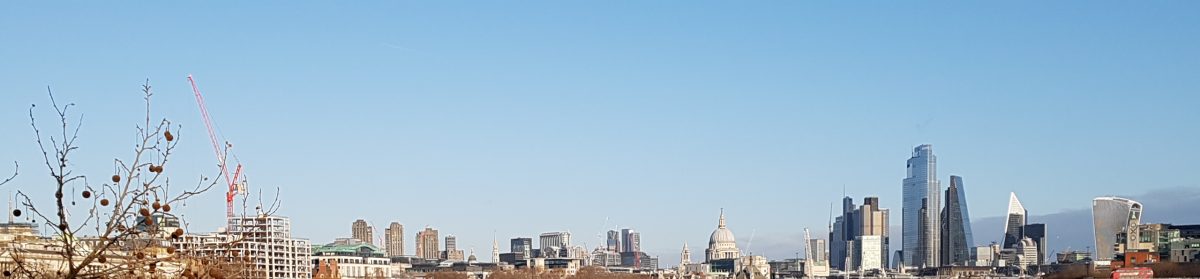
The River VerIn the cityTaken at Blackfriars Station coming home. Sunset.


 My London+