I only found out about The Rookery recently through an article I found on Facebook. It was time to check it out in person.
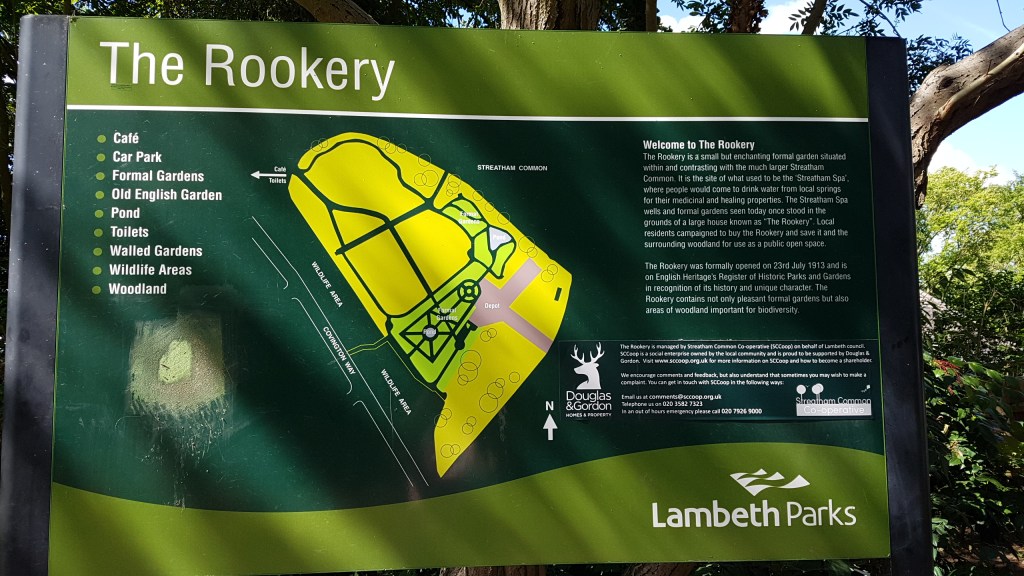
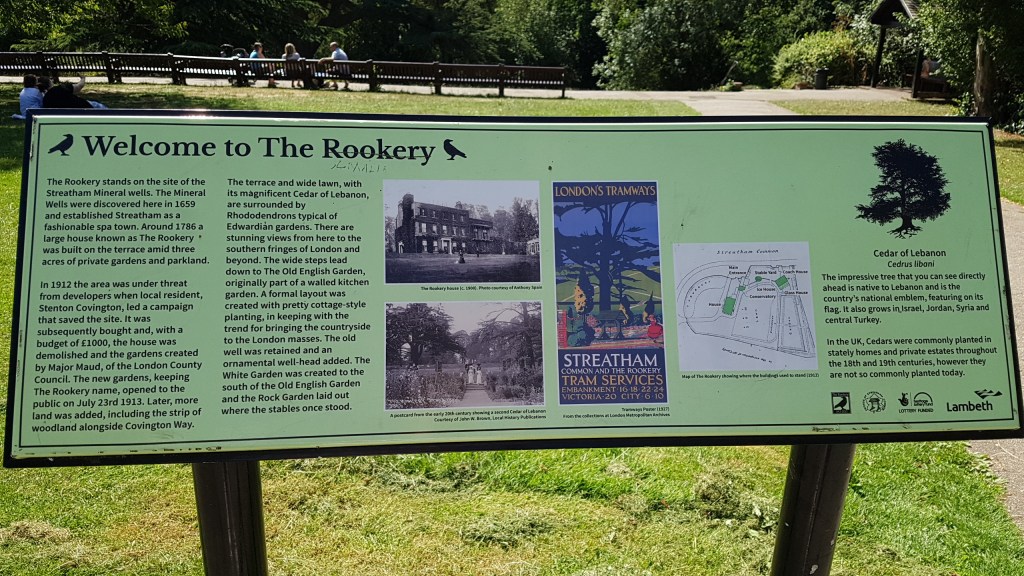
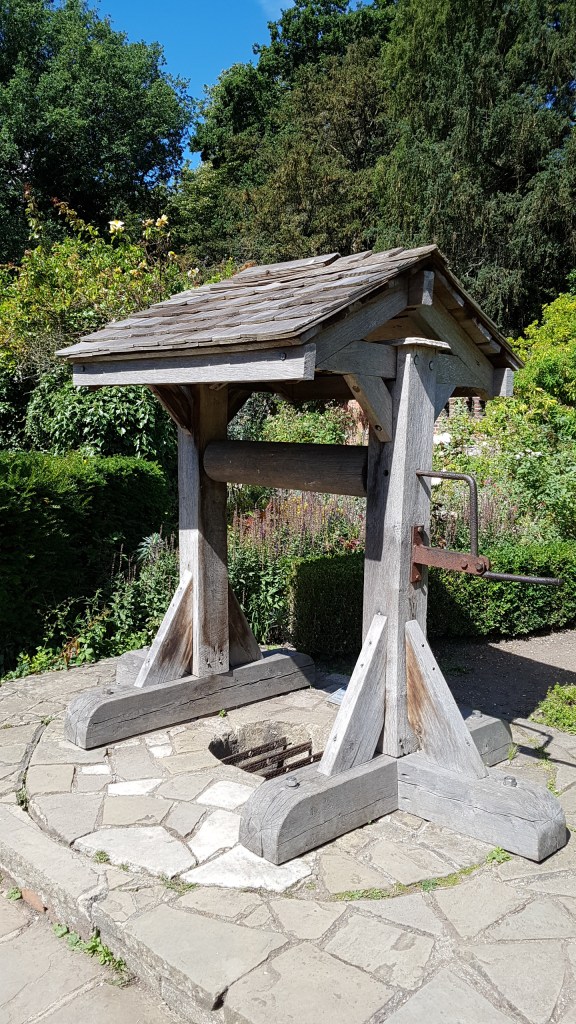
Nestled to the back and to the side of Streatham Common, The Rookery is a maze of gardens and new delights. Originally built as a Spa, there is a modern well to mark the spot. Created in 1659, the house and gardens were laid out on a site orignally known as Well House. Unfortunately, the spa waters were found not to be beneficial due to the clay soil.
Site of the Spa well
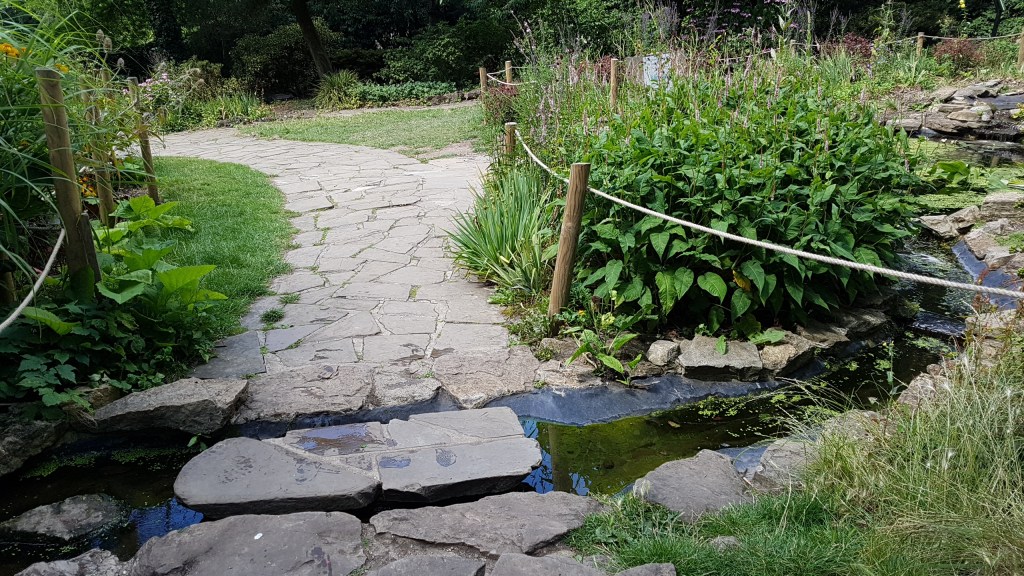
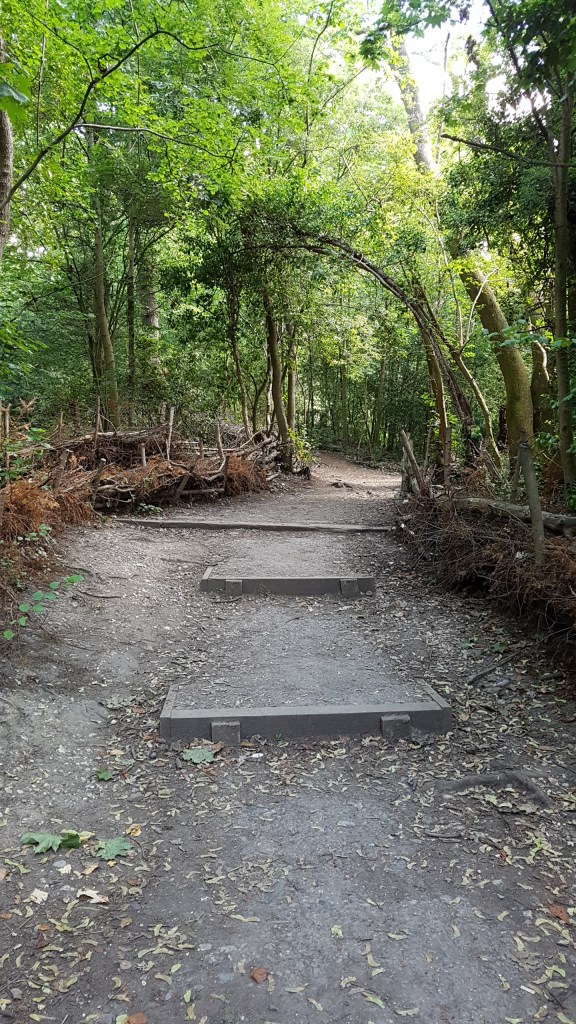
Stepping stones
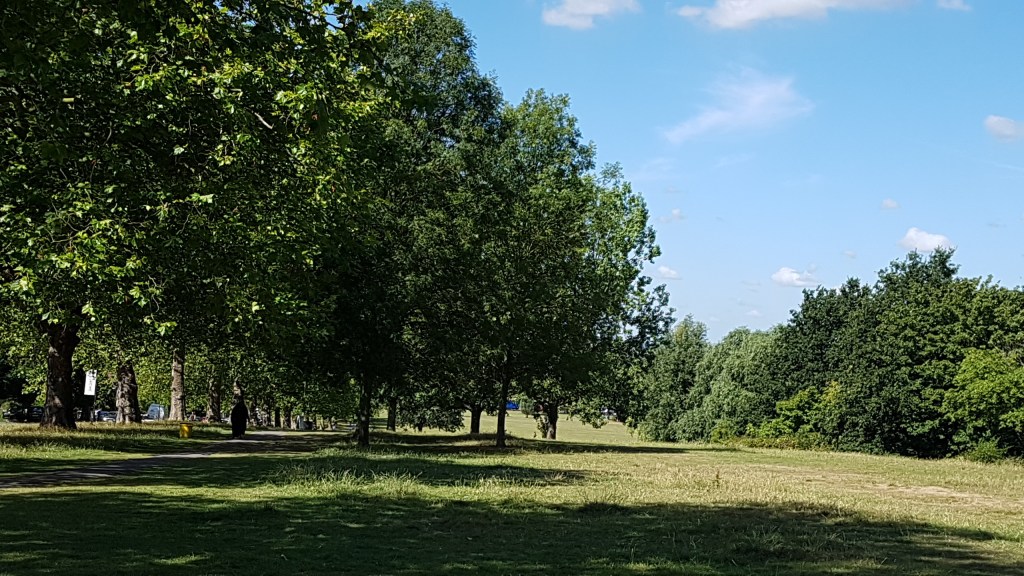
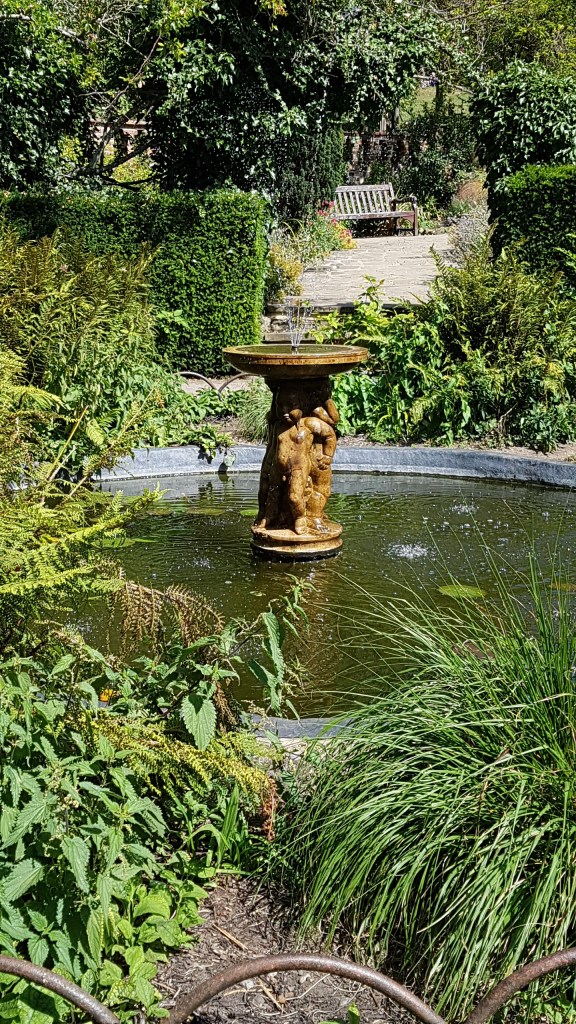
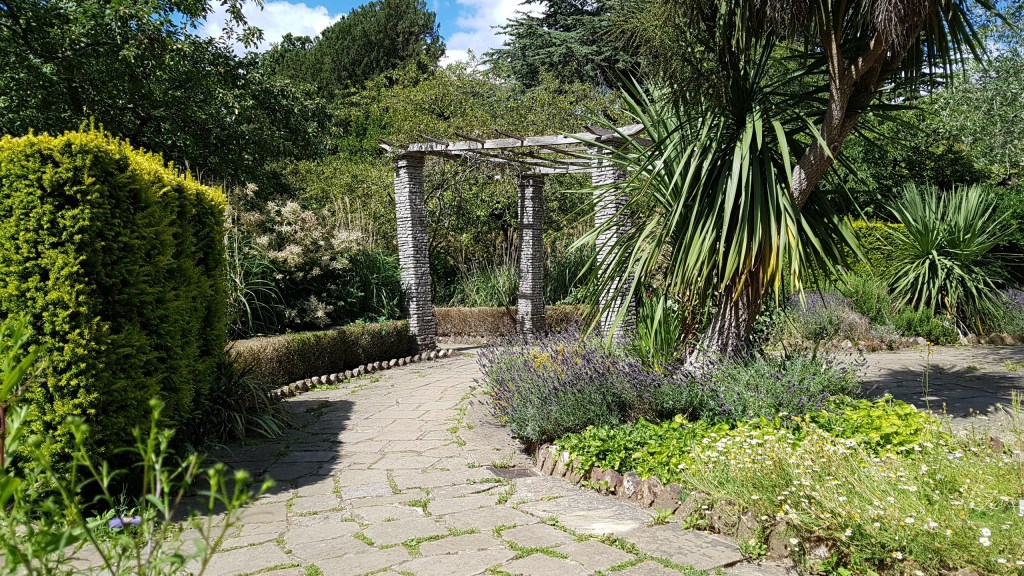
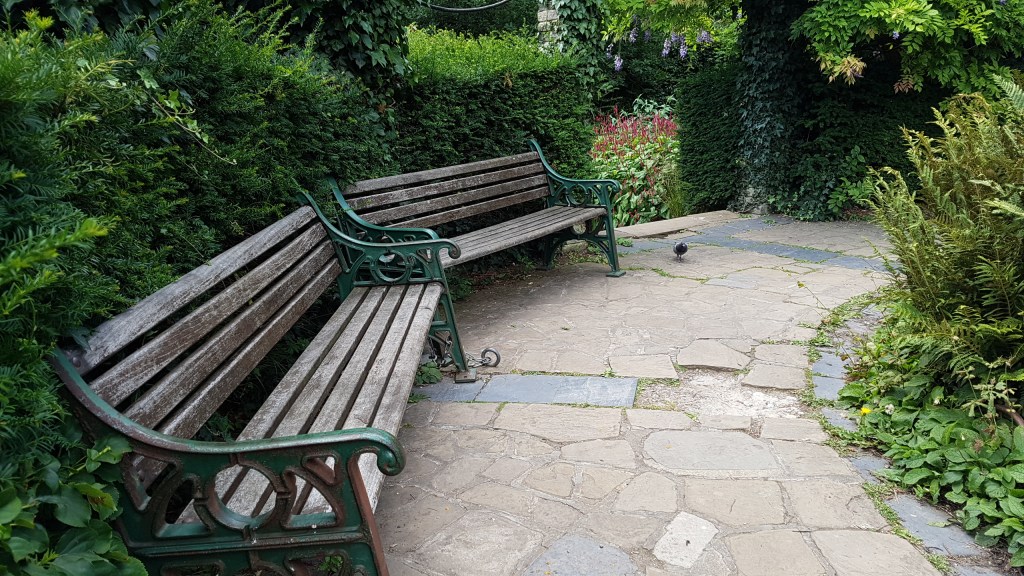
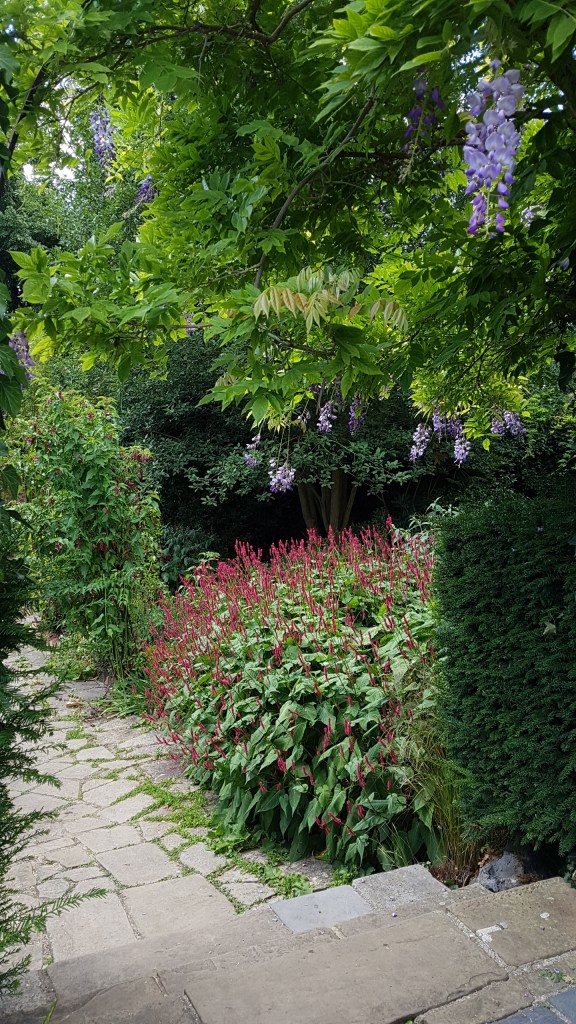
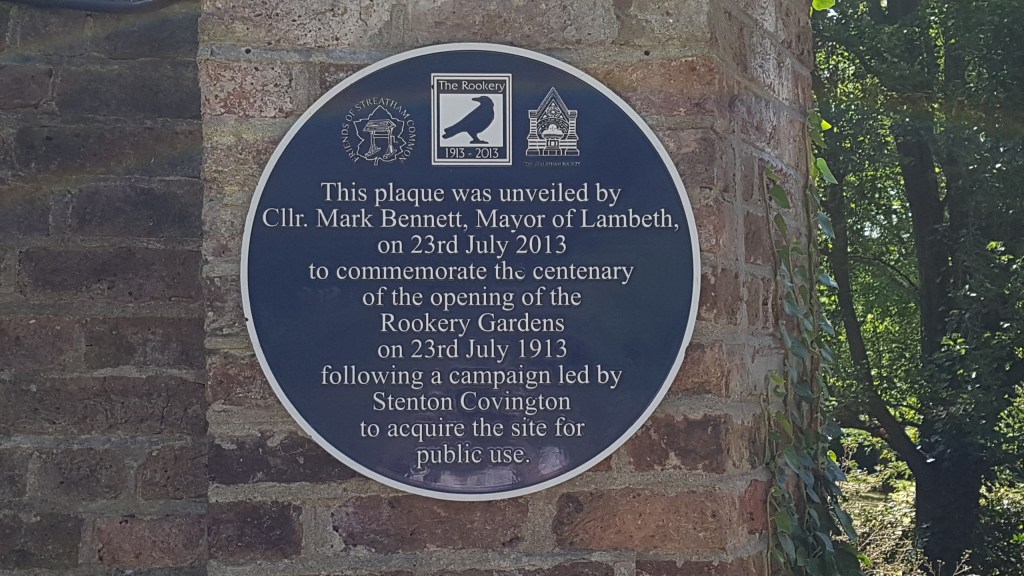
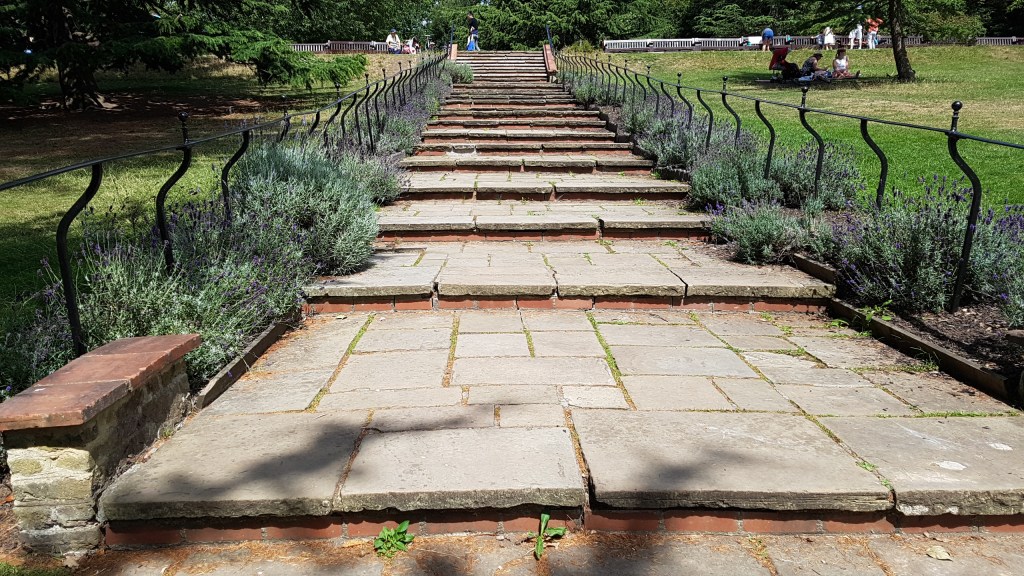
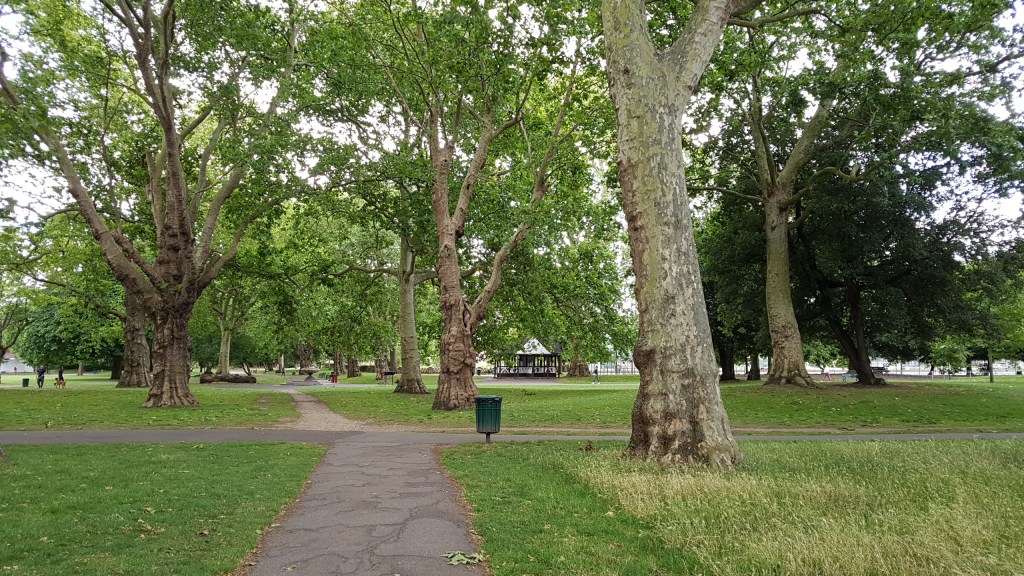
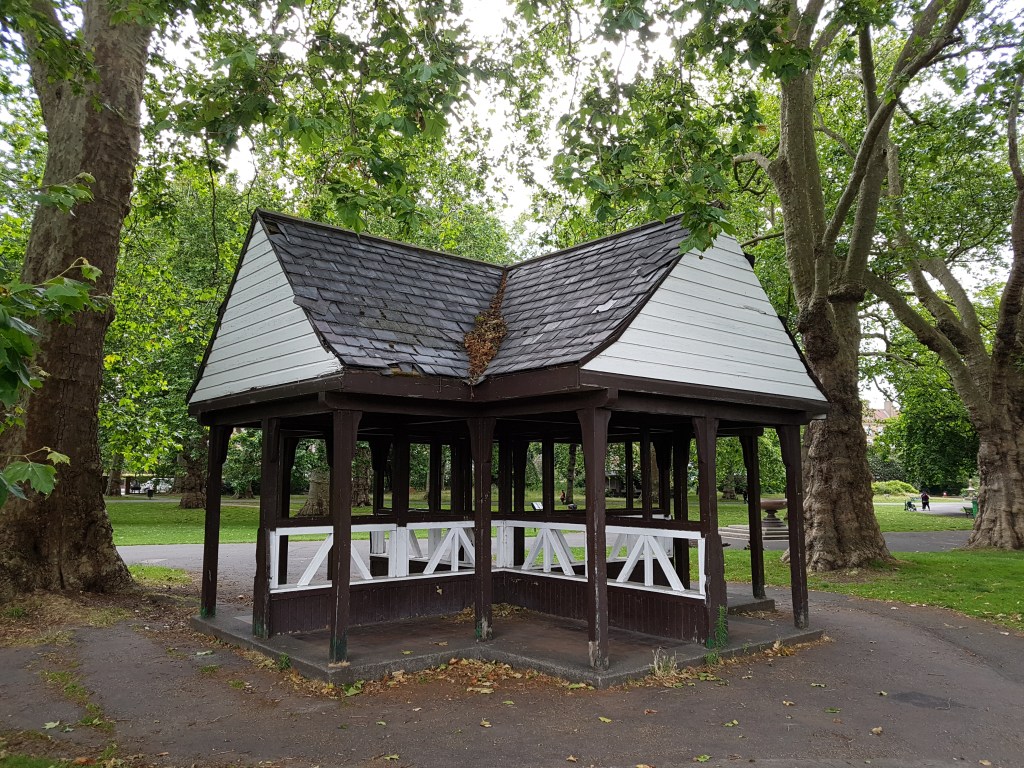
The present gardens were opened to the public in 1913 and haven’t changed much in all that time. Arbours and paths lead to different parts of the garden, gardens within gardens, so to speak. There are plenty of places to sit and this seems to be a favourite haunt of young families. You will find the well of Streatham Spa, a fountain, streams, and just outside there is wooded area which is part of Streatham Common.
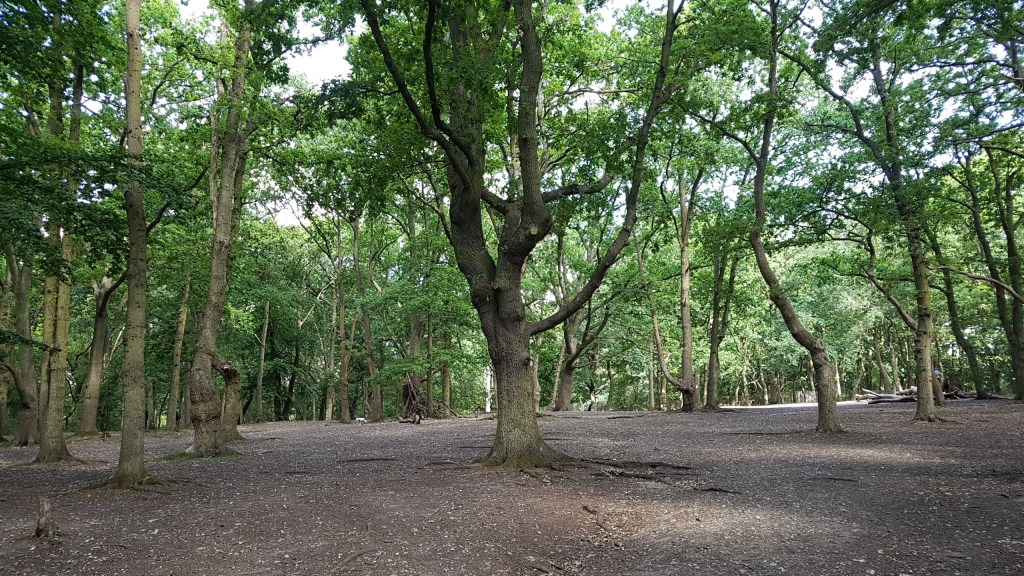
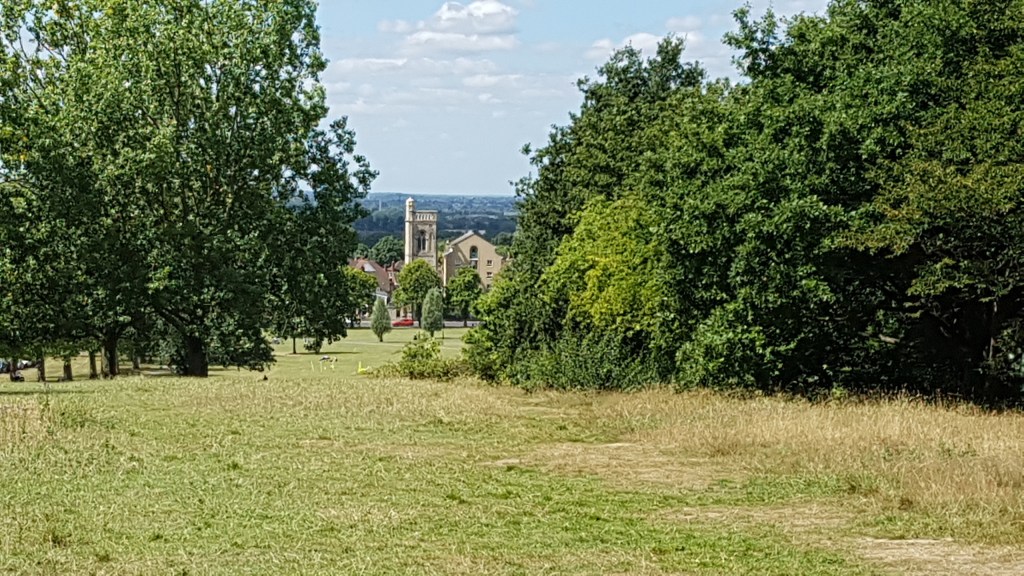
The woods
The Rookery Cafe sits on the edge of the gardens. It was open when I was there but to order food and drink you had to download an app first.
I can do no more than to share some photos with you. Nearest station is Streatham Common running from either Victoria or Cannon Street stations. From there it is a short walk. The gardens are free to visit and there are toilets!
Knowing the weather was due for a downturn this week, I decided to go out on one of the two better days. So, on Monday I set off with a couple of intentions. Things didn’t turn out quite as expected, but a visit to Kennington Gardens was an unexpected delight and made the trip worthwhile.
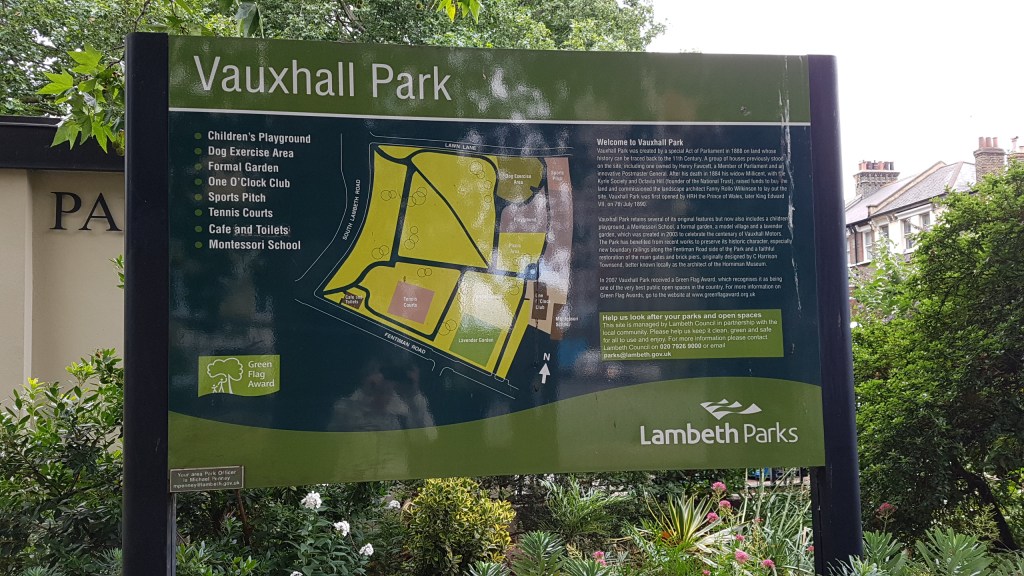
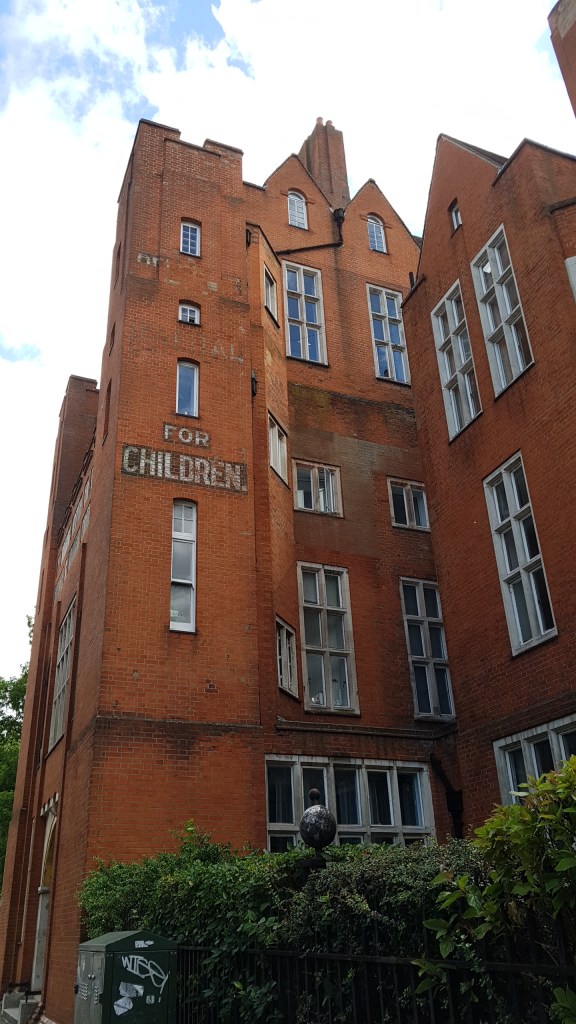
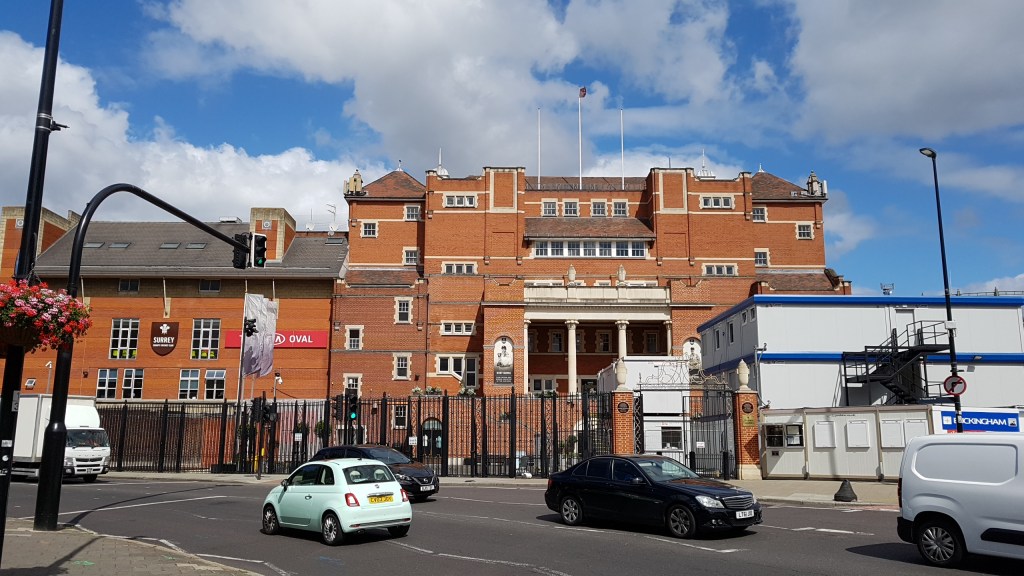
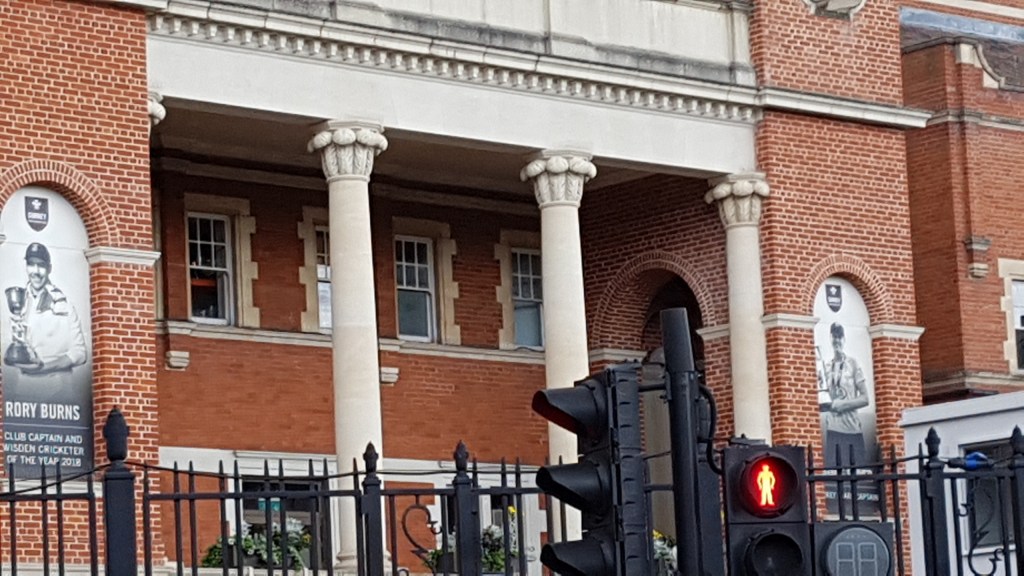
My first port of call was Vauxhall Gardens, only to find that it was in the middle of a re-vamp and barriers closed off the flower beds. Only the tennis courts and cafe were open. So, then it was off to my second port of call Harleyford Road Community Garden via Oval. I’m not a cricket fan, but I thought it would be nice to see where Oval Cricket Ground was. On the way I found an old red brick building which intrigued me. I later found out that this is the former Belgrave Hospital for Children founded in 1866, the original building being in Pimlico. The building here on Clapham Road was built between 1899 and 1926, as it was added to. It was designed by Charles Holden in the arts and craft style. The hospital joined the National Health Service in 1948 as part of King’s College Hospital Group, but closed in 1885. It was designated a Grade II Listed Building in 1881. The hospital was converted into residential accommodation in the 1990’s.
Former Belgrave Hospital for Children, now flats
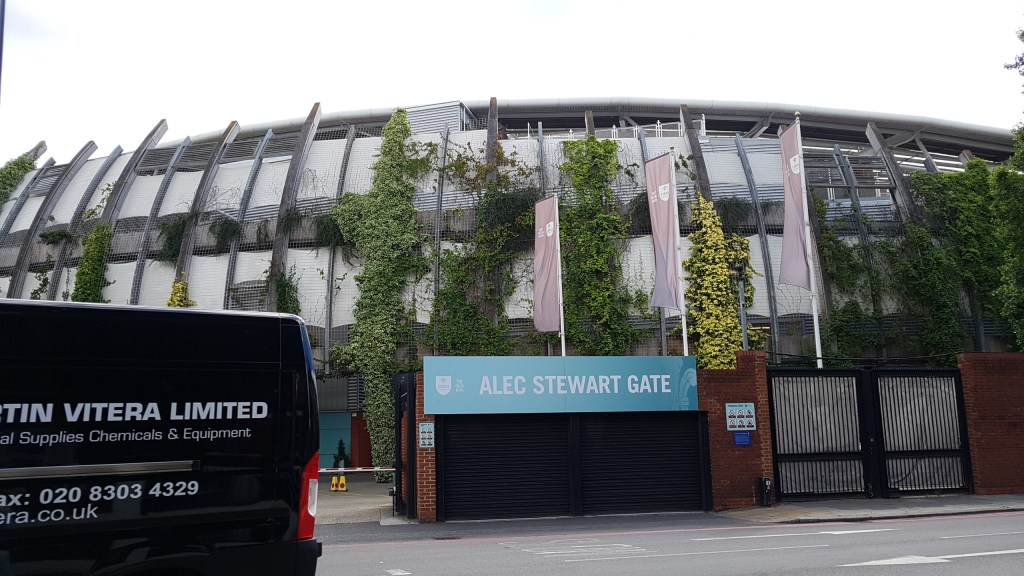
Onwards to the Oval Cricket Ground for some photos and then to the community garden, which I knew was nearby by. However, the gardens were locked still, due to Covid 19!
The Oval Cricket Ground
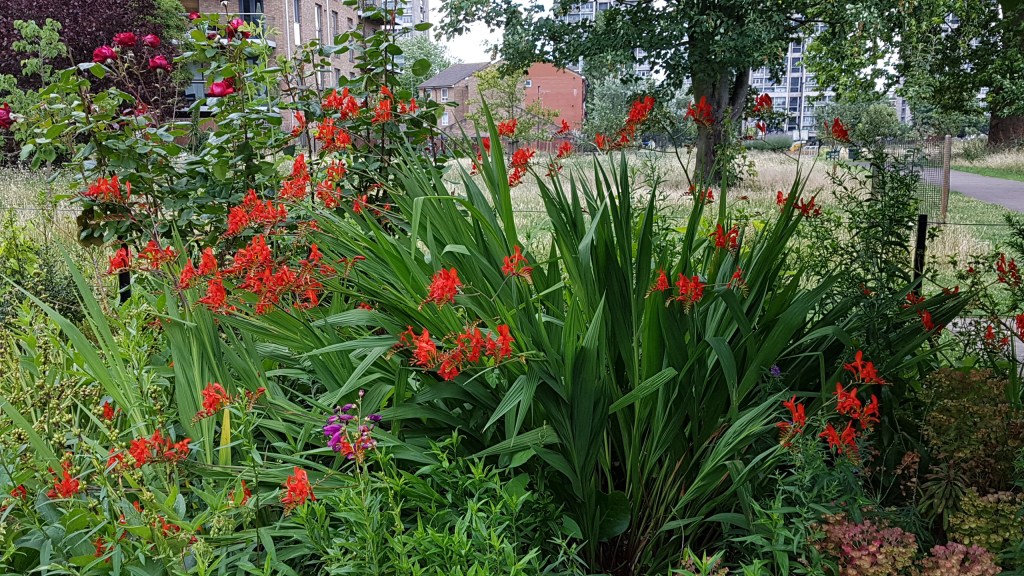
I decided to double back and visit Kennington Gardens which I had noticed opposite Oval tube station. This was well worth going back to. It has a beautiful flower garden with pond and plenty of seating areas, tennis courts, football (looked like 5-a-side astro turf), a cafe (closed when I was there) and skate bowl. Lots of trees and border plants and lots of plaques telling the history of the park and nit’s former buildings. This is a lovely place to sit and relax away from the busy world. Definitely worth a second trip sometime.
Kennington Gardens
The Flower Garden
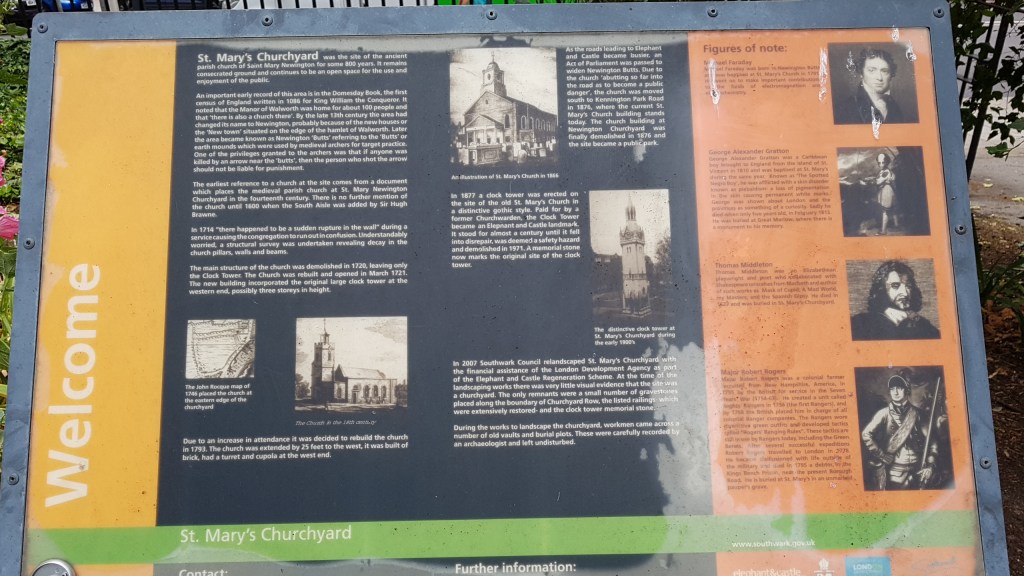
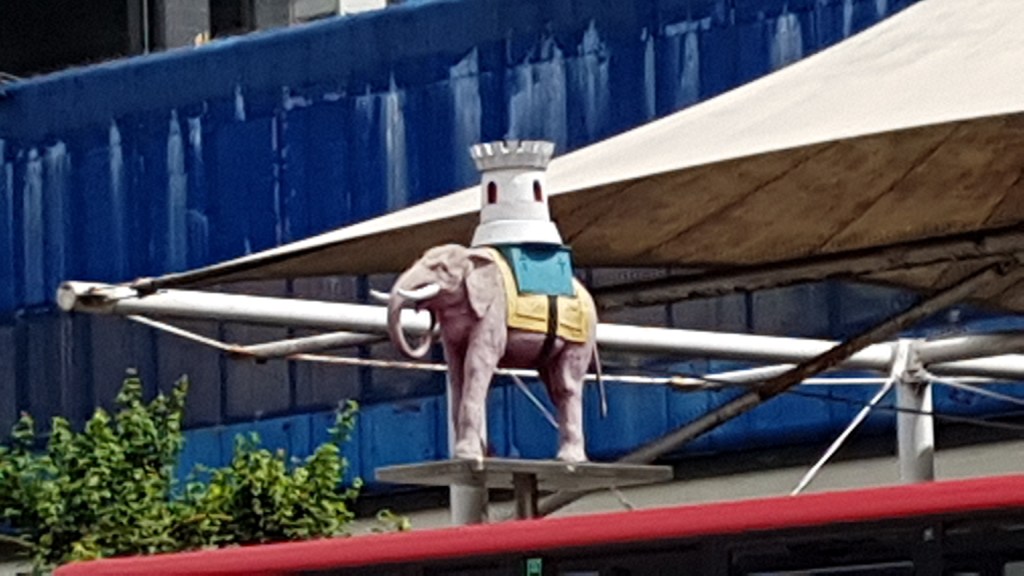
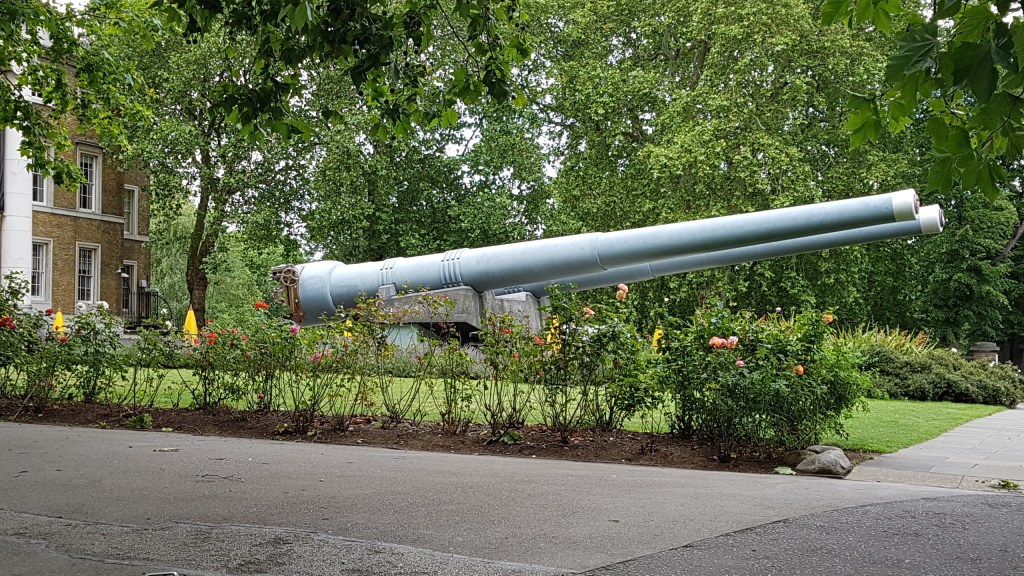
Leaving the park I headed along Kennington Park Road in the general direction of Vauxhall. My internal map was a little off (which it often is), but it was the tall buildings that threw me. I found myself in Elephant & Castle. There was a former churchyard (nothing, not even the church, remains), now the site of a Leisure Centre. Over the road is the famous shopping centre. I carried on and followed the signs to the Imperial War Museum. Further down, I spotted Elliot Row Pocket Park (closed). A tiny garden with a children’s play area. Finally, I reached the gardens of the Imperial War Museum. At present the Museum is shut, but I am sure it well re-open soon, as other museums and galleries are beginining to. Having been there many times, it is well worth a visit.
Elliot Row Pocket ParkThere’s something about this building……(Elephant & Castle)
From here it was a short walk to Waterloo, cutting through a side road and passing Morley College where I have taken a few courses over the years!
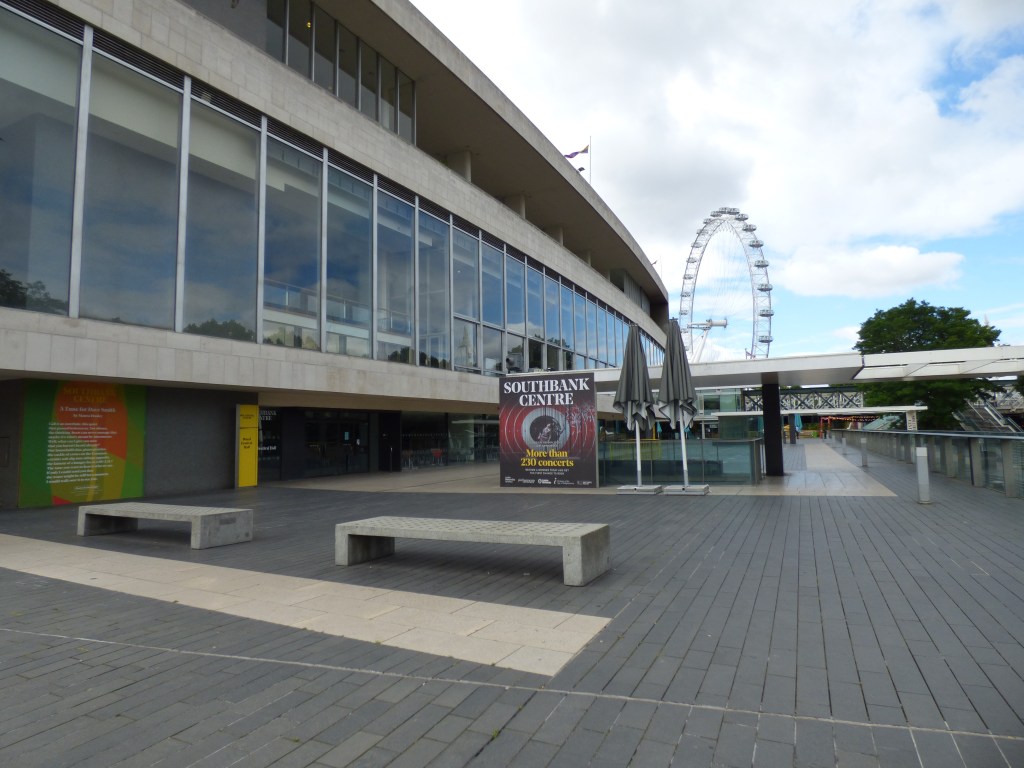
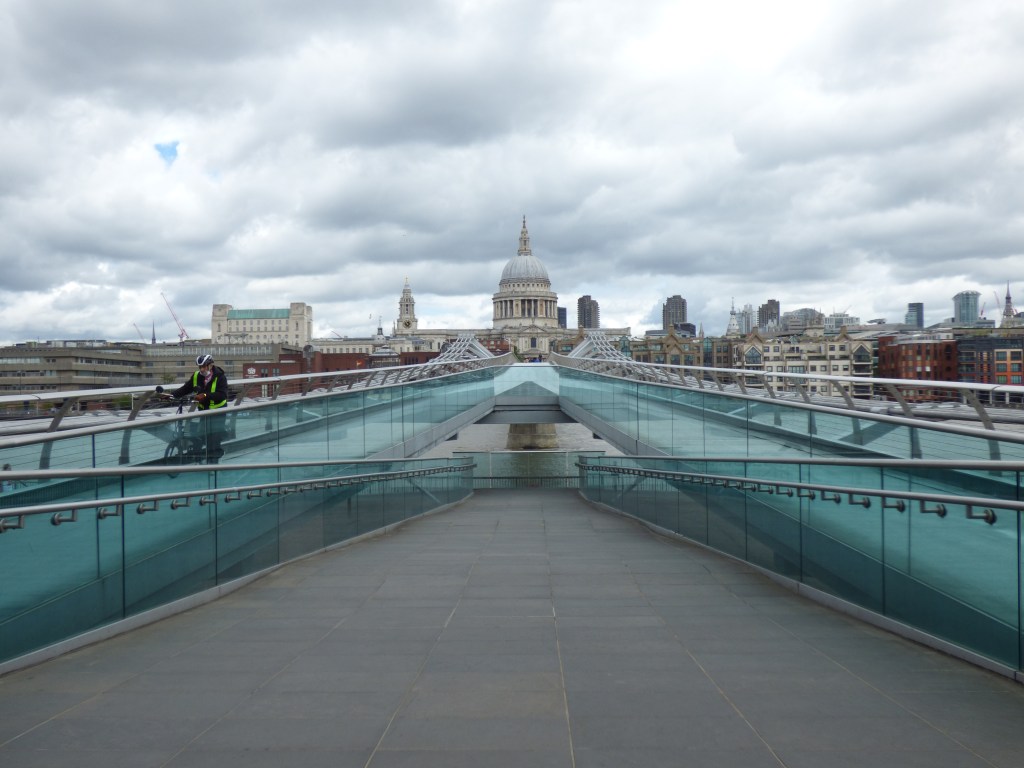
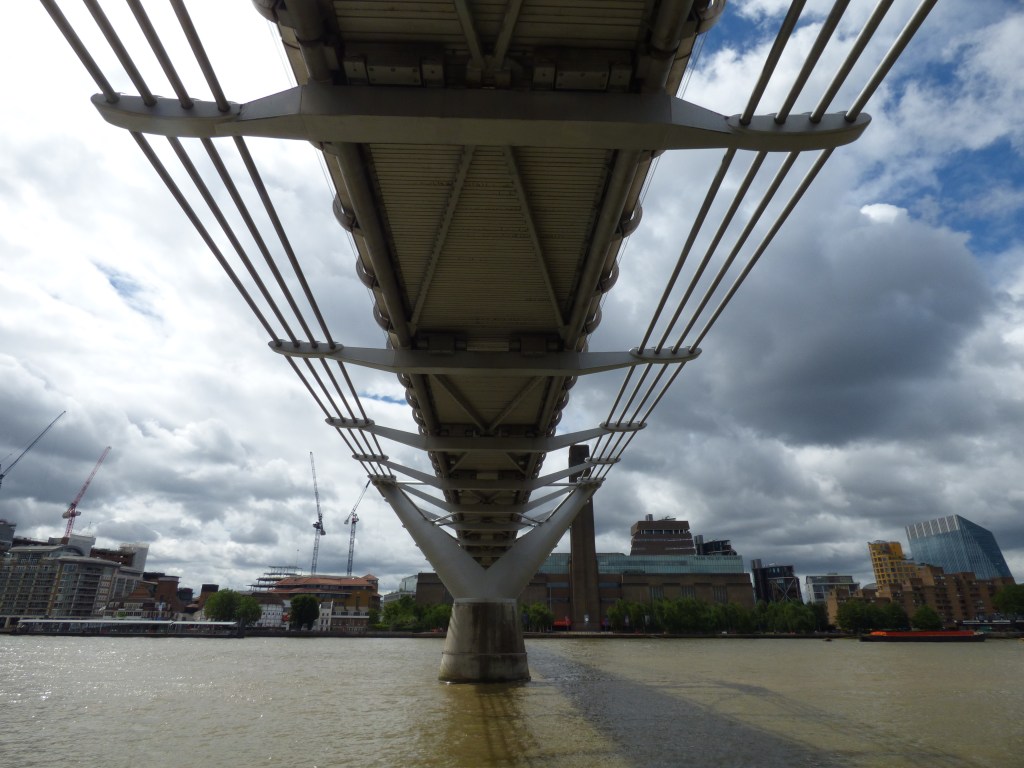
Last week I ventured into London. I wanted to see it before everything opens up again. The train journey in wasn’t busy, nor was the station. Everywhere was really quiet, though there were a few joggers out. I walked along the River Thames on the south side down as far at Tate Modern and the Millennium Bridge, briefly walked to The Globe, and then came back and crossed the bridge. Along the north bank it was also quiet.
Millennium Bridge
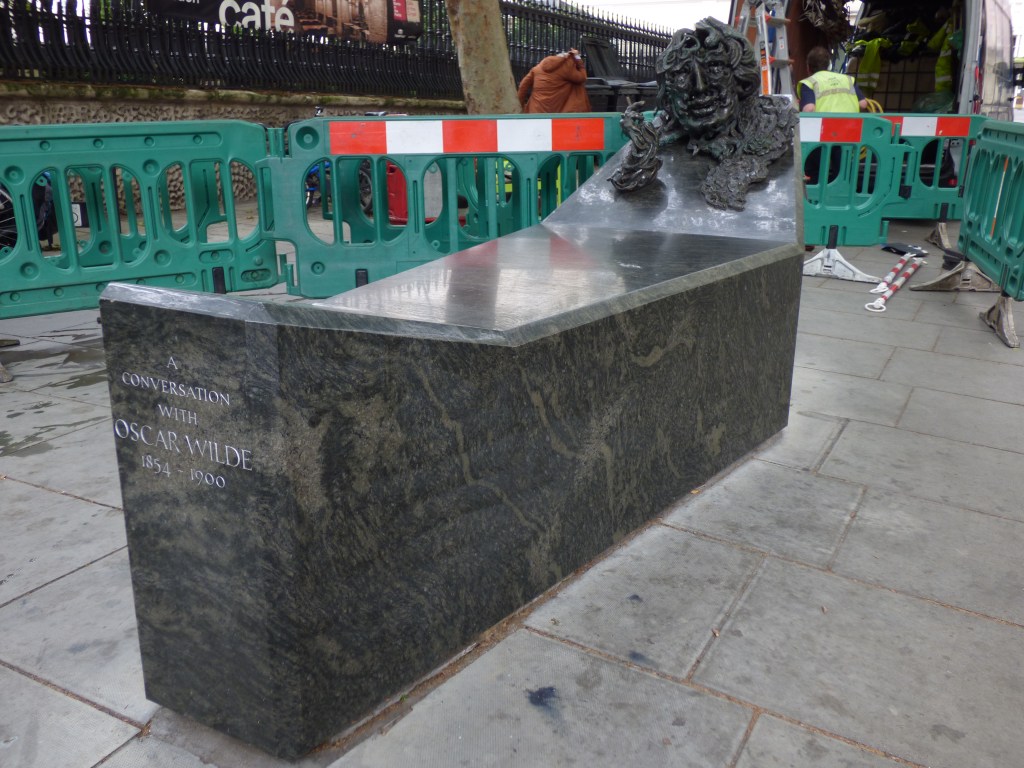
The Embankment gardens were occupied mostly with workmen taking breaks from whatever building they were working on behind the park. Temple Station appeared still to be shut. I came up to Embankment tube and then up to Charing Cross. There I crossed over and went to Martins-in-the-Fields, where a pretty empty Trafalgar Square was before me on the other side. What I was after was a photo of Oscar Wilde’s statue, which usually has someone sitting on it, or groups of people hanging around it. Today, it there was no one. However, road work barriers marred the shot. It’s like I’m not meant to get a good photo!
I’m doomed to get a decent photo
Walking back, I turned off to some side roads and then walked back over Hungerford Bridge, where there is a one-way walking system in place – very wise. By then I was hungry and weighing up my options. I decided to buy a sandwich from the station and go over to St John’s Churchyard to enjoy it. It was a nuisance having to keep putting my mask up and down to go in and out of the station. I admit I hate wearing a mask. Because I wear glasses, there is a knack to getting it just right otherwise every time I breathe my glasses steam up. It’s also hot and annoying! However, I’ll put up with it to get out and about again.
By Charing Cross
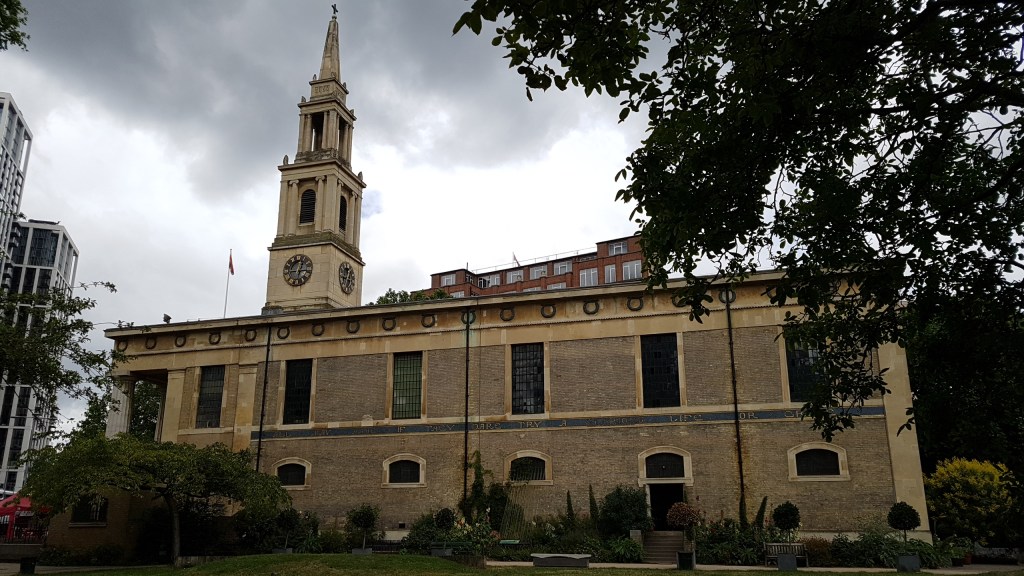
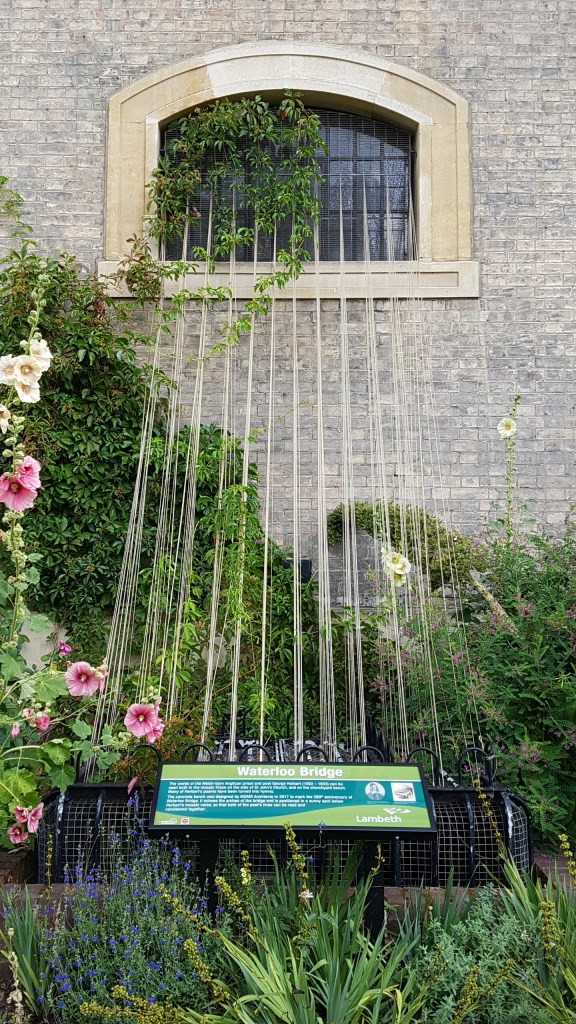
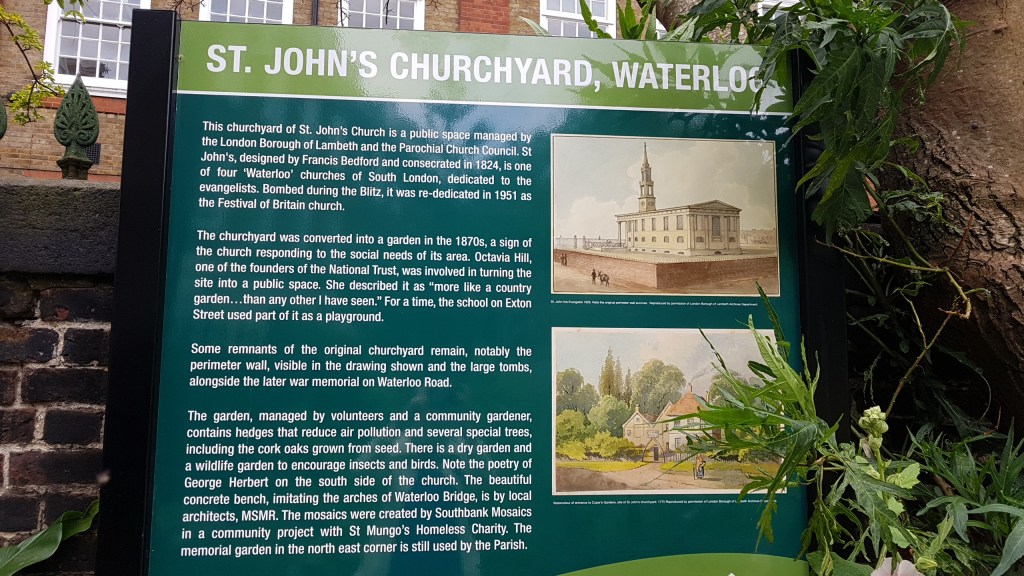
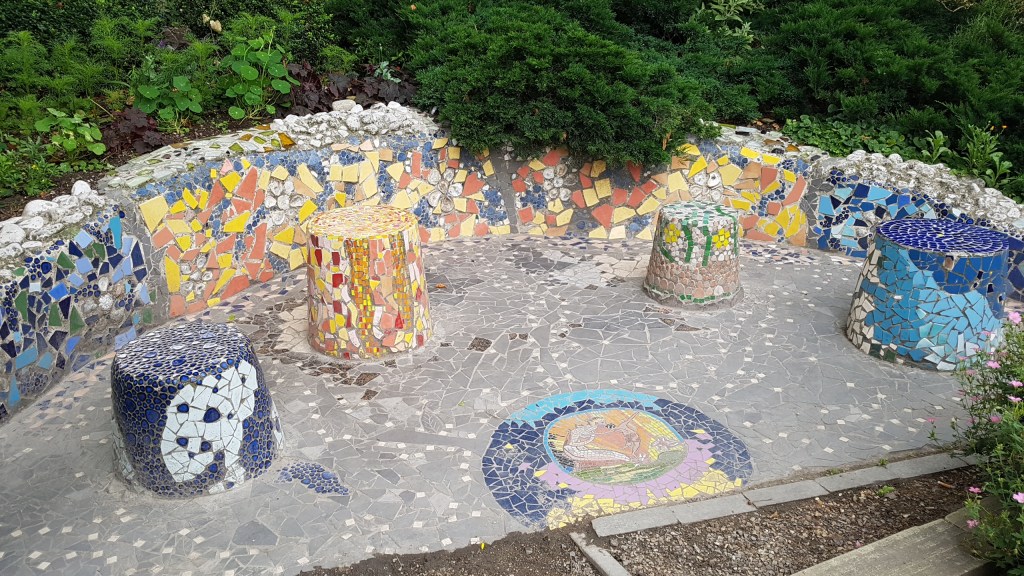
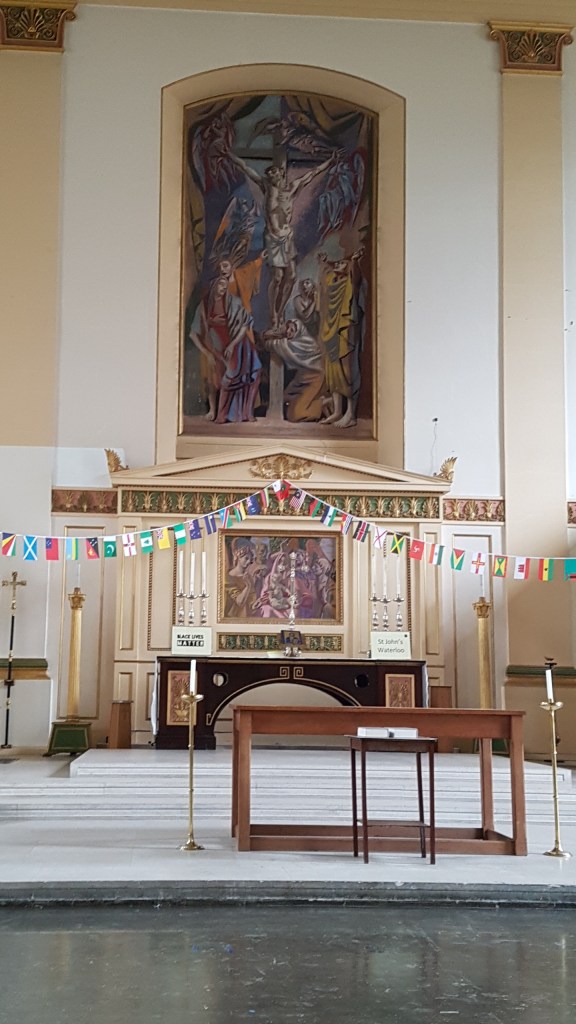
St John’s Churchyard (Waterloo) is one of my favourite places, and today it was almost empty. Normally it is buzzing with people. I sat on a bench to relax and eat my sandwich. As I was leaving I noticed the church was open, so I decided to go in for a few minutes. I’ve not been inside a church since February. At the door was hand sanitiser, and chairs spaced apart in a semi-circle. There was a lady at a desk keeping an eye on things, but otherwise I was the only one there.
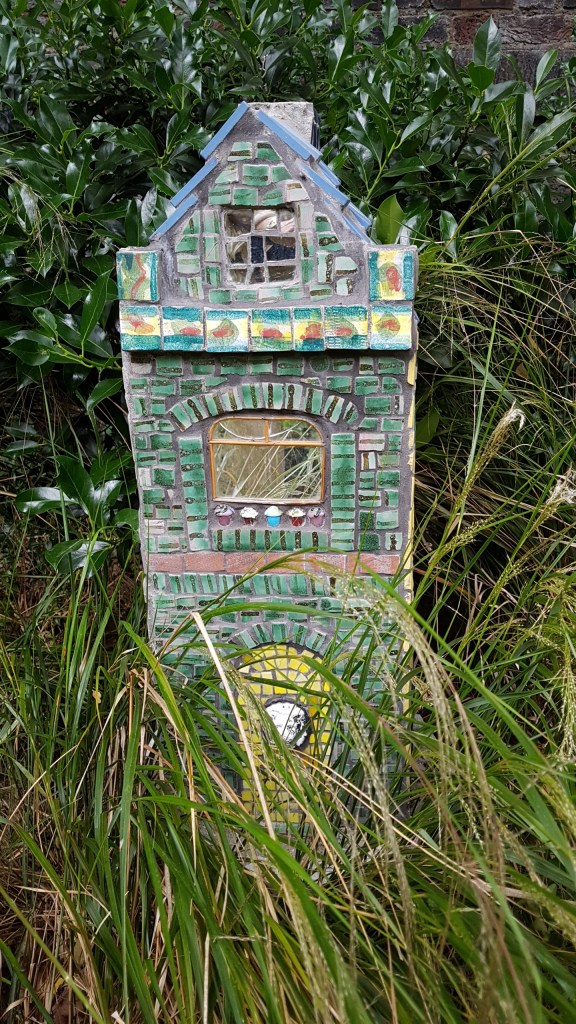
Known for its Mosaic garden (created by Southbank Mosaics) this is a lovely example in St John’s ChurchyardSt John’s, Waterloo
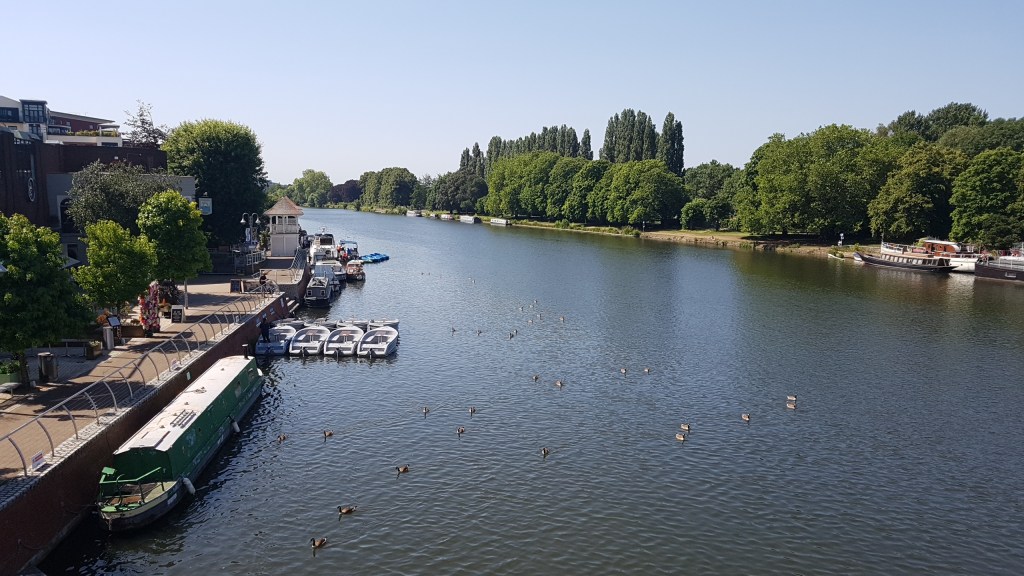
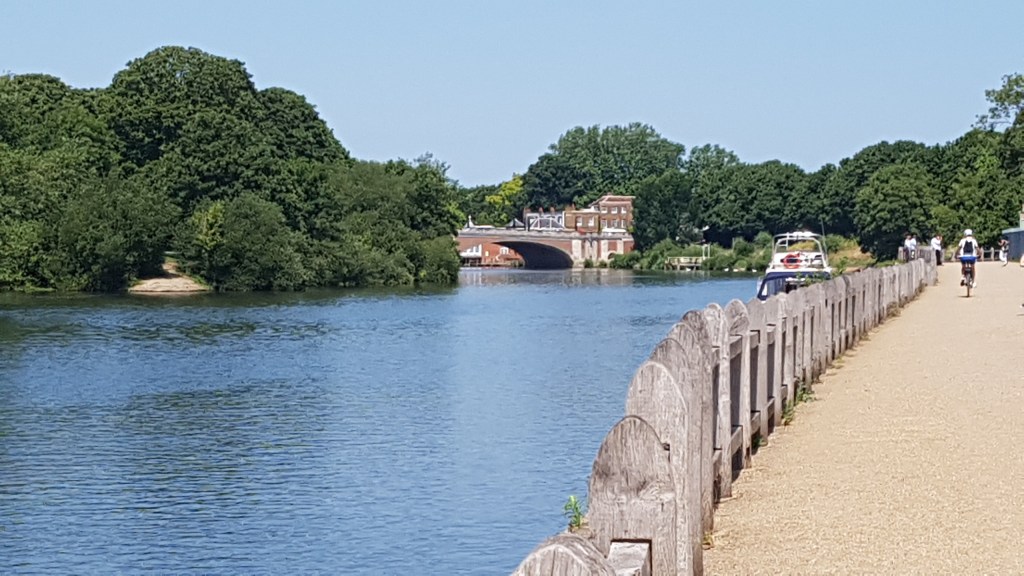
River Thames from Kingston Bridge – looking towards Hampton Court
This is a walk I have done many times over the years, well to Hampton Court anyway. Last week I ventured out on public transport for the first time since early March. I’d taken stock of buses and trains and how empty they were and decided I was happy now to use them. I had my face covering ready.
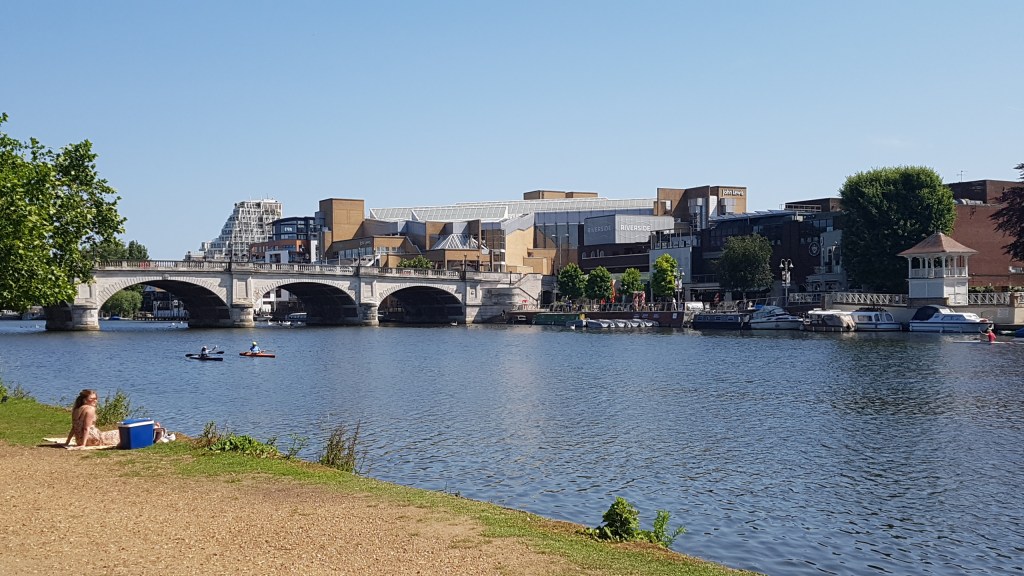
Kingston Bridge
The day was hot, but it hadn’t reached the 30c of later in the week. The walk began at Kingston Bridge and followed the pathway all the way to Hampton Court Palace. Home Park (a lovely park I’ve also walked) is on the right. I’m sure at one time it was possible to enter Hampton Court gardens from there, but these days there is a railing at the end of Long Water to stop that.
Although the Palace is still shut, I knew that the gardens were due to open and I had thought it would be a good place to stop and eat my sandwich. However, the gates were closed. An official looking man was standing around so I asked him what the situation was. He said the gardens were only open Wednesdays to Fridays and tickets had to be booked online (though the gardens are free). He also added that it wasn’t easy to get hold of tickets at the moment. I could imagine that everyone and his wife wanted a change of scenery after being cooped up for so long. In fact a friend of mine tried to get online tickets for a National Trust garden and all the tickets went in half an hour!
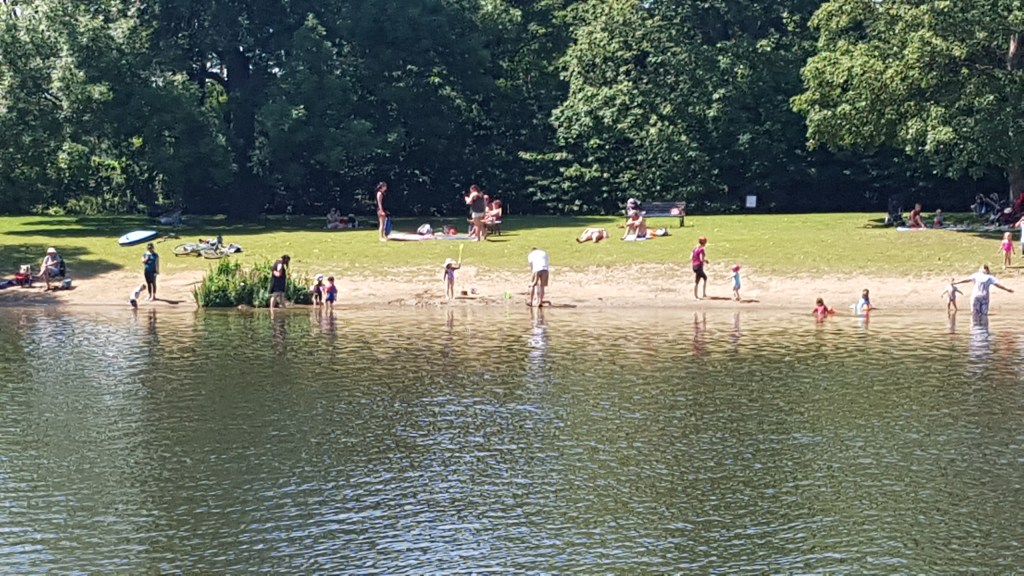
On the other side of the river (opposite Hampton COurt Palace) people bathed and swamComing up to Hampton Court Bridge
Instead it was a short hop over the road and Hampton Court Bridge and down onto the other side of the river. Shortly, there was Molesey Lock (cafe closed), but no place to sit. There were a lot of people here too. Perhaps it was more noticeable because the path is more narror here. Finally, I came across a small children’s park (play equipment still sealed), with benches. There was a nice shady place under a tree, far enough from the overflowing rubbish bin to suffice. This was a cool spot in which to relax. Afterwards it was a short walk to Hampton Court Station for the train. The train was almost emptuy – no one in the carriage I was in at first, and never more than two or three people afterwards.
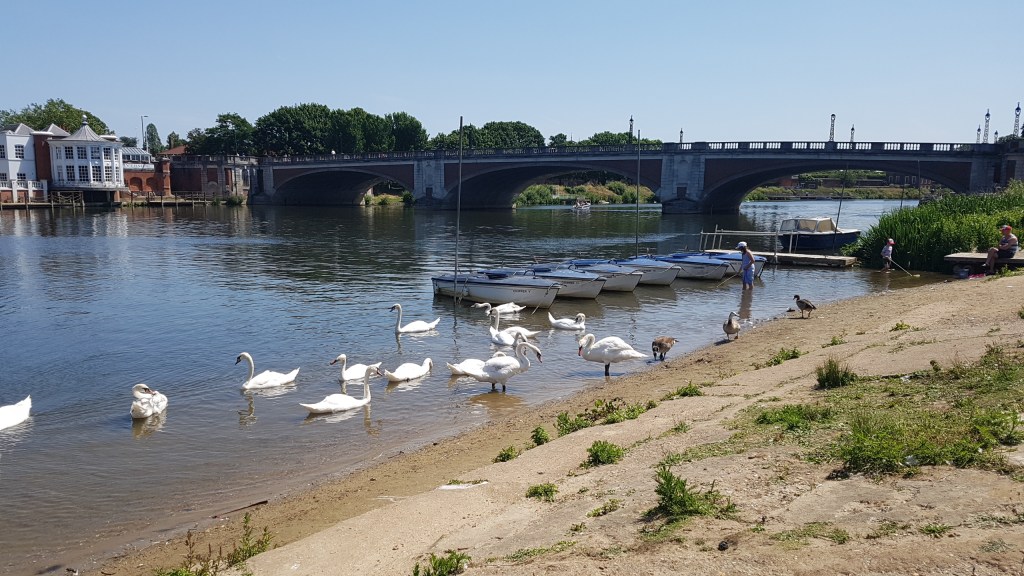
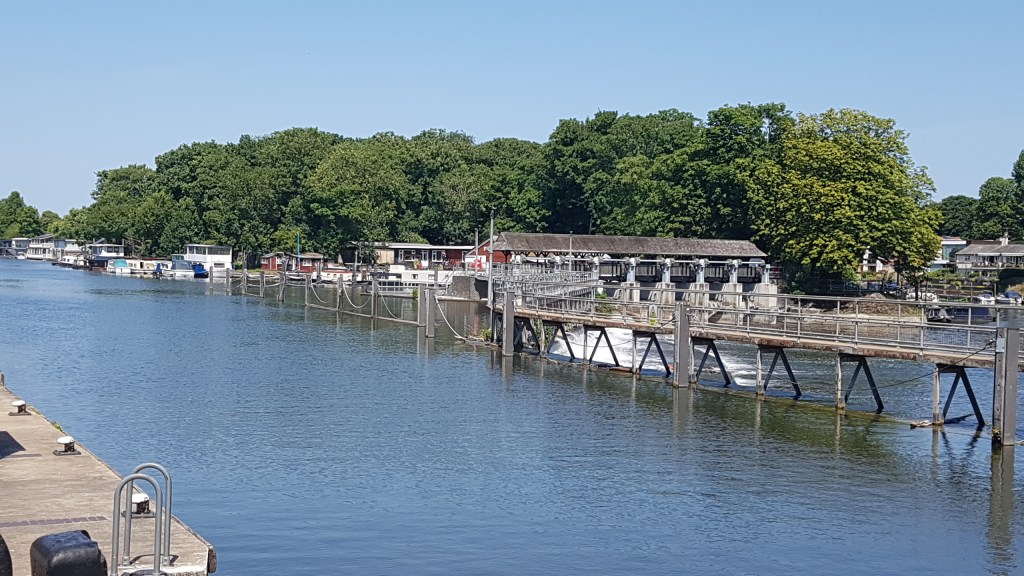
Hampton Court Bridge from the Molesey sideMolesey Lock
It was lovely to go somewhere different, even though it’s a well trodden path for me. Do have a look at the websites of the Palace and Home Park for more information and some lovely photos.
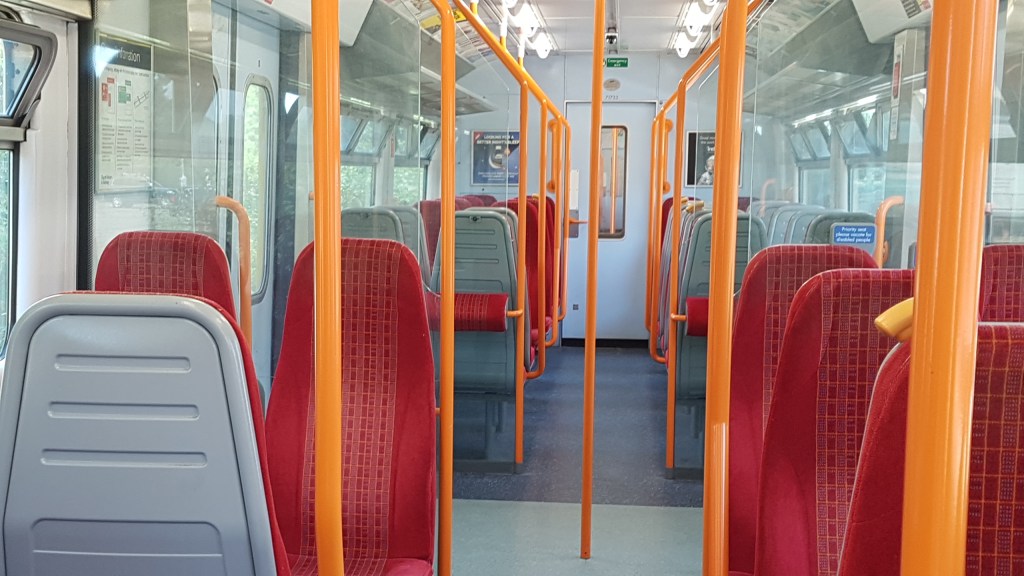
Empty train carriage
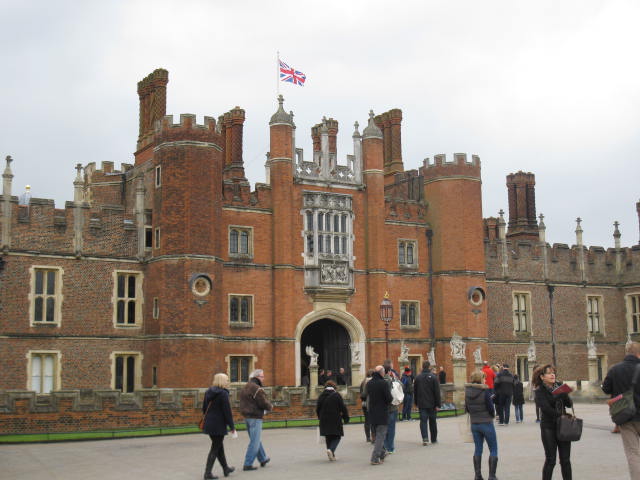
I realise I took no photos of the Palace on this walk, though I would have had to take one through the railings. Anyway, so as not to disappoint you, I’ve delved into the archive for the one below.
Sometimes a walk takes you to unexpected places. This was one of those walks. I set off with only a vague idea of the direction I was going, but not the destination.
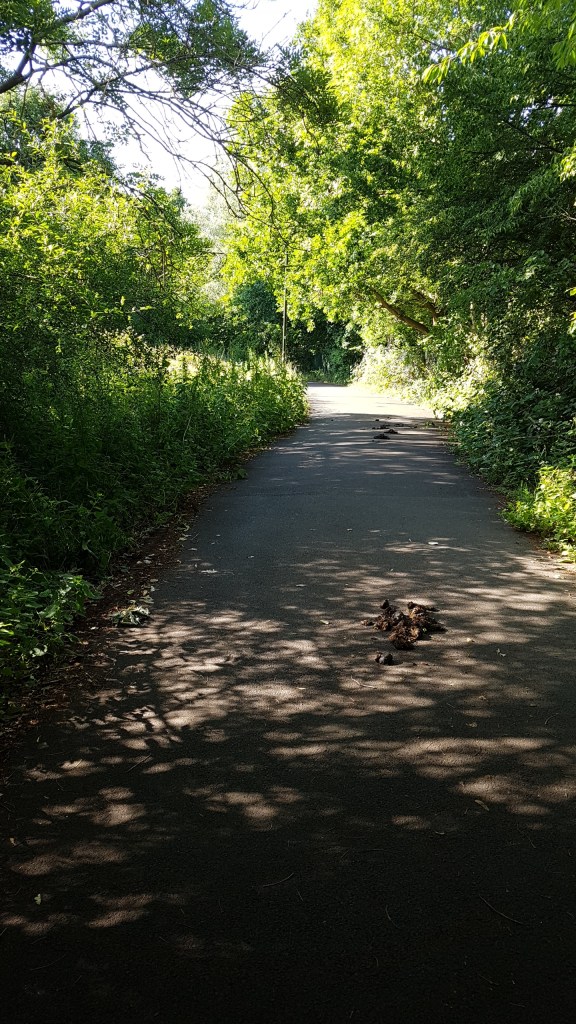
I began by retracing some of the steps I’d taken a few weeks beforehand, when searching for the source of Beverley Brook, crossing the field I call the horse field around Motspur Park way. On getting to the end, instead of turning right towards Worcester Park, I turned left to see where it took me. This turned out to be a lovely mystery walk. The footpath is well laid in tarmac. The only cars to come through were going to an Equestrian Centre, but I only encountered two cars the whole time. The path is tree lined and I found two other pathways – one leading to Arthur Road (Motspur Park) and the other to Trafalgar Road (I think it was), labelled as Sutton, though I believe it is actually Cheam.
The horse field, as I call it
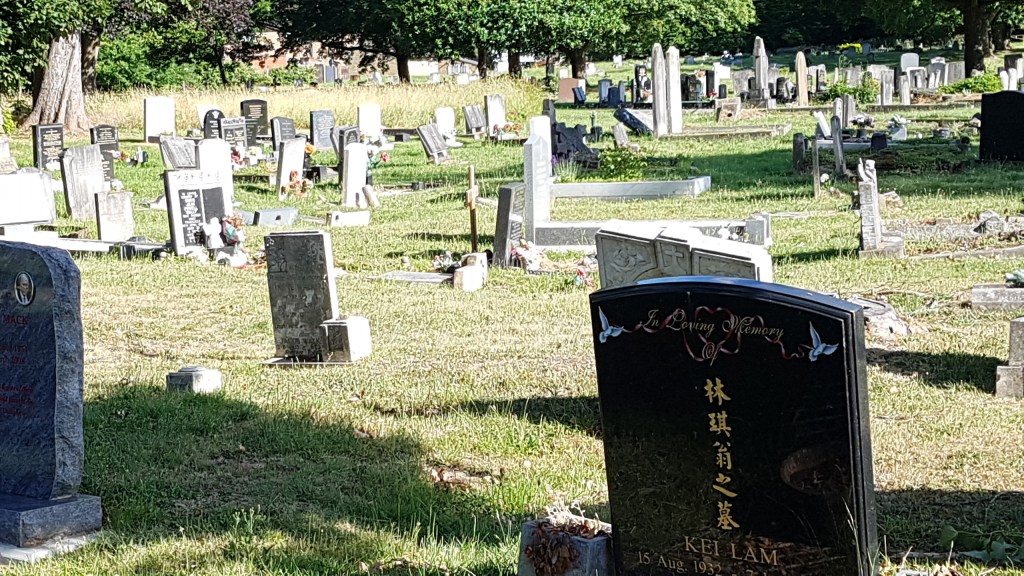
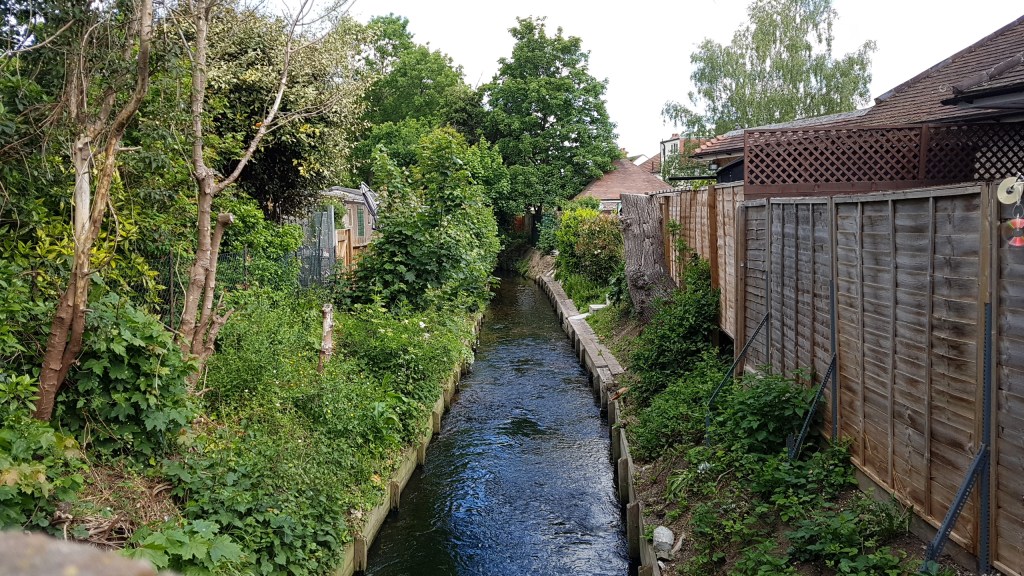
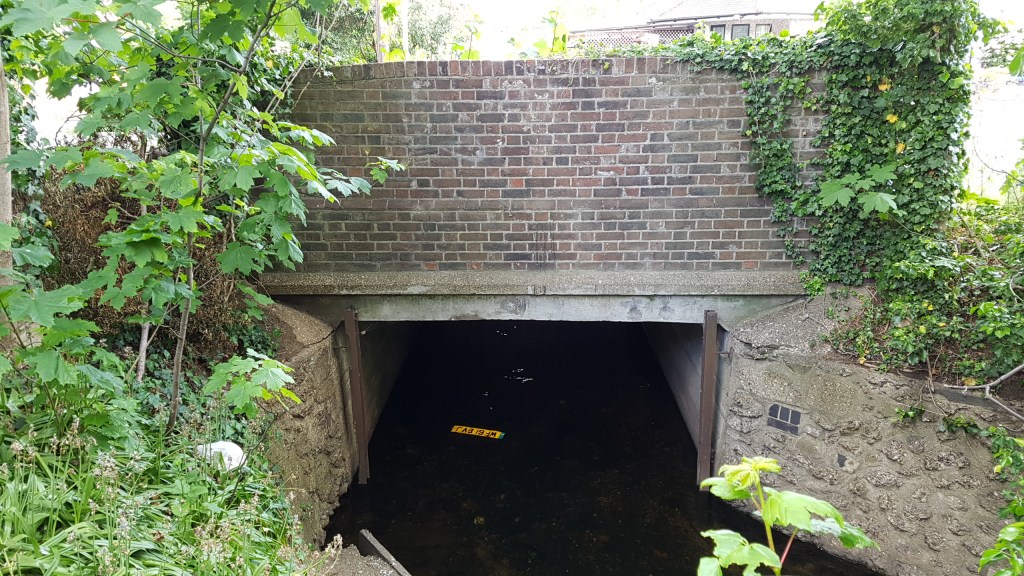
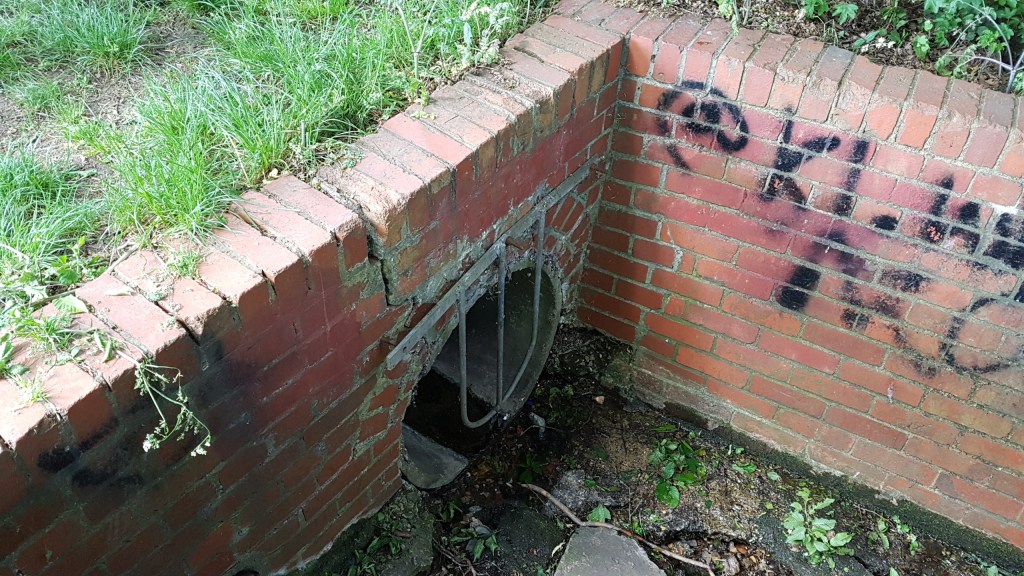
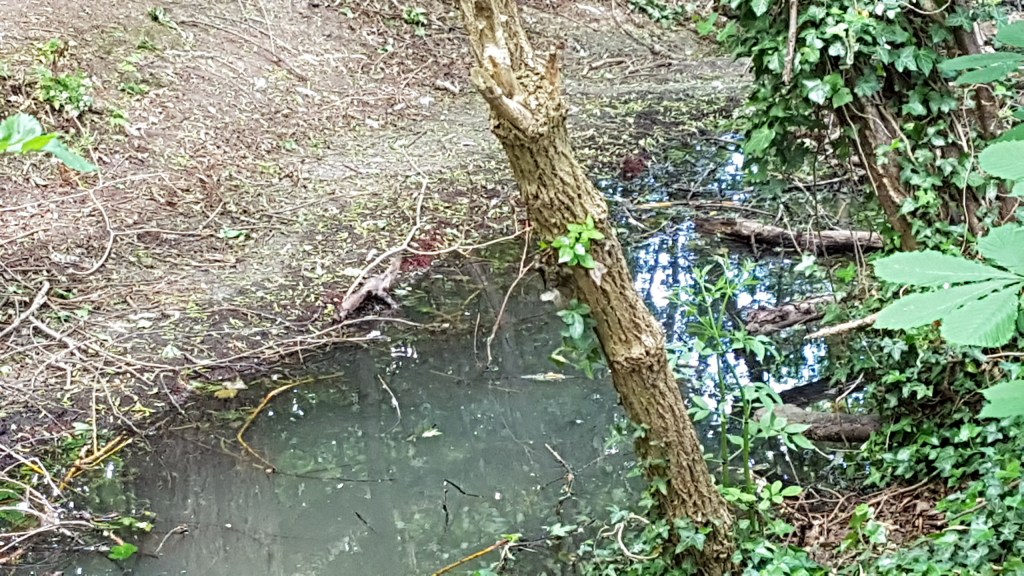
Along the tree lined path there are blackberries growing. It seemed a popular walk on the late Sunday afternoon I was there, but became quieter the further I went. As I walked along it began to border a cemetery, and when I reached the end of the path, there was an entrance into the cemetery, known as the Merton and Sutton Joint Cemetery. I do find cemeteries and graveyards quite fascinating, so I had a quick wander before heading off again. Not sure now of quite where I was I continued down the winding road. To my left there appeared to be a green overgrown space which I felt must be accessed from somewhere. Then I found a stream. It ran underneath the road and out on the other side. I took photos and wondered if this was another part of Beverley Brook.
Merton & Sutton Cemetery
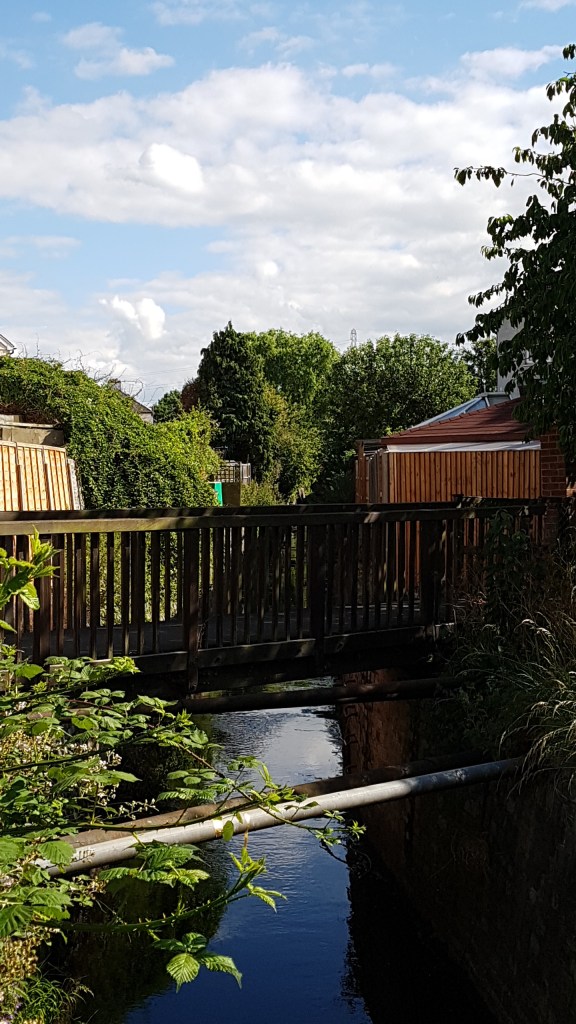
The unknown brook which turned out to be Beverley Brook after all.
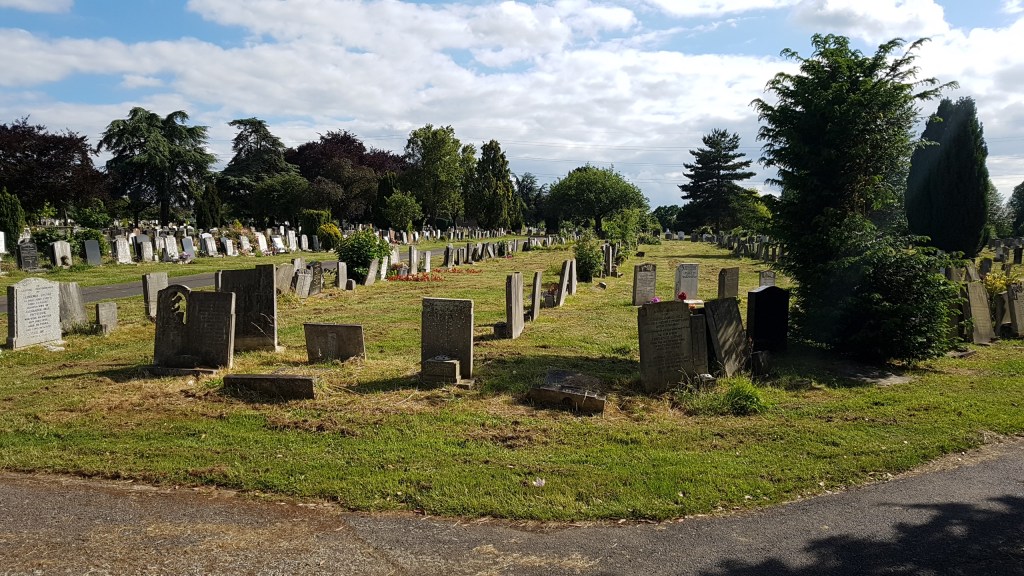
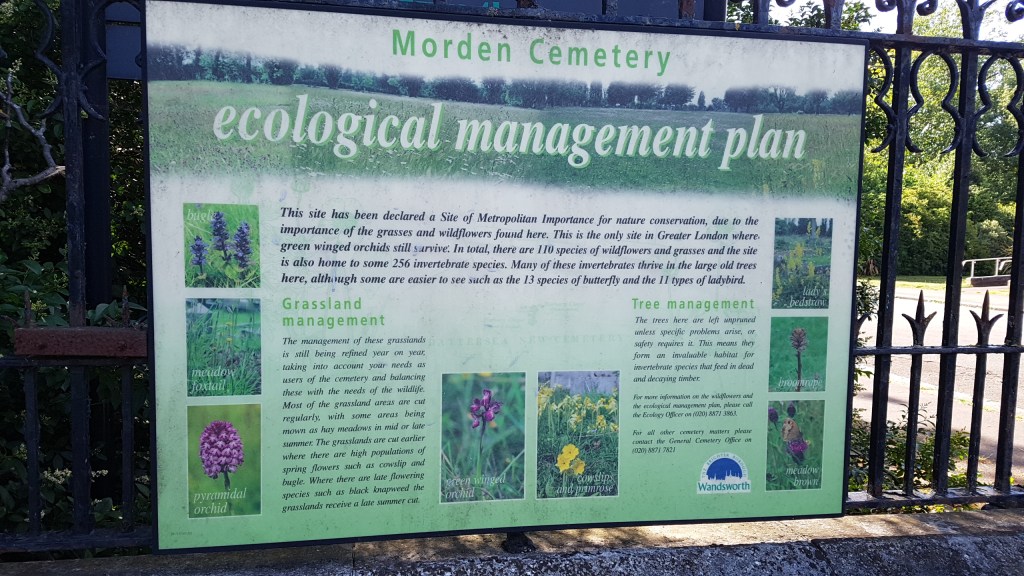
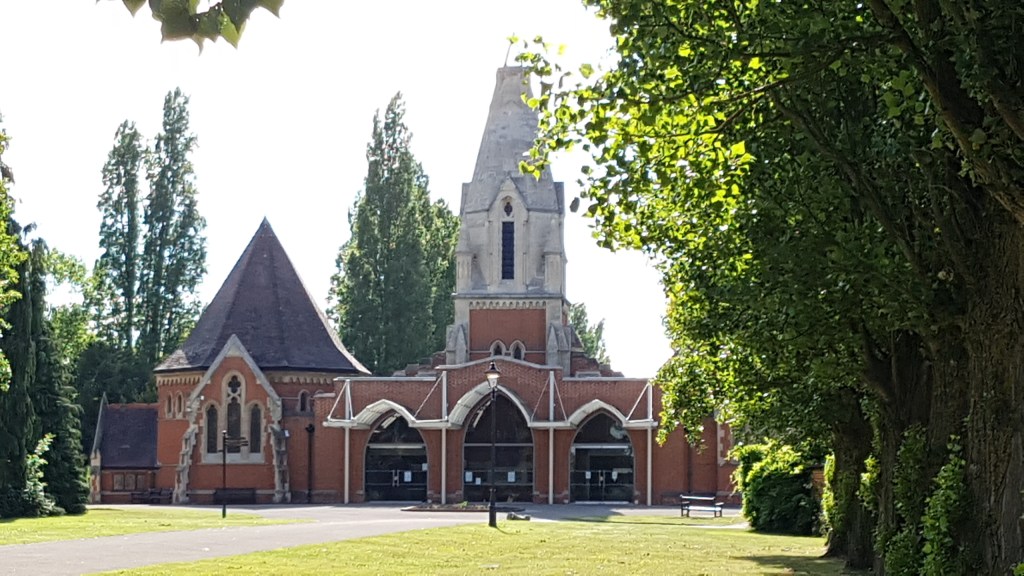
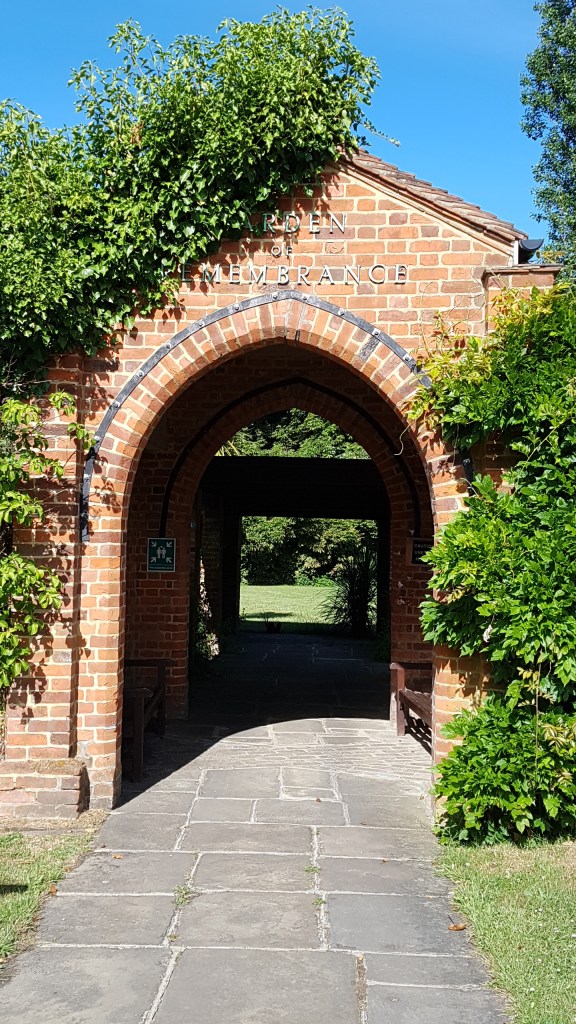
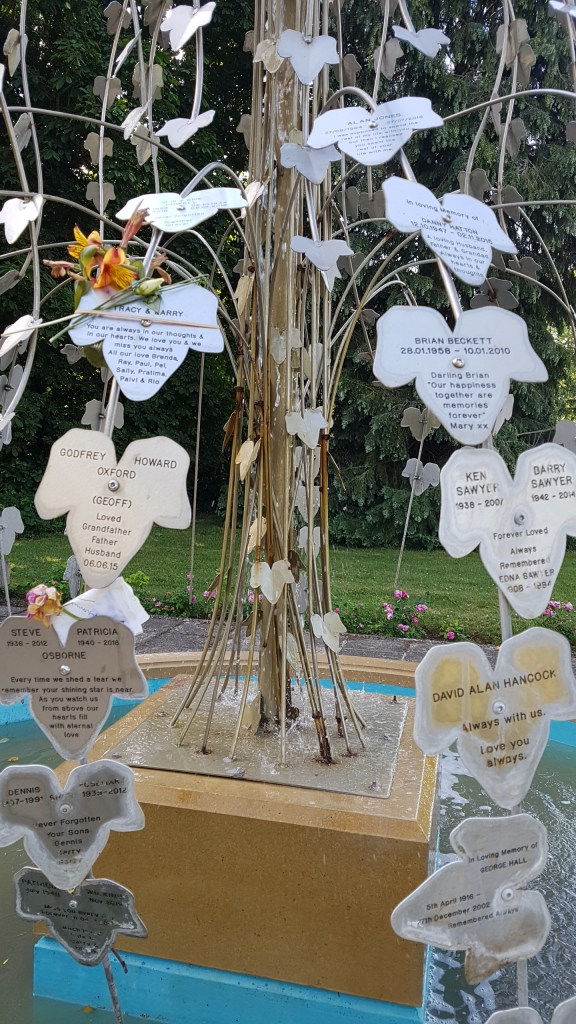
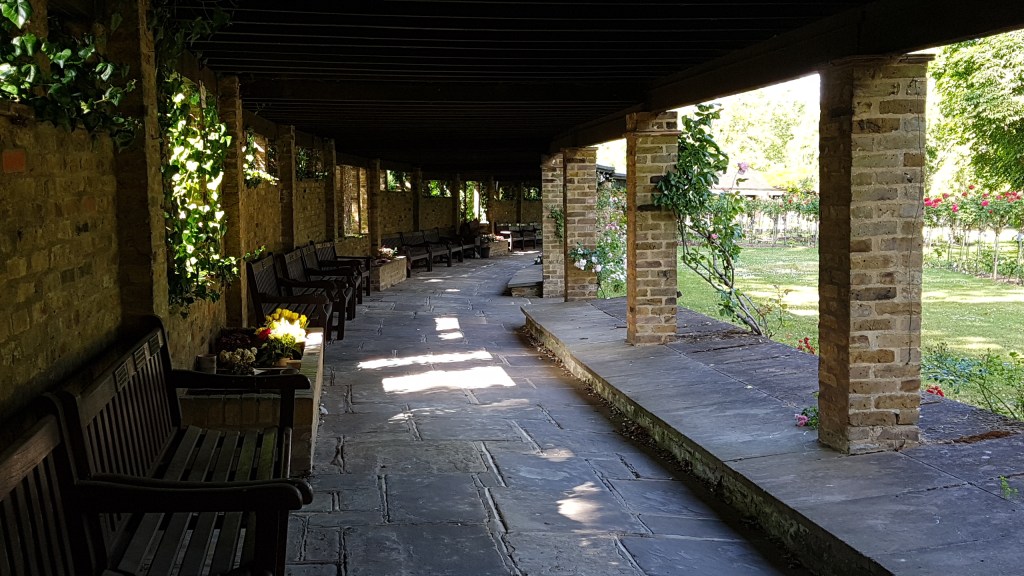
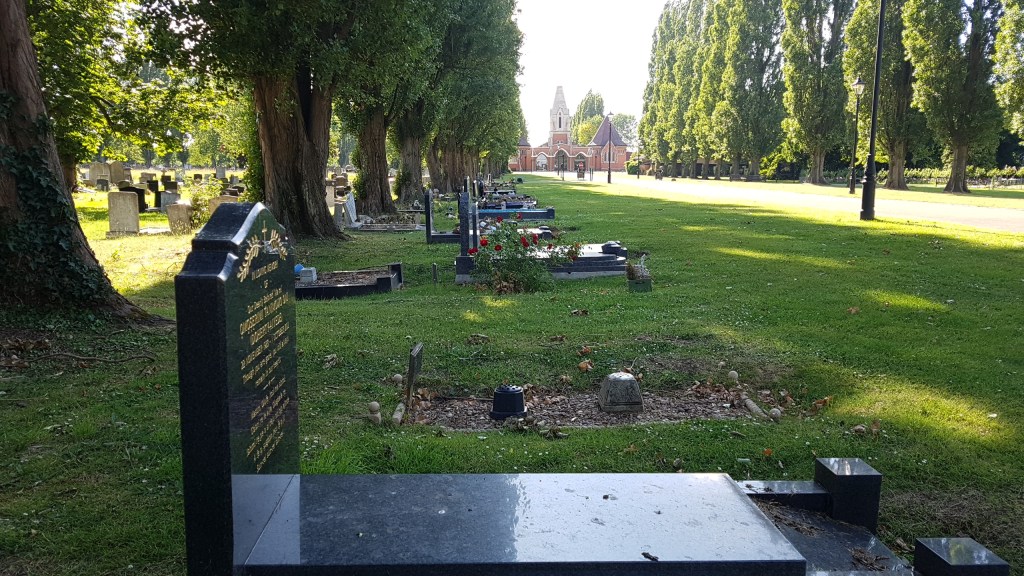
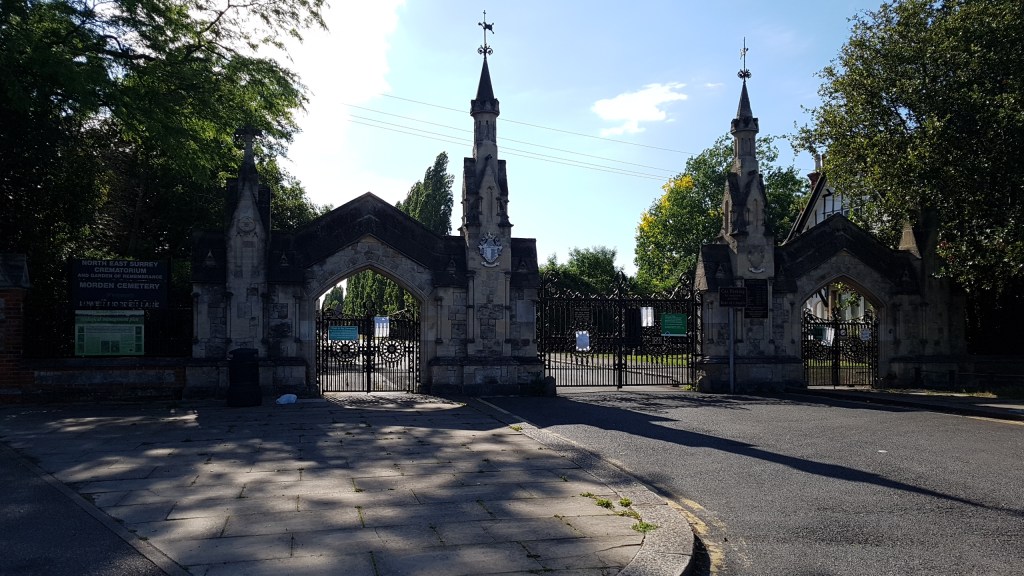
I continued on until I came to another cemetery – The North Surrey (confusingly also known as Morden Cememtery), also an ecological space. Through the gates it looked impressive and well laid out, so I went to investigate. And it was impressive with wild areas, the mix of old and new graves, a beautiful garden of remembrance and circled enclosures with seating around a tree. The buildings were also impressive. Situated at the end of the driveway, they are the first things you see as you enter. And there is a beautiful memorial pond with fountain. It has been made to look like branches of a tree and each ‘leaf’ has the name of someone who has died. With plenty of space and benches to sit on there was the temptation to just sit and relax in this place. However, I aware of the time, so reluctantly said goodbye.
Heading left out of the gates I walked to the end of the road as I could see there was a pub on the other side of the roundabout. I could just make out that the pub had ‘Brook’ in the name. I thought I might be able to solve the mystery of the stream I had crossed (which, incidentally, runs through the North Surrey Cemetery). The name on the pub said The Morden Brook. I’d never heard of a Morden Brook, but I know there are many long forgotten brooks and streams that run through places. I decided I was look it up on my return home.
The pathway leading tio Arthur Road
I began the journey home retracing my steps, with one exception – I took the path to Arthur Road. I’d heard the name of this road and thought I knew where it came out (I was right). The path was beautiful, shady and it ran between the cemetery and the horse field before running along side the park. I took a slightly different route home, crossing the level crossing near Motspur Park station and cutting off down other roads.
Once home I looked up the pub name and feel rather chuffed that I had been right about the stream. It is in fact part of Beverley Brook before it heads off to Beverley Fields, RIchmond Park, Barnes Common, Putney and into the Thames. The pub, The Morden Brook, was originally The Beverley and built in the 1900’s. Read about it here. I love it when things come together.
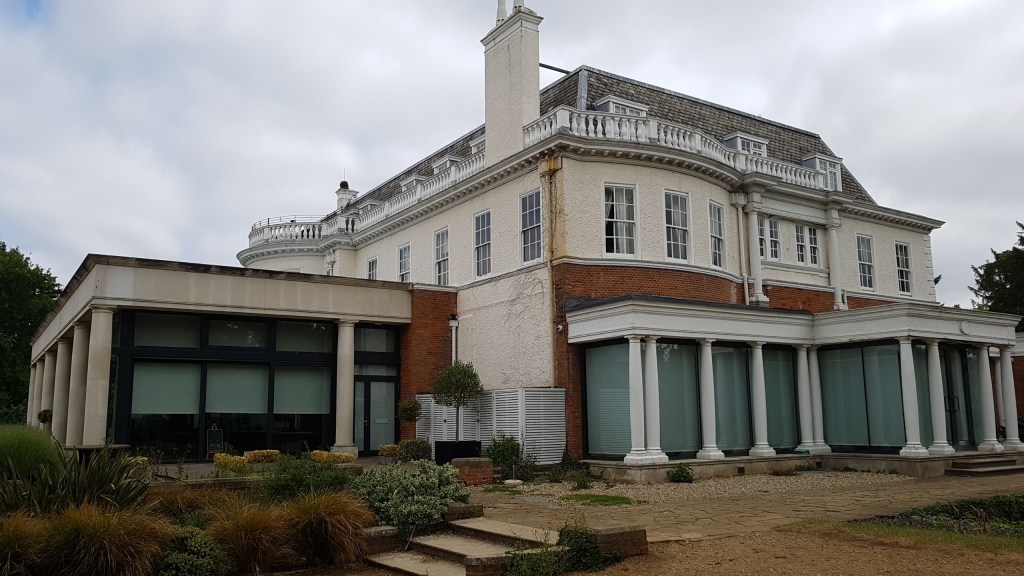
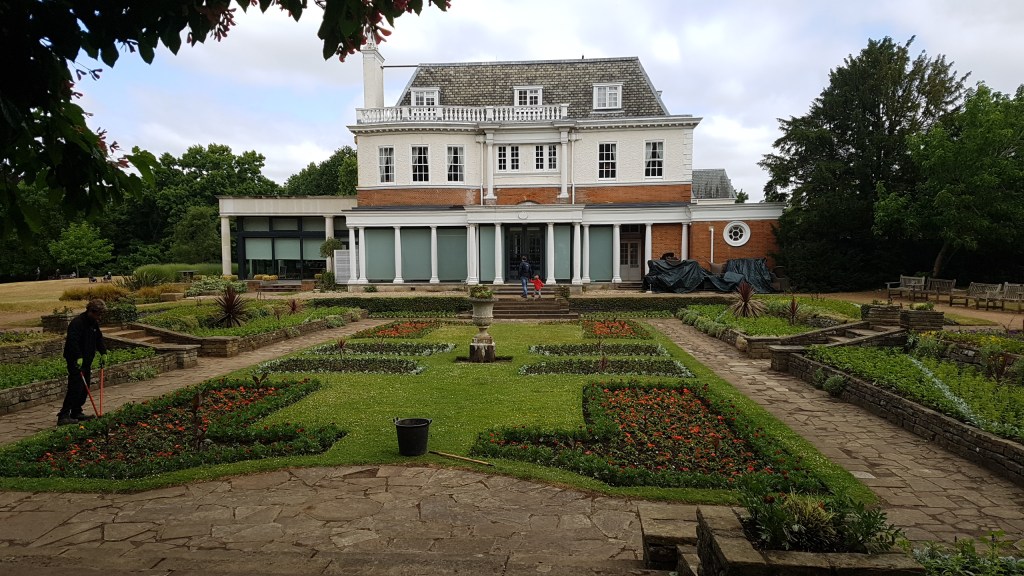
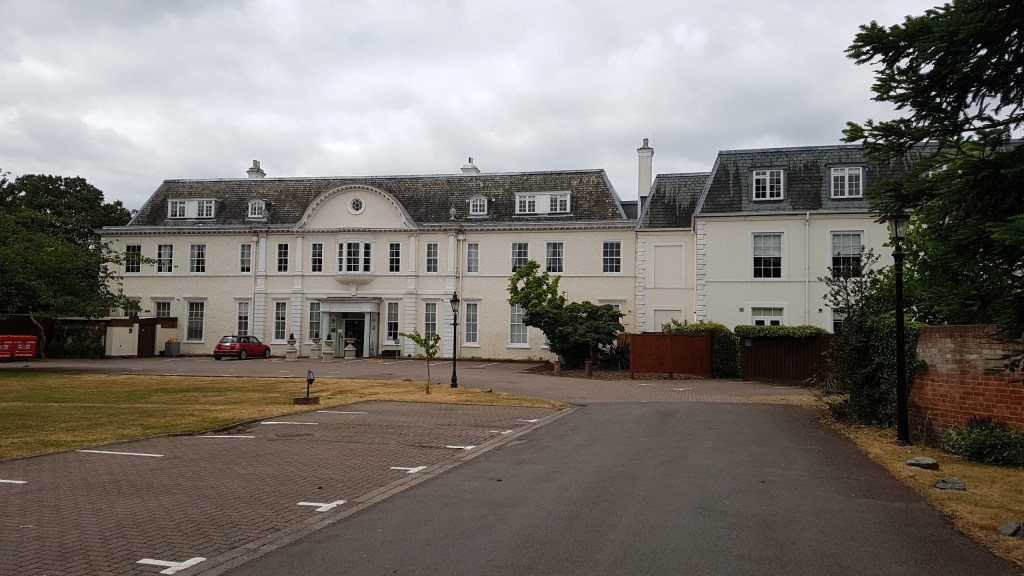
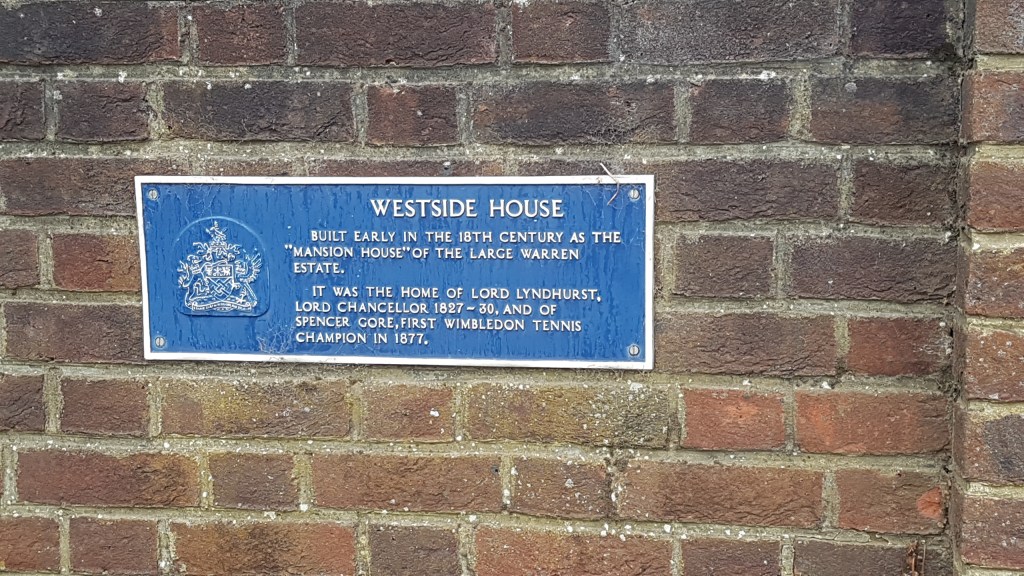
Cannizaro Park sits on the edge of Wimbledon Common and above is a picture of the house, now a hotel (Hotel Du Vin). However the conservatory is open to the public as a cafe (though obviously not at the moment, sadly). The park is free to visit.
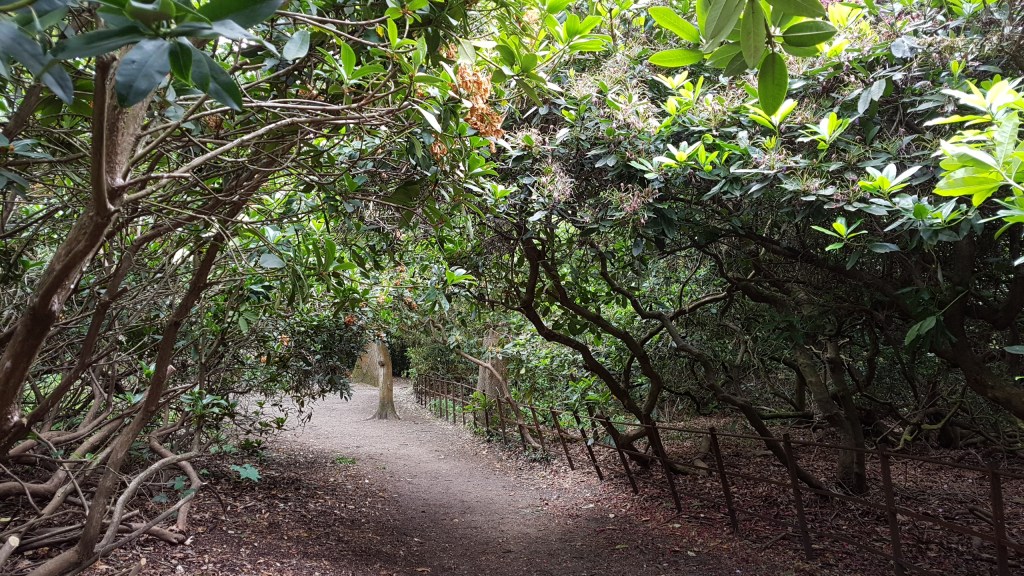
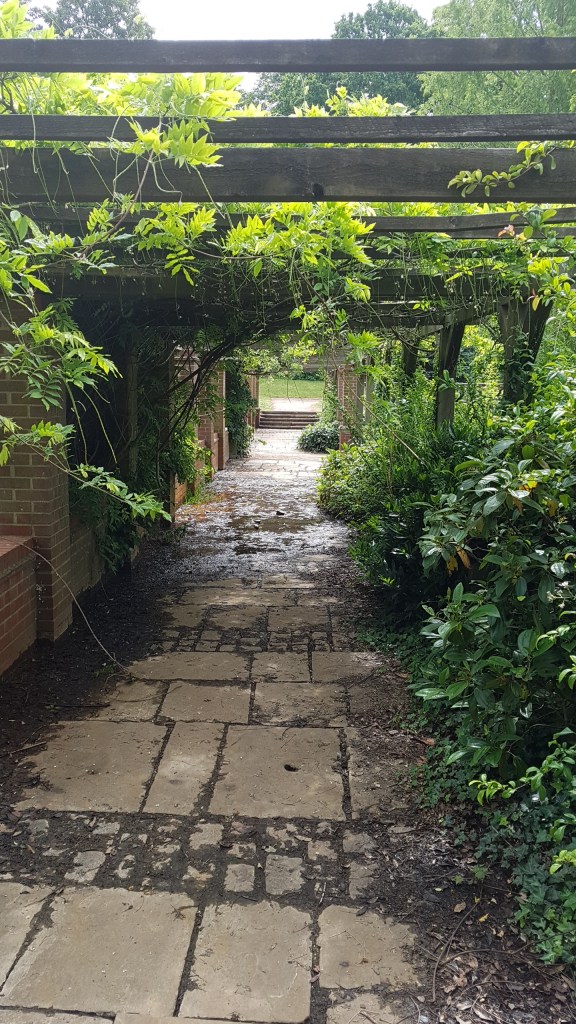
It was a fair walk for me to reach here, and a trek uphill. My only thought was how easy it would be going back downhill afterwards! But it was worth the walk, for this is a beautiful park, and larger than I remembered. The spring flowers having faded, the summer ones are not yet at their peak, but the woodland walk is peaceful and shady with little quirky diversions.
The woodland walk
The name Cannizaro dates back to 1832 when Count St Antonio was occupant of the house, then called Warren House, became Duke of Cannizzaro in Sicily. But he didn’t hang around. He went off with his mustress to Milan leaving behind his Scottish wife who kept the house and gardens until her death in 1841.
The sunken garden
Later, the second ‘z’ was dropped from the name, and after other occupants, Cannizaro became known as a country retreat whose visitors included Lord Tennyson, Oscar Wilde and Henry James. In the early 20th century the Wilson’s bought the entrie estate and lived in it from 1920 to 1947. The estate was finally sold to Wimbledon Corporation and Surrey County Council. Seperate conditional covenants to the sale meant that some of the lands was be used for housing, while other parts became the Royal Wimbledon Golf Course, allotments and so on. The house was destined to be an old people’s home.
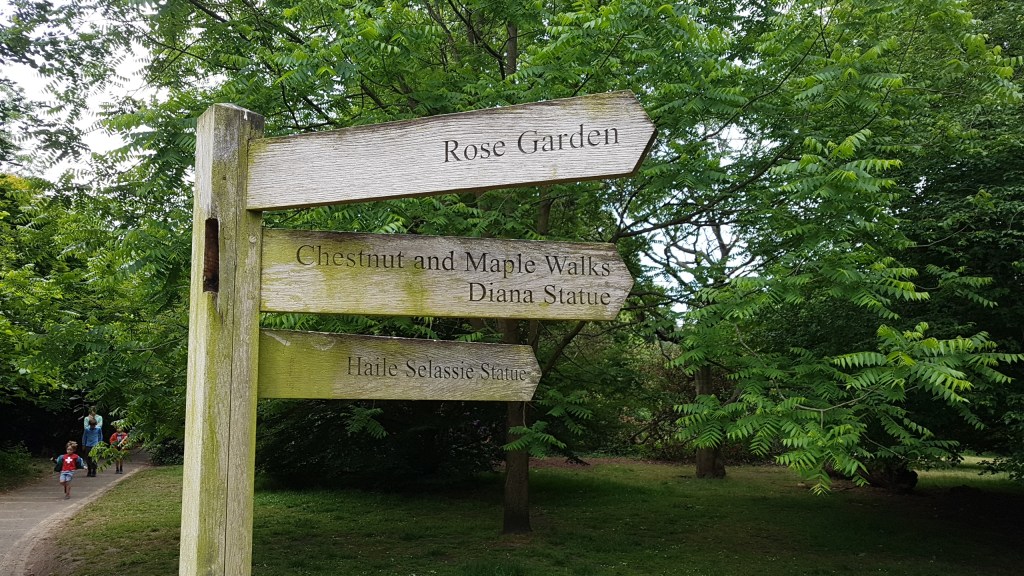
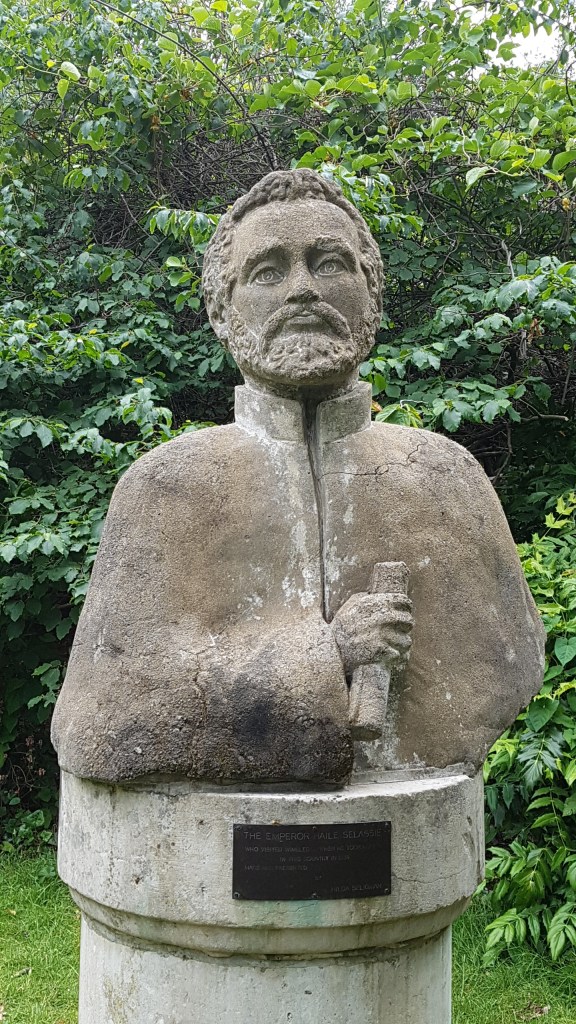
Haile Selassie, who once visited
The house, as I have said, is now a hotel. If you want to see what the inside of the hotel is like click here. You can book a room for around £120 per night through TripAdvisor!
Hotel Du Vin
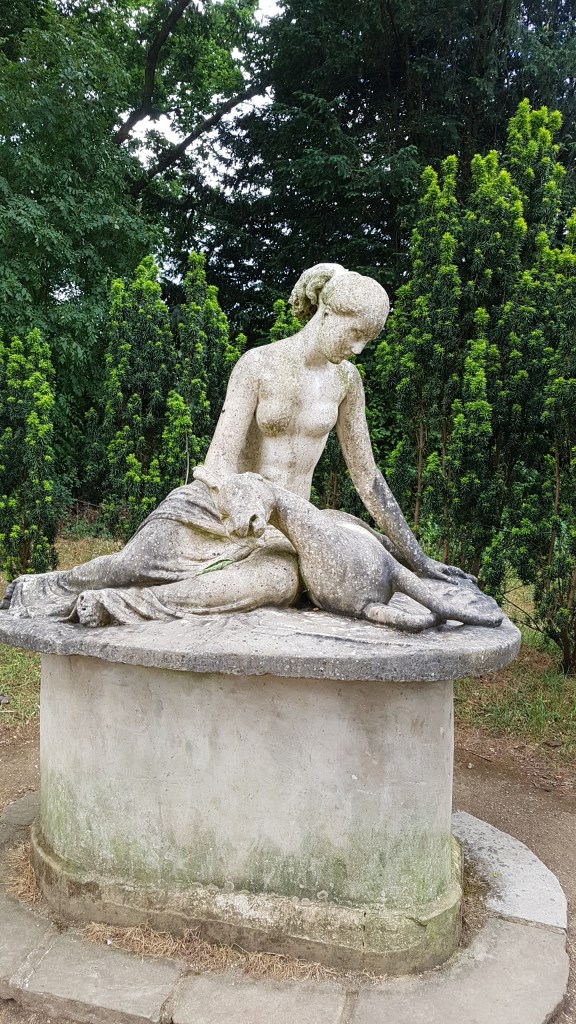
The park is set out with different areas, the large main grassed area, the woodland walk, a rose garden as well as a sunken garden by the side of the house. There are many benches to relax on and enjoy the peace, plenty of space to picnic, as well as a couple of statues to find on your walkabout.
Diana Statue
The houses close by in this part of the world are massive with gates and entry codes. Some are now apartments. There are also a couple of lovely pubs (when they re-open), The Crooked Billet and Hand in Hand. And of course, over the road is Wimbledon Common. What more could you ask for?
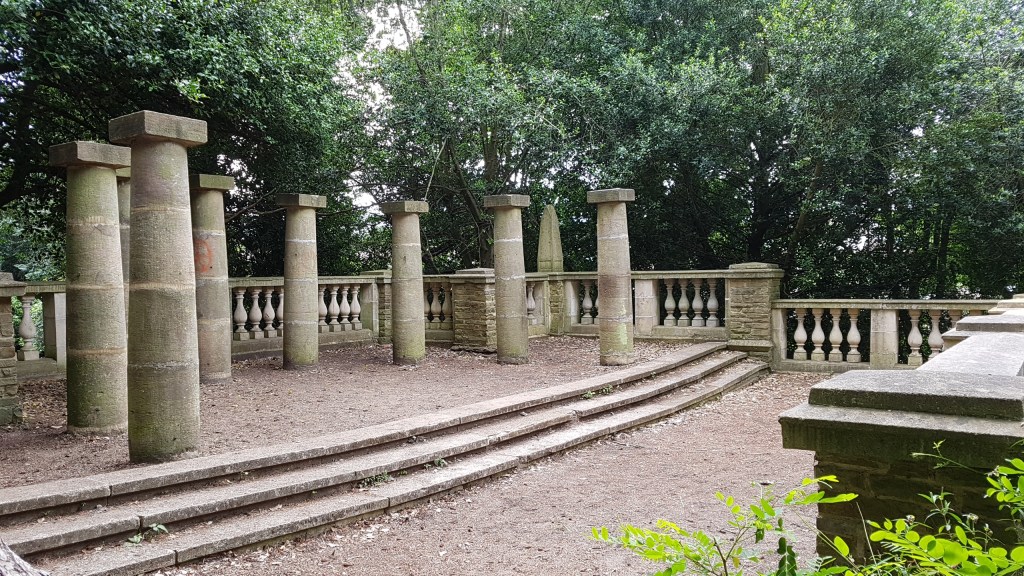
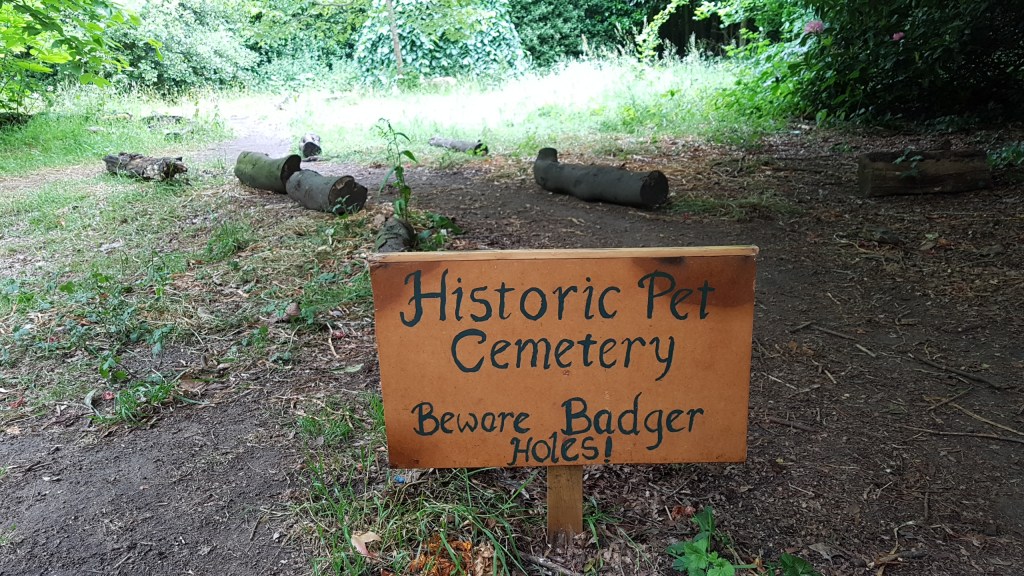
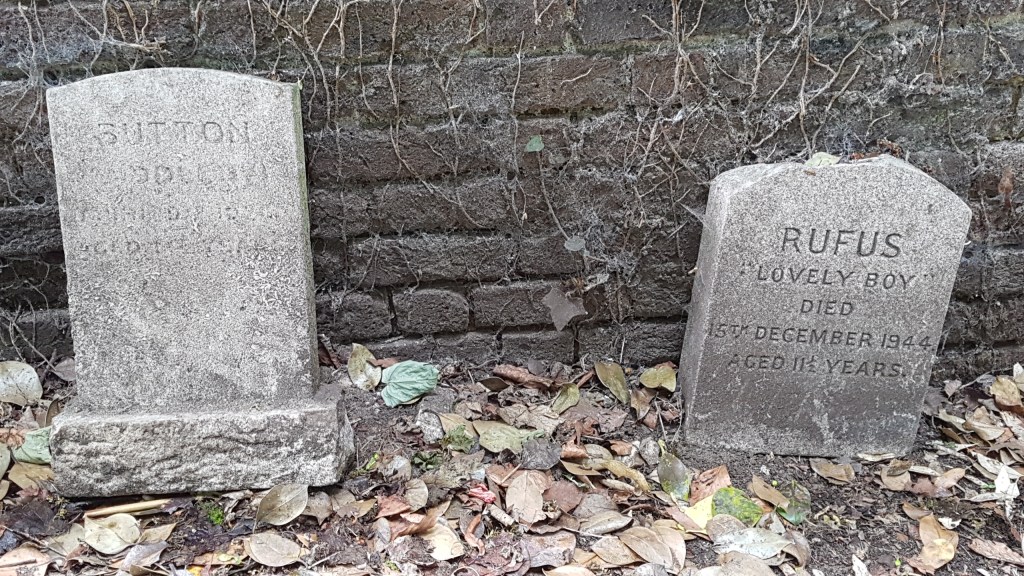
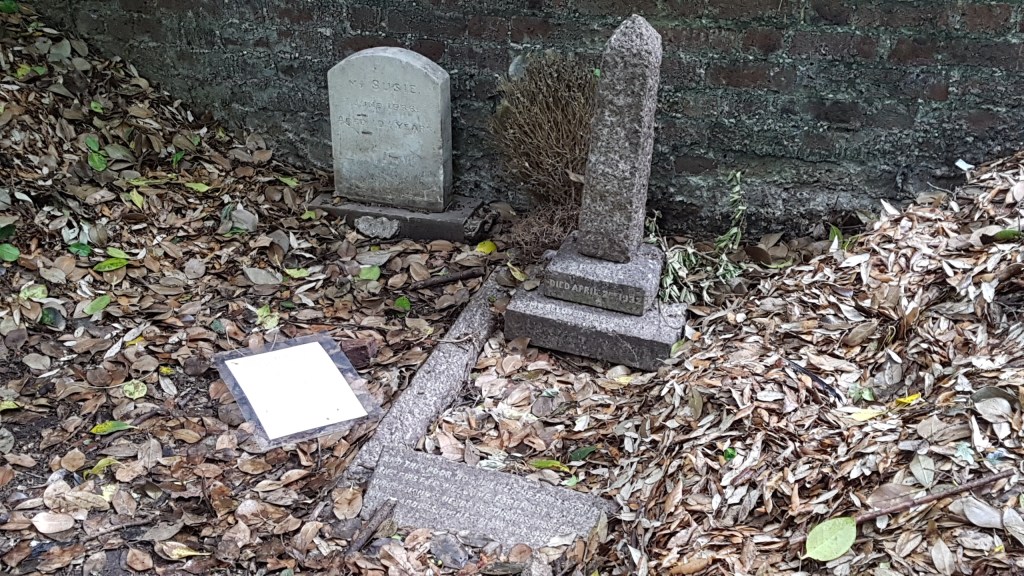
The pet graveyard (below) was a real unusual find. Hidden away off the main path, and yes, there does look like there are badger setts there.
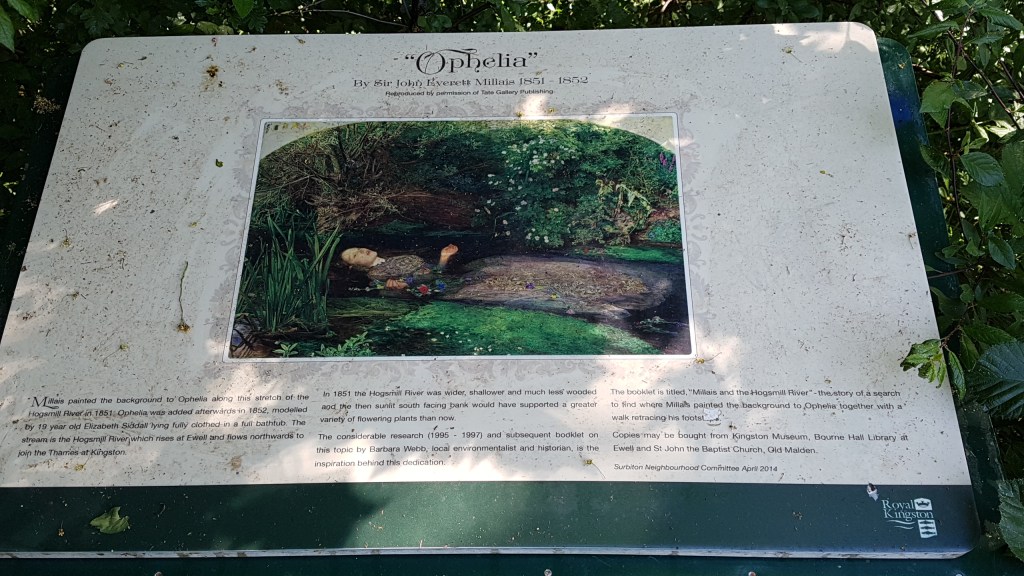
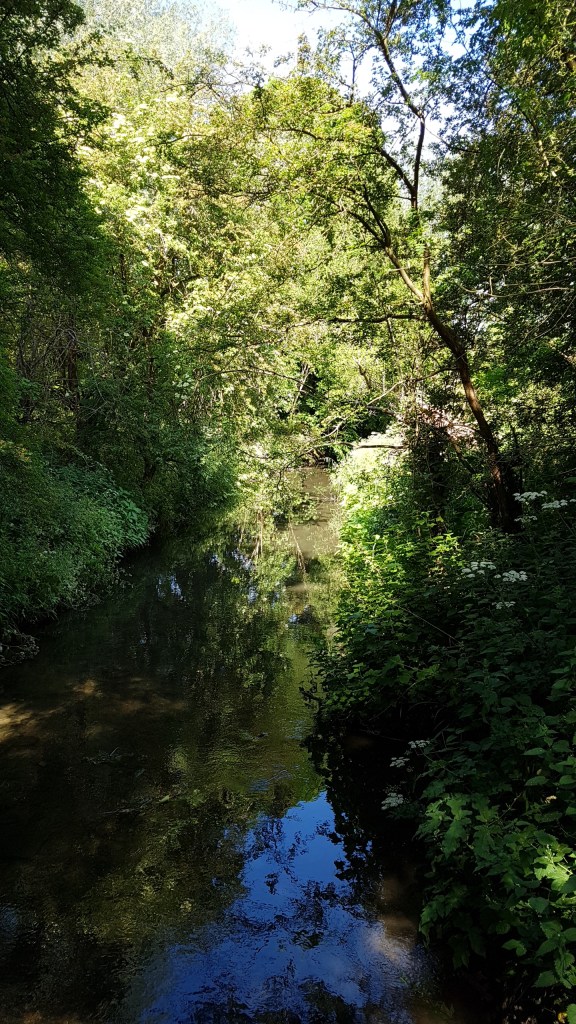
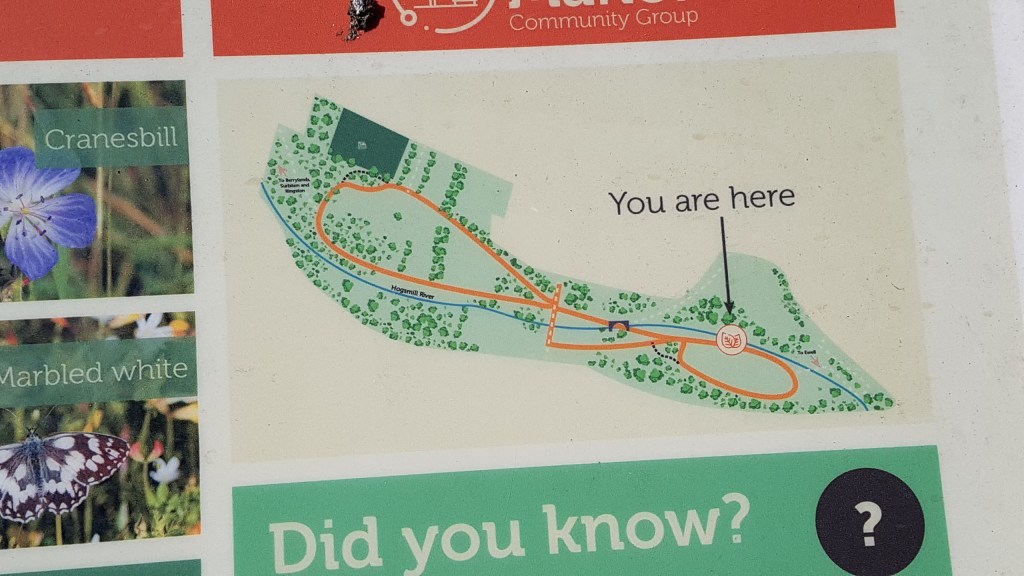
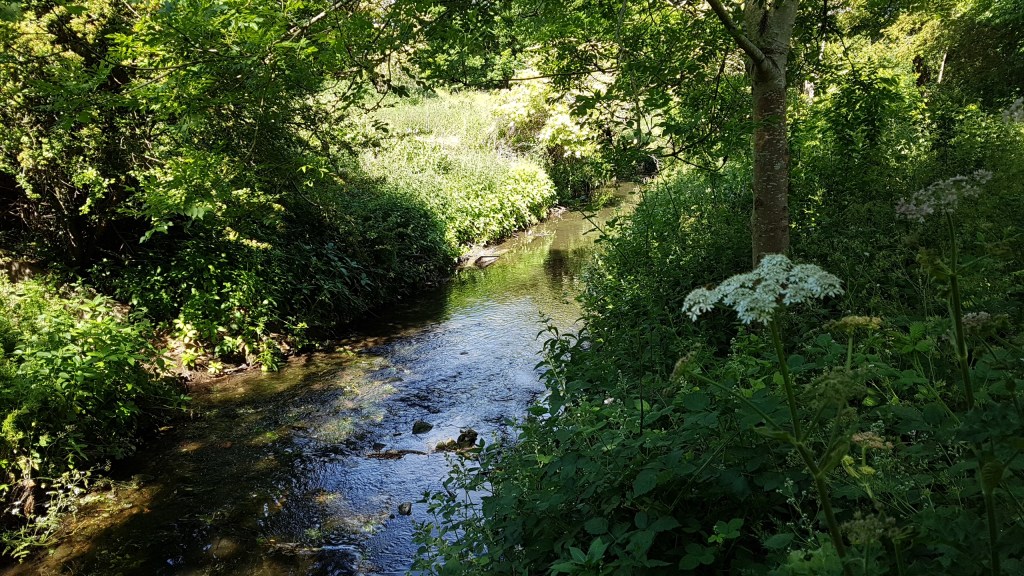
The Hogsmill River rises in Ewell and runs into the River Thames at Kingston. The length is approximately 6.2 miles. In the past I have walked it, doing it in two sections, but last week it was just a small section I wanted to re-visit, the site where John Everett Millias painted Orphilia.
The last time I walked this section there was no physical evidence of where the painting took place, but this could have been because I was on the wrong side of the river, or the area hadn’t had any notification. I think the former is more likely as I found myself on the wrong side of the river..again! I had to double back and enter Six Acre Meadow, which somehow I’d missed!
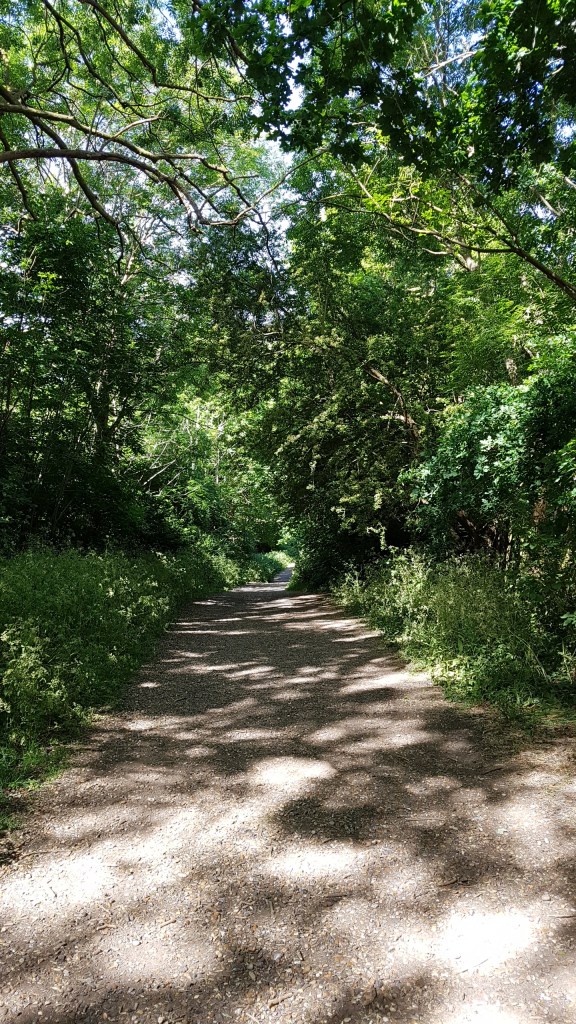
I found my way to the Hogsmill via a pathway which runs along the side of St John’s Church, Old Malden. The footpaths are shaded with trees and there are information boards telling you the sort of wildlife you may see. My first mistake was to cross the first bridge and turn right (I should have gone left). This path led down to a new play area being built called Knollmead Play Area close to the path leading to Malden Manor. There is a bridge here with two alternative routes. I found a map nearby and realised I had missed the site altogether.
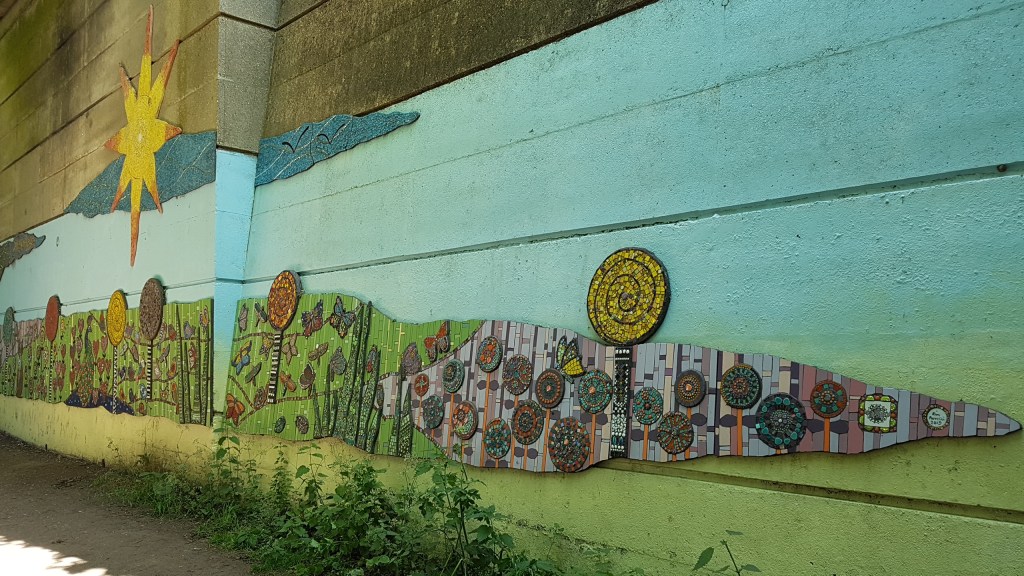
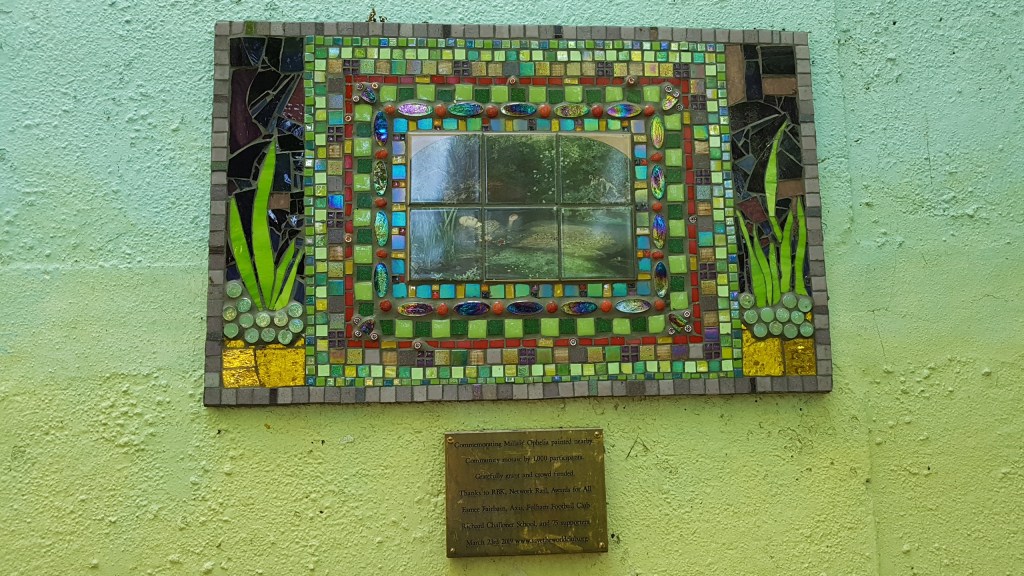
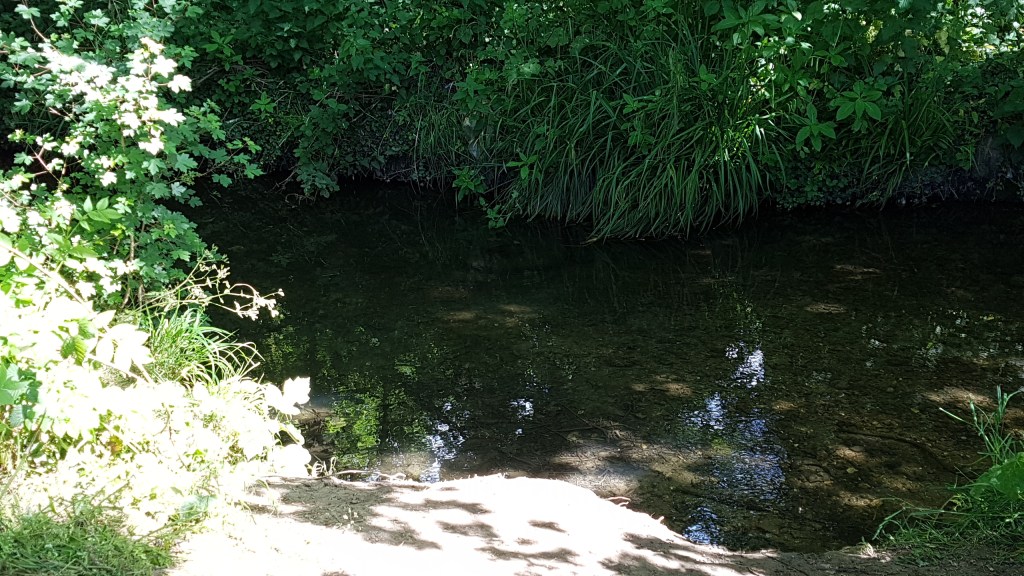
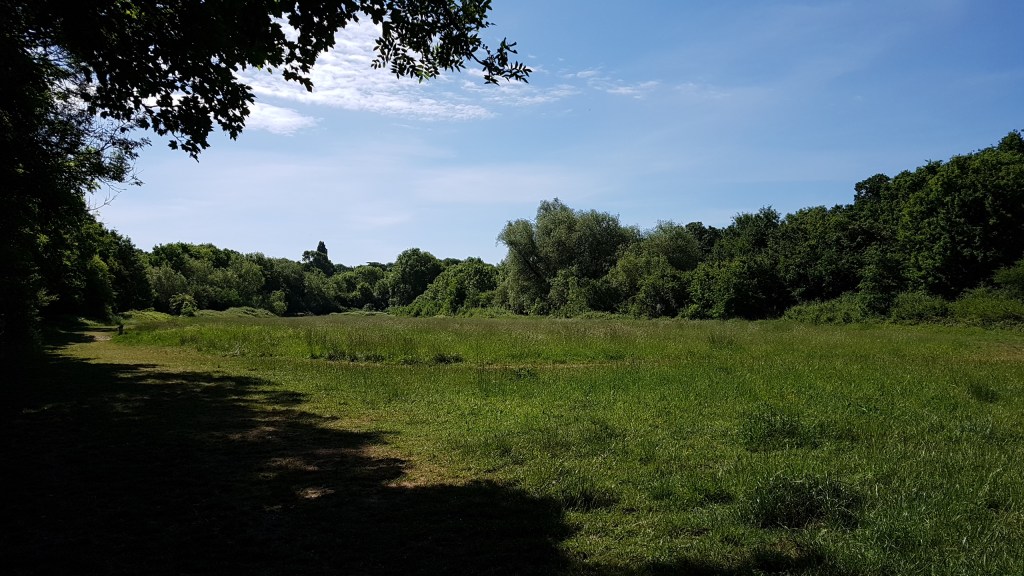
I doubled back walking under a bridge on the other side of the river. The bridge wall here had a community mozaic and alongside it a plaque commemorating the painting of Orphlia. I knew I was close. Finally I came out in Six Acre Meadow, which I recognised from my previous visit, and began walking alongside the river. A short walk brought me to the information board, and right by it is the clearing where the painting is said to have taken place.
Community moziac
John Millias was a Pre-Raphaelite painter, along with Dante Gabriel Rossetti and WIlliam Holman Hunt. They formed a Brotherhood in 1848 with James Collinson and Frederic George Stephens. Rossetti’s brother was the secretary. Later a second Pre-Raphaelite phase saw Edward Burne Jones and William Morris join them. My personal favourite of this group of artists is William Morris. I may have mentioned this before in my posts, so perhaps I won’t wax lyrical here about him as this is about Orphelia, a painting inspired by Shakespeare’s Hamlet. Millias painted the background detail here by the river and Orphelia herself was painted in his studio in Gower Street, London.
The plaque commemorating the painting
This is where the painting is said to have been done (just right of the board in the top picture)
The model for this painting was nineteen year old Lizzie Siddel, who was discovered in hat shop by a friend. She later married Rosetti, and what a tragic story that is! Anyway, to pose for this painting, Lizzie laid in a bath of water, lit below by oil lamps to keep the water warm. Millias was so engrossed in his painting that he failed to notice that the lamps had gone out. Lizzie became quite ill afterwards and needed medical treatment. Later Lizzie’s father insisted that Millia foot the bill for the treatment. To learn more about the painting of Orphelia follow the link here. To learn more about the Pre-Raphaelites in general follow the link here.
Six Acre Meadow
After discovering what I set out to find, I walked a little further on in the Kingston direction, then turned back and came off at the path leading to Malden Manor.
The pedestrian/cycle path runs along the side of the railway line
On Monday I set off on a walk with my youngest son who had a few days off from work. We’d both been considering a walk in the same area so when I asked him if he wanted to walk with me, he said yes. Like me he often likes walking on his own, so I never push it, but it was nice to have his company and a chance to chat.
Beverley Brook or Coombe Brook runs through Malden Golf Course
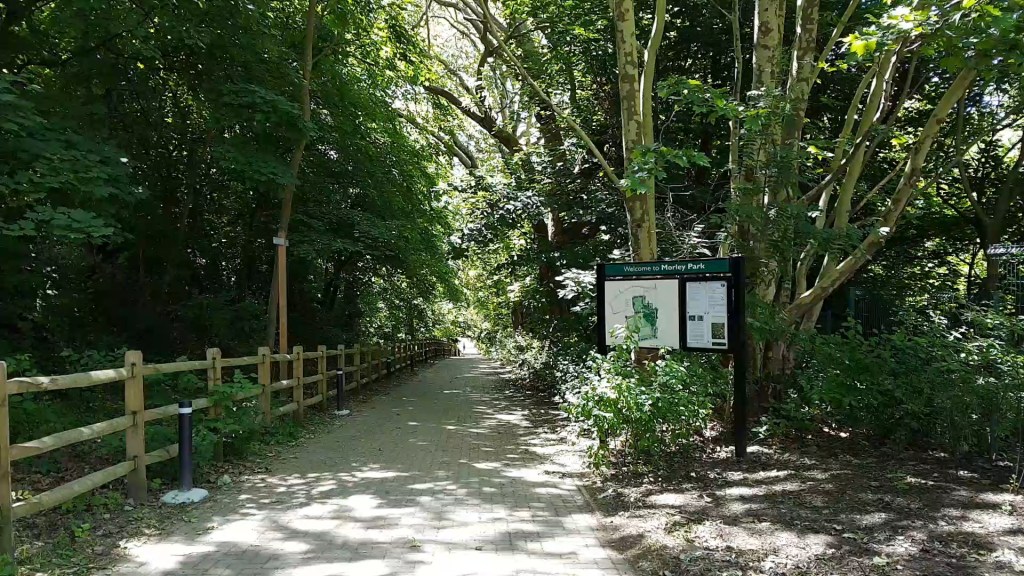
Our destination was a park in West Wimbledon called Morley Park. I’d read online that it has a nature walk. Getting there was easier enough. We managed to avoid most of the busy roads by going back ways and using a pedestrian/cycle path. The park itself has a children’s play area and tennis courts. It is also has regular usage by Urseline High School in Wimbledon. Walking up through the park you come to steps that take you to a pond. Thought it had dried out somewhat, there was a dog enjoying what was left.
The pond – Morley Park
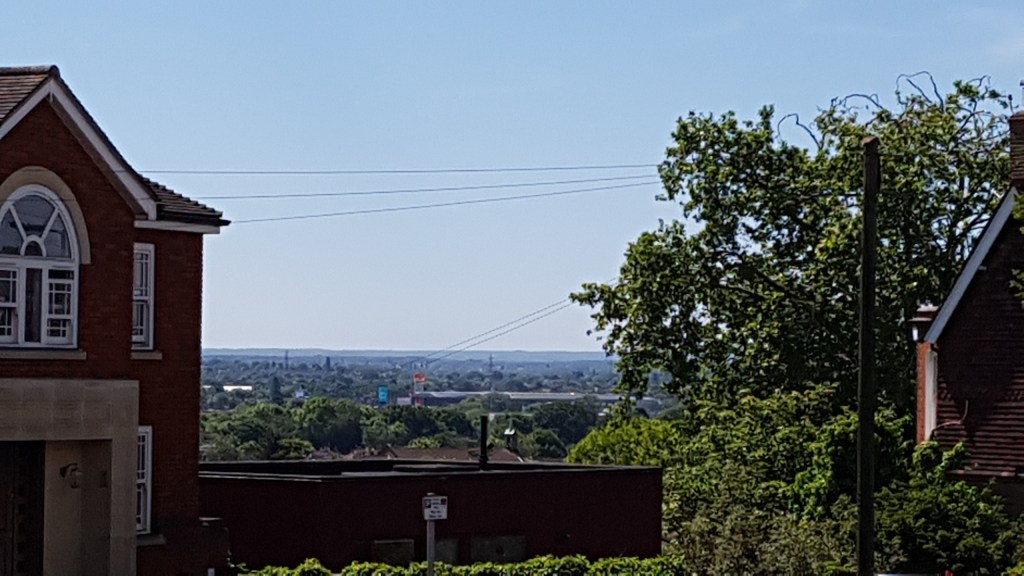
The nature walk was rather smaller than I envisaged and we were through it quickly. We then had a choice to make – go back down or walk up to Copse Hill. We chose the latter where you get a wonderful high view looking down towards where we live.
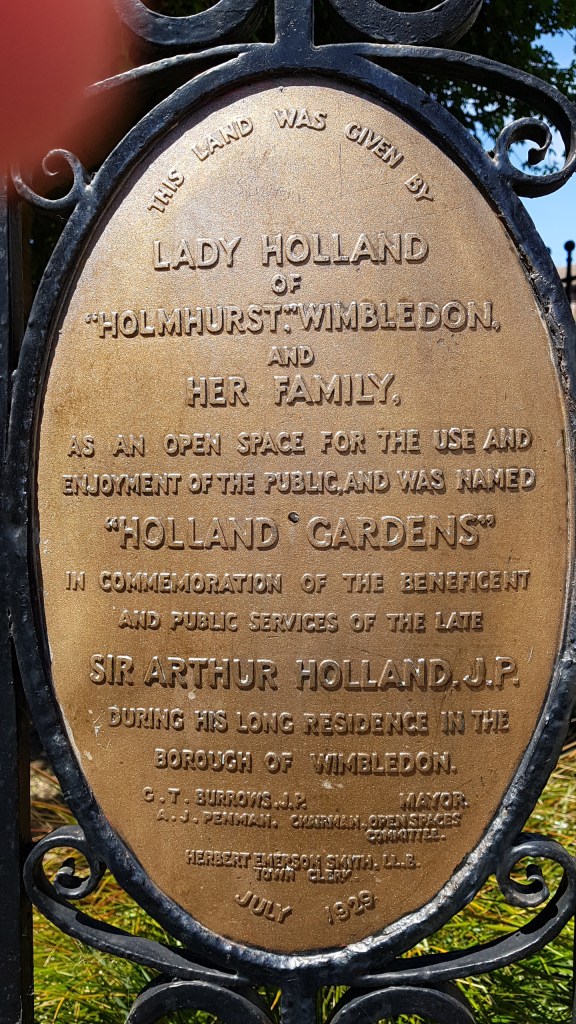
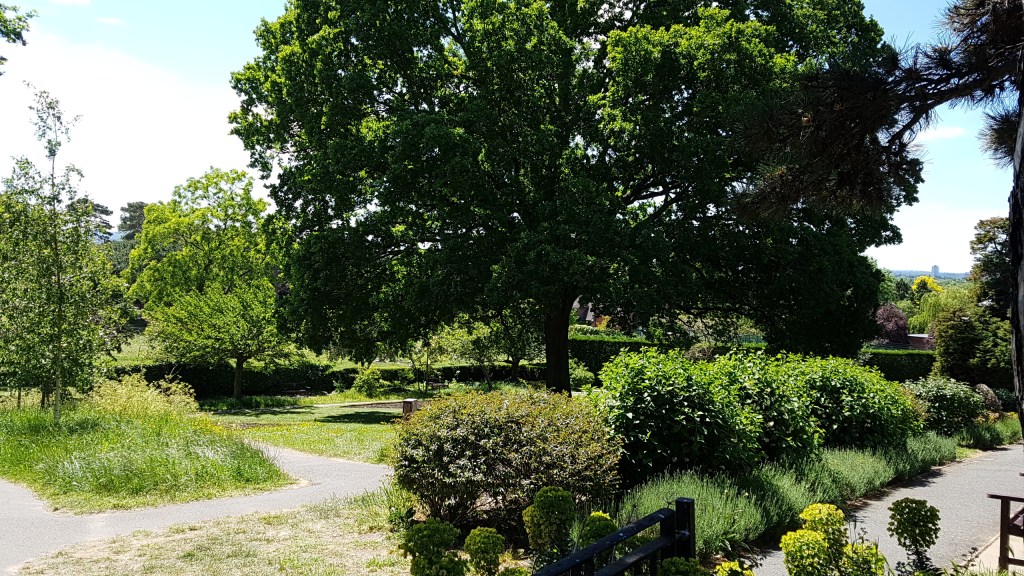
Nearby is Holland Gardens (not to be confused with Holland Park in Kensington). I have been here before. Again the views are great and the park is in two halves. The top park has the flower beds, a grassy area dominated by a large tree. Here we sat on a bench to eat our sandwiches.
Woodland Walk, Morley ParkThe view from West Wimbledon
To the side of the park are the tennis courts, a rose lined pathway runs along on edge of it. Below the main gardens (which are being prepared for new plants) is the main playing green. The other entrance gate is down here and was the way we came out. We decided to walk back home the same way to avoid most of the roads. This turned out to be another two and three quarter hour walk, yet it didn’t seem as far as the Beverley Brook walk of the previous week – maybe that’s because I had company and I didn’t get lost!
Last week I went on a local walk, bearing in mind that I would have to allow myself enough energy to walk back., us still being in Lockdown. My aim was to find the source of Beverley Brook. Two or three years ago I walked this brook in the other direction (it took two walks) from New Malden where you can see the book adjacent to Dreams and Currys on Burlington Road (the entrance to the car park, left, hidden behind a corrugated fence) and then it runs under the road, along the backs of houses in Beverley Road. It passes behind an industrial estate before crossing the A3 where it skirts Wimbledon Common before running through the edge of Richmond Park, across Barnes Common (where there is a nice old graveyard) and finally out into the River Thames at Putney. A leaflet for this walk can be found at https://www.merton.gov.uk/assets/Documents/beverly-brook-walk.pdf
The walk in the other direction is not so well documented. Articles quote Cuddington Park in Worcester Park as being the source, but I have not found a map of the walk, save Paul Talling’s website where he lists some places where Beverley Brook can be seen, and he offers some photos. So, armed with a photo of the relevant parts from an A-Z map (primitive, but that’s me), I set off.
Motspur Park & West Barnes Lane meet here
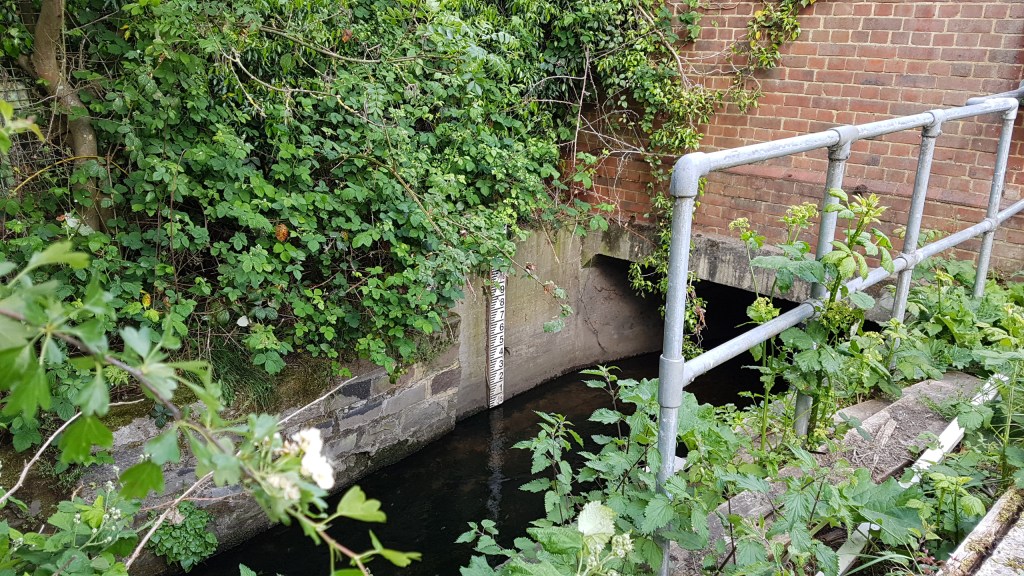
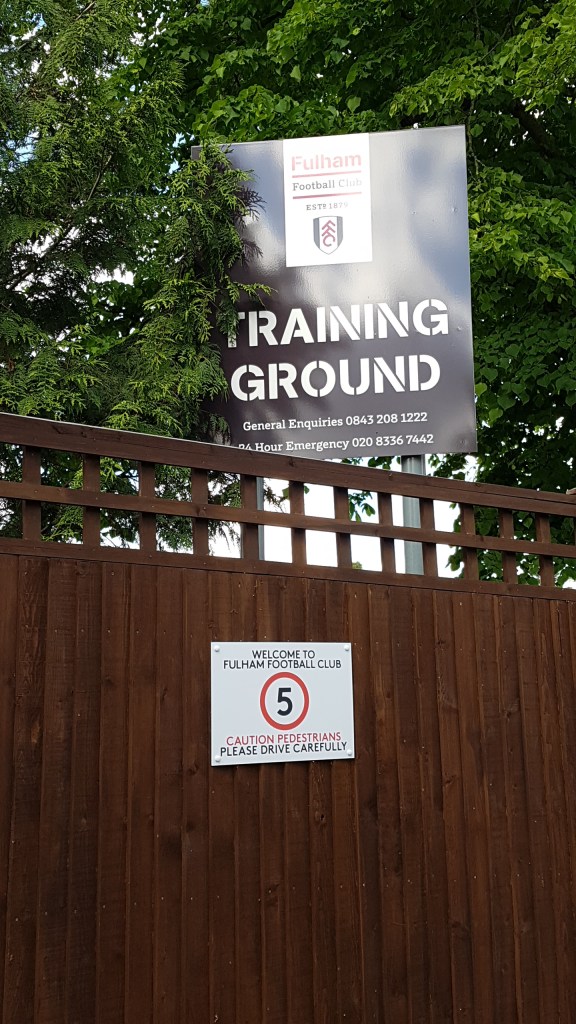
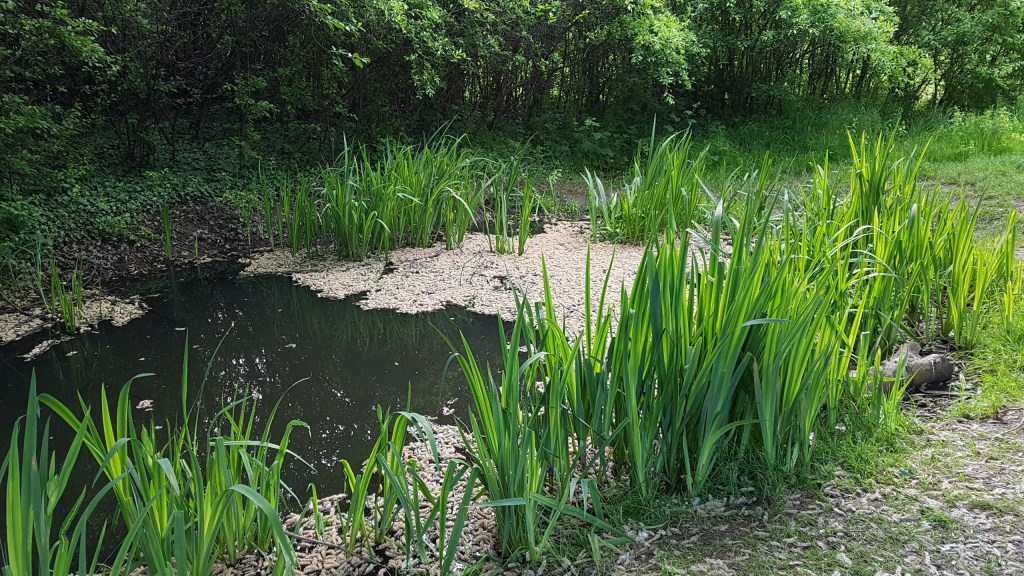
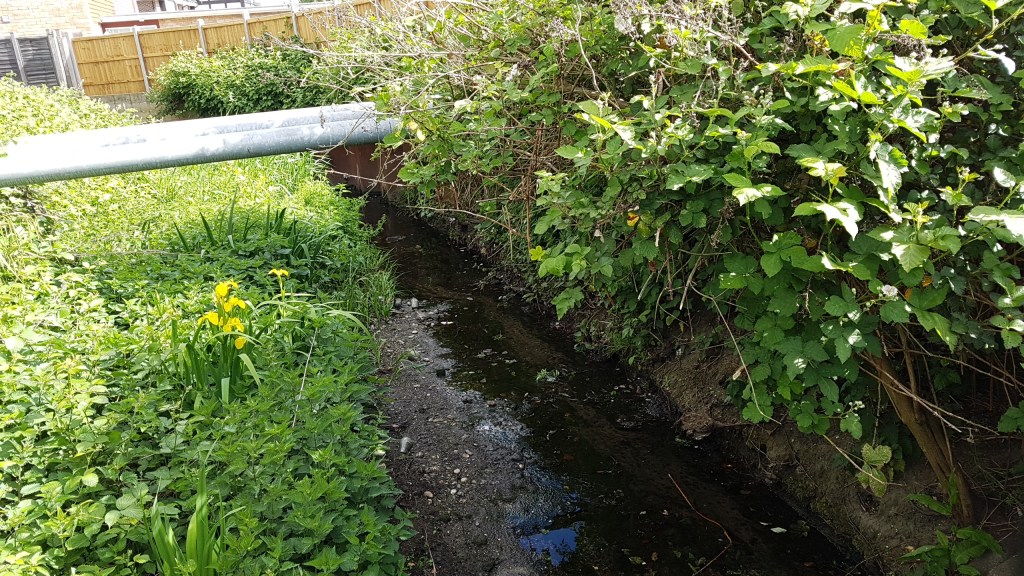
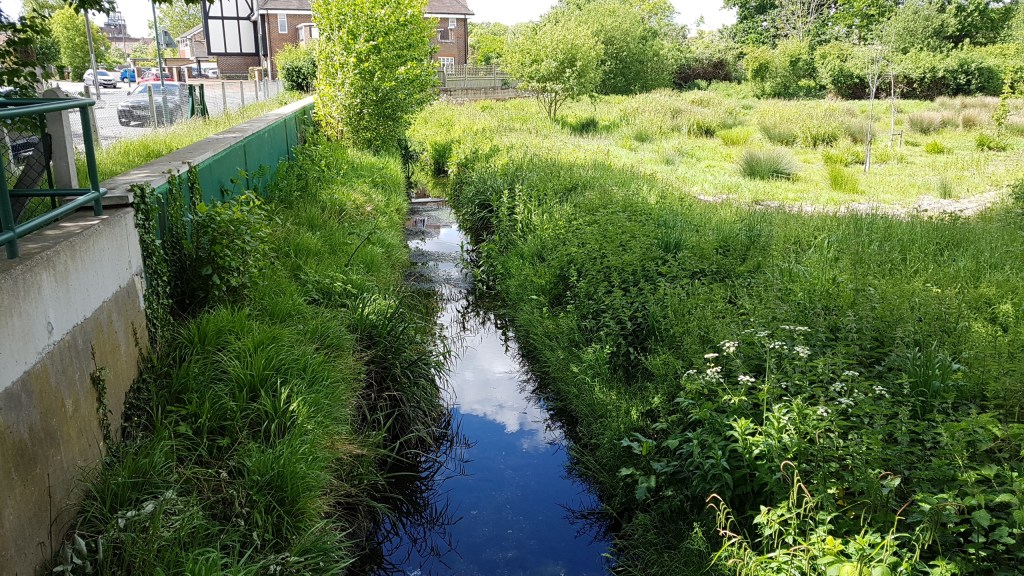
This lesser-known river was called Beferithi in 693, getting its name from where Beavers lived (they live there no more). My first sighting of the brook was over a small bridge where two roads meet – Motspur Park and West Barnes Lane. Here I followed it found as it passes along Fulham Football FC Training Ground. I followed it into a no-through road where we had to part company as it ran behind houses. There was a lot of road walking then before I eventually came out on Malden Road and cut the big sweeping corner off by stepping through the edge of Malden Manor Park before joining the main road until I reached Worcester Park Station. Here Paul Talling said Beverley Brook came out. I found it (with some excitement) just around the corner in Green Lane. There was far more to be seen than I thought there might be.
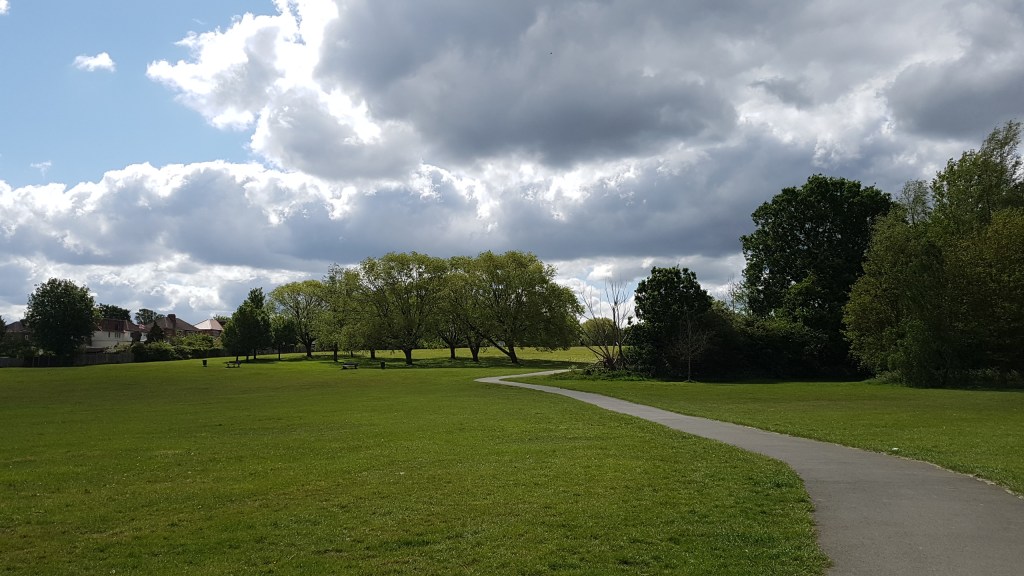
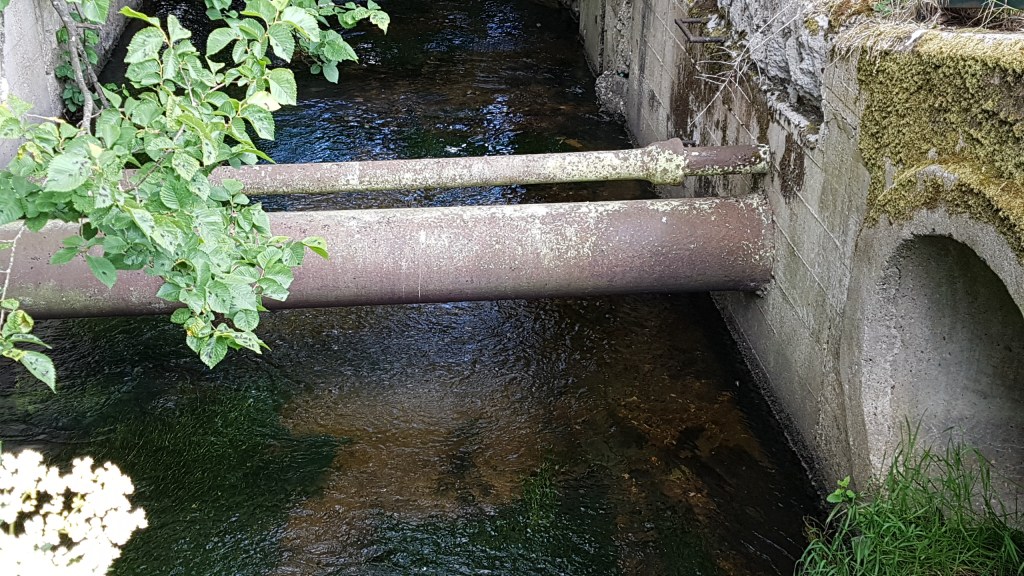
I turned back and crossed Central Road and headed up Lynwood Drive and into Sandringham Road where I found Cuddington Park. It’s a lovely park, but I had to walk the whole length of it to find the source, a rather disappointing sludge coming from a pipe. Yet I was excited. I then managed to follow the brook down back through the park using a small footpath behind the trees until it ran underground again.
I retraced my footsteps back to Central Road but this time I decided to walk back via Green Lane to see how much there was of Beverley Brook that way. It turned out to be quite a lot as it ran along the side of the road until its end. There were some giveaways too by the names of roads – Beverley and Brookside. By the local primary school, Beverley Brook disappeared down the side, and here I got lost! I tried going one way, which was in the right direction of the brook, but the road seemed to be going in a circle. I had to double back to where I last saw the river and headed in another direction. I had no idea where I was going, but I seemed to be entering a field. There were a few people about so I asked someone where it led. The lady told me to Sir Joseph’s Hood Park. That was just what I wanted!
Manor Park
Green Lane
Cuddington Park
The source of Beverley Brook
Along the path in Cuddington Park
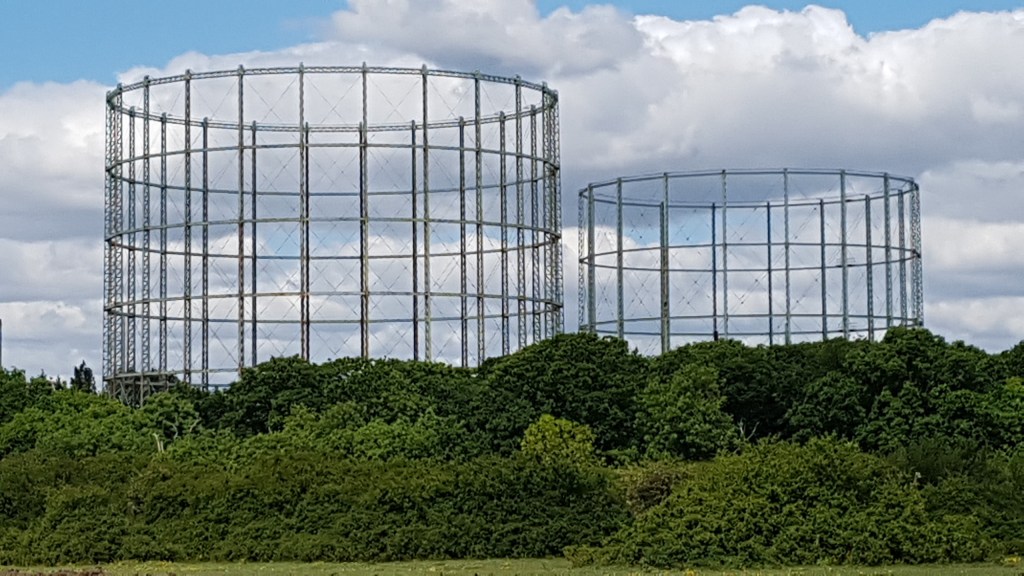
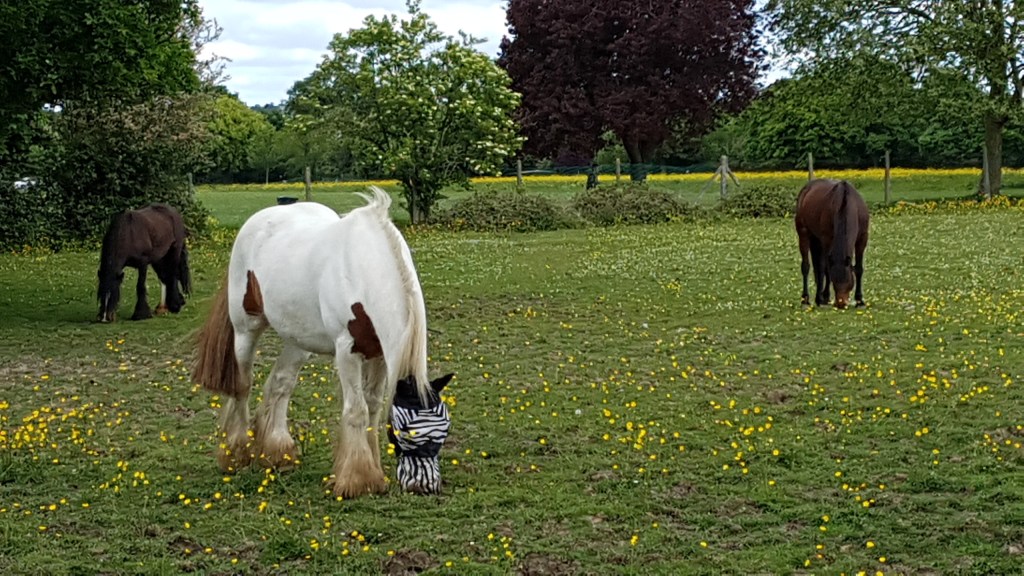
Walking through the field with horses on both sides, the wide open space was lovely. The fields were full of wild flowers and the imposing gas works (so majestic) were on my left. There was to be no more sightings of Beverley Brook which ran along by the gas works (where I couldn’t walk). The map shows the brook running alongside of the park, but though I entered a path that took me into trees I was unable to find it. Nevertheless, I was happy to have found so much evidence of the brook and finally to complete the whole accessible route from source to Thames.
Green LaneMy last sight of Beverley Brook by the Primary School
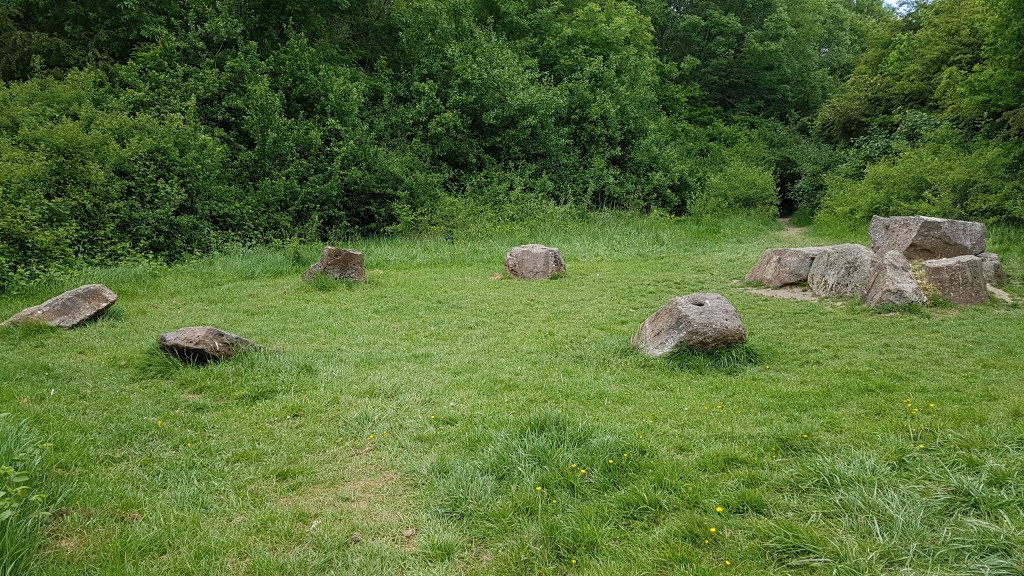
Rather interesting stone circle, Sir Joseph Hood Park
Note: Paul Talling’s book London’s Lost Rivers, is an excellent source of information with maps and photos of the many rivers running through London. Sadly, some can only be heard through drains these days as they have been built over, but some, like Beverely Brook, rise up in certain places, and evidence can still be found in road names and other signs. Paul’s website is https://www.londonslostrivers.com/ He runs walking tours of lost rivers and has a Facebook page. The information on his website was most helpful in guiding me to the right places on this walk.
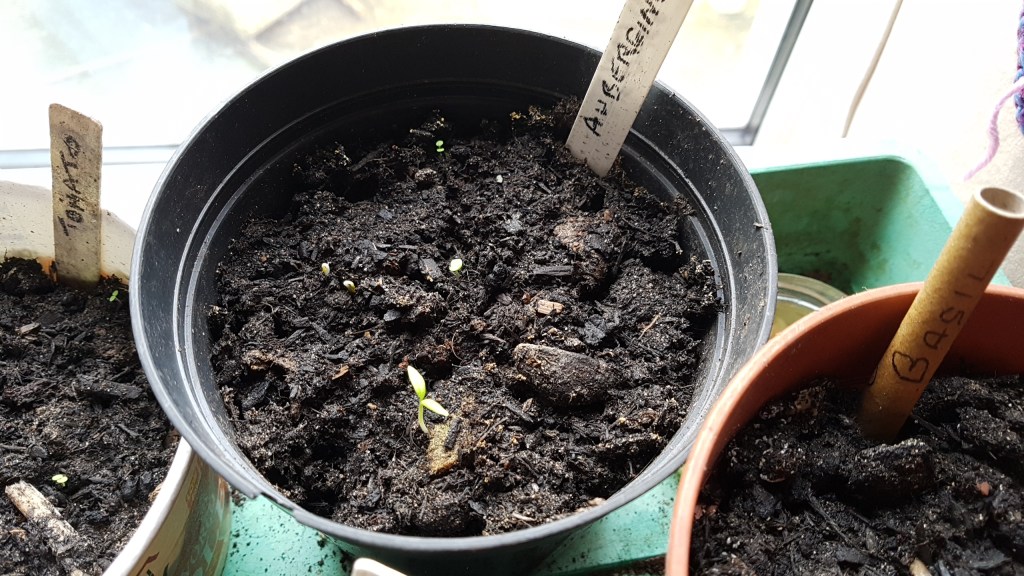
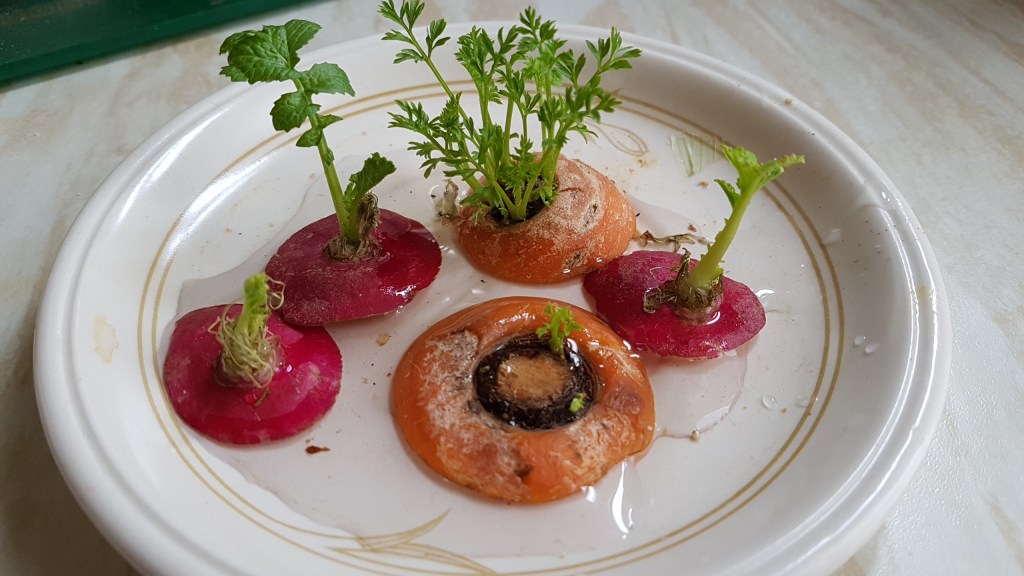
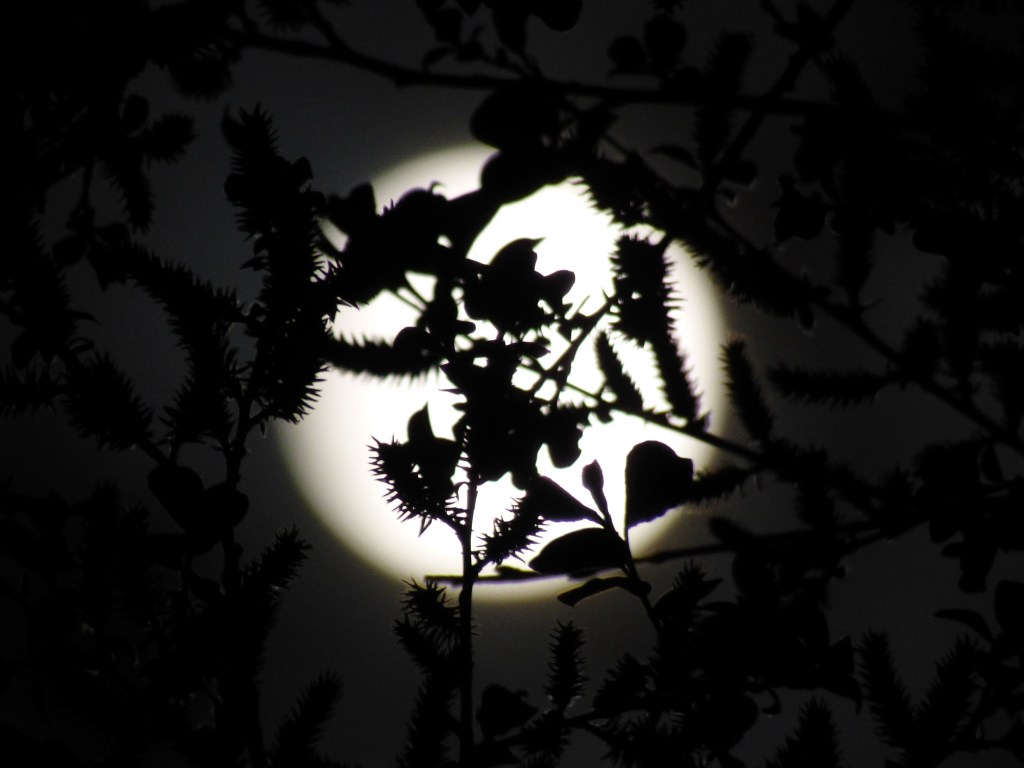
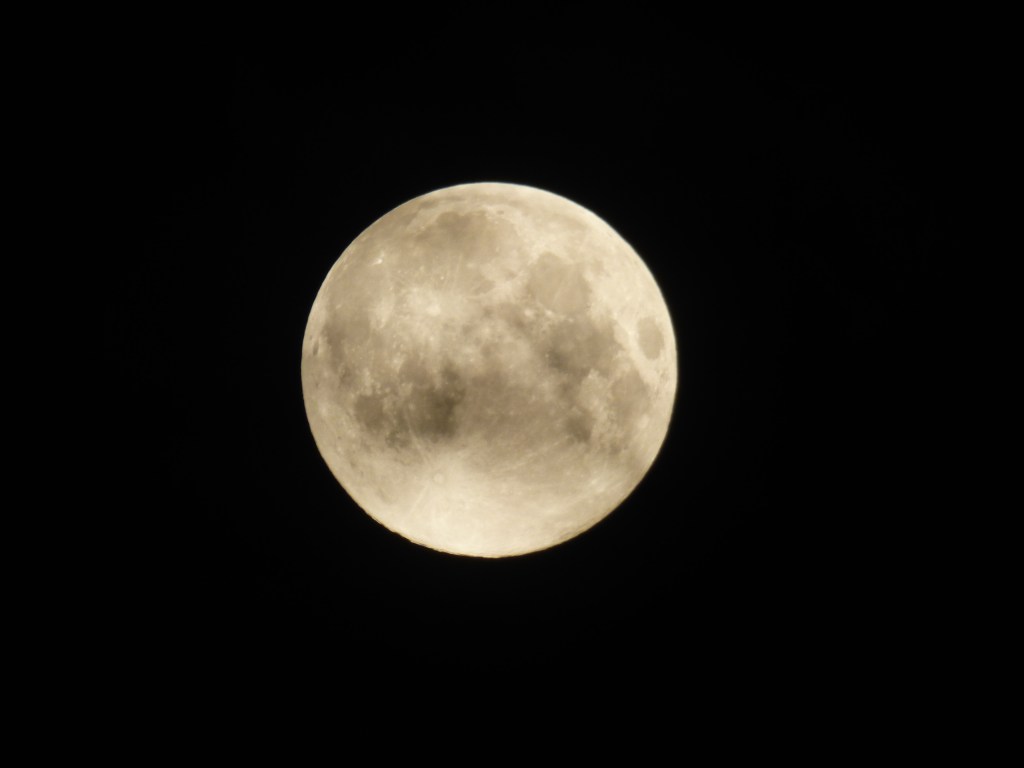
Highlights this week were the Supermoon and tracking down cans of tomato puree. The weather continued to be sunny and just how I like it, so I’ve been in the garden reading a lot of the time. I also dug over another bed and scattered more seed. I have a saucer with the ends of carrots and radishes sprouting. These are experiments because I’ll admit I’m no gardener. I have some aubergine seeds sprouting by the look of things (everything looks weed-like to me in the first stages).
I became quite obsessed with the Supermoon and one of my sons brought out the smaller of his telescopes and we set up in the front garden before moving to the back garden to carry on as the moon rose over the roof of our neighbour’s house. I was able to cadge a look at Venus through the telescope and my son pointed out Orion’s Belt. Anyway, I took a ton of photos messing around with increments of exposure (both up and down) to try for that perfect shot. I am limited a little with a bridge camera and the length of zoom, but I came away with some shots I was happy with.
When I woke up sometime after three o’clock the next morning I decided to get up and see how the Supermoon was doing (I’d heard it would be at its best at that time). Through the kitchen window all I could see was cloud and a few breaks where I could see the light of the moon, but no moon. I made a mug of tea and went into the lounge on my laptop (as you do), but with one eye looking through the curtains every so often to see what progress the cloud had made. Finally, I saw something worth going outside for. Yes, there I was in my jim jams sitting on the bench trying to steady the camera (all my shots are hand held). This went on for almost two hours – in and out of the house – until at about 4.45am when I got full moon shots. I uploaded them onto my laptop and went back to bed.
The following evening my other son said the moon looked even better. Did I need an excuse? Nope. I went into the front garden for a few shots, and yes I think it did look better.
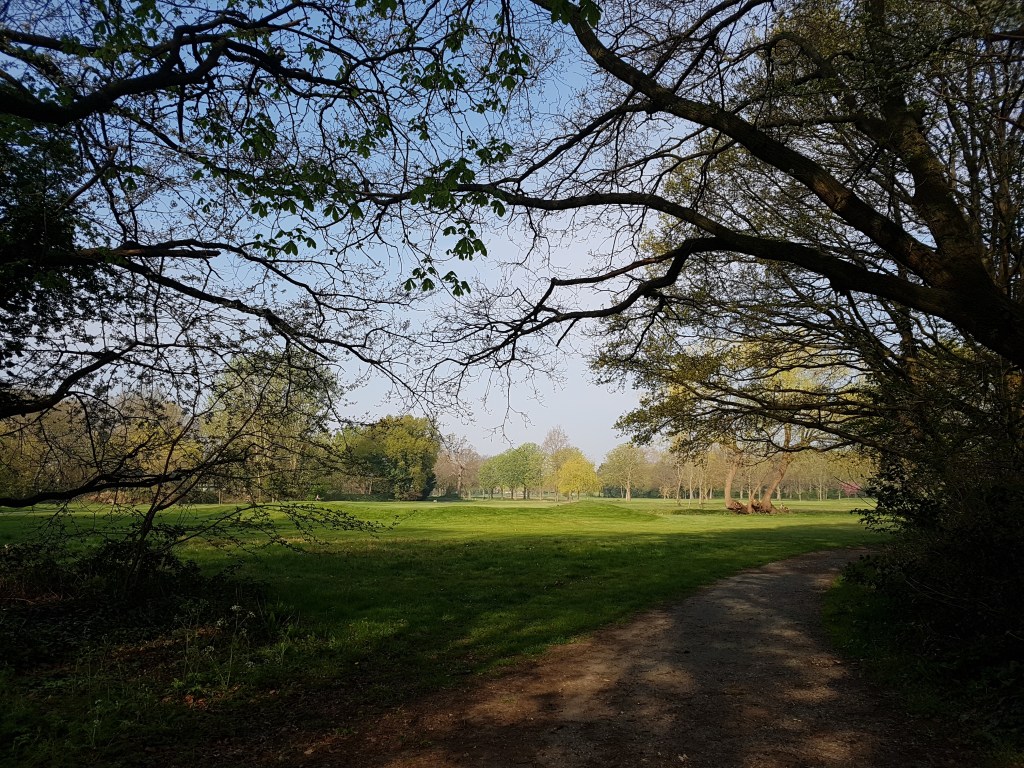
I have managed only one walk this week (we are very limited for decent walks living as we do in an urban area). This walk incorporated a busy road before heading off down through a golf course. On the way back through the high street I did my shopping and finally found the coveted tomato puree. Still looking for plain flour.
If you are missing views around London and learning a bit of history, I’d highly recommend Look Up London (who I have been on real walks with). Katie is running virtual tours about three times a week through Facebook and Instagram. Details through her website here.








 My London+