Holy Trinity, Sloane Square was given the name ‘Arts & Crafts Movement’ by Sir John Betjeman. It really is a splendid church. Quite unusual and houses a stained glass window by Edward Burne-Jones and William Morris & Company. So, of course I had to visit!
Not by Burne-Jones, but impressive
The building work began in 1888 on the site given by the Earl of Cadogan. He also financed the building and its furnishings, designed by J D Sedding. Sedding died before the church was completed and his assistant Henry Wilson carried through the work as the architect intended.
Holy Trinity has many stained glass windows, but the one I had come especially come to see was the east window – the one of Burne-Jones and William Morris. It is the window first seen as you walk in as it is behind the altar. To the right is an information board with a description of all the panels in the window.
It was lovely to see the busts of William Morris and John Ruskin as sort of bookends over the case containing the frontal altar cloth designed by John Sedding.
East Window by Edward Burne-Jones & William Morris & Co.Who’s who in the window!DetailDetail
There was interesting decoration around the top of wall by the chapel. The chapel itself is quite dark, but has a lovely stained glass window of St Michael and Gabriel.
The churchThe church showing the east window
Certainly a very interesting church to walk around. While I was there, a group of dancers were rehearsing for an up-and-coming performance. There was also a Christmas shop for ‘Good Causes’ so I bought my first pack of Christmas cards, advent candle and an advent calendar!
Holy Trinity features in the book London’s 100 Best Churches by Leigh Hatts. I’ve visited only sixteen of them so far! The church is just a short walk away from Sloane Square tube station.
Red House was built by architect Philip Webb for William Morris. The two were good friends. The Morris’ only lived here for five years, and some of the wall decorations are incomplete, but the house is beautiful and fascinating. There were plans for Edward Burne-Jones and his family to move in later, making it a village for the Arts and Craft Movement, but the extension planned was never forthcoming because circumstances changed. The Burne-Jones’ lost their baby boy shortly after birth (he was premature) and the constant trips to London for business got too much for William Morris, so it was decided to move the family back to London. Morris could not bear to return to house once it was sold on. It was his dream home.
As readers to this blog will know, William Morris is a hero of mine and regularly crops up in posts! This house has been on my ‘hit list’ for many years and it did not disappoint. Entrance to the house is by tour only, booked in advance. It’s free to National Trust members. Not all the rooms are accessible, but enough. Owners after the Morris’ did paint over things, but on occasions left strips to show what it was like. Most of the furniture is not original (though there is little furniture anyway), but what is there is in keeping with the Arts and Craft Movement. Original pieces were gifted to museums. The Ashmoleum Museum in Oxford has some pieces (gifted by Janey Morris after William’s death) as Morris studied at the University as well as helped paint the Debating Chamber of the new Oxford Union, recruited by Rossetti. Other pieces can be found at other houses the Morris’ lived in and the museum in Walthamstow (Morris’ childhood home)
Entrance to Red House
The inside of the front door is not original, but the then owner repainted it and followed the lines of the previous decoration. The stained glass was also added. I think it fits in well with the style.
The entrance hall is large and was used by the Morris’ as a dining hall. A table was moved into the space and lively conversation, as well as good food, would have made for an interesting evening with all of Morris’ friends. Morris was known for his love of food (Edward Burne-Jones often drew little cartoon sketches of Morris as round and jolly, and sometimes in a fit of temper, which his close friends seemed to encourage!). Morris also liked his drink and would come up from the cellar with several bottles of wine.
Settle-cum-cupboard, Entrance Hall
The settled in the entrance hall was designed by Philip Webb especially for the house. Morris painted the central panels with a scene from Malory (Sir Lancelot bringing Sir Tristram and the Belle Iseult to Joyous Gard). They include portraits of Janey (seated left) and Burne-Jones feeding a cherry to his wife Georgiana. However, the piece remains unfinished and was later painted green, and then brown during the second world war when the house was occupied by the National Assistance Board. I believe Rations Books may have been kept in in the settle cupboard!
The wallpaper in the house is not original as the house was pre-Morris’ wallpapers, but was added at a later date.
The dining room has a row of original William Morris chairs as well as a dresser designed by Webb and painted dragon’s blood red (in keeping with Red House!). This was a favourite colour of William Morris.
Kindy do not sit on the WIlliam Morris chairs!The fireplace, dining roomThe dresser, dining roomEmbroidered panel depicting Aphrodite designed by William Morris and believed to have been worked by Morris’ sister-in-law, Bessie Burden)Decorated ceiling over the stairs
I loved the landing with its wood floor, sofa and beautiful windows worked by William Morris and Edward Burne-Jones.
Landing window – William MorrisNot sure if this is original. I suspect not, but covered with William Morris fabric. (Landing)
William Morris’ bedroom was quite a surprise in that it was quite small. There were no furnishings here except wall paintings, unfinished and not in best condition. Those who came after Morris whitewashed the walls, but there are patches where you can see what was there before. Again, the paintings are unfinished.
Unfinished painted wall in the bedroom depicting characters from the Bible, including (far left) Adam and EveThis wall hanging is a copy of one worked on by Janey Morris. The original is at KelmscottLanding ceiling and more windows!Morris’ studio. This is one of two wood blocks on show for Morris wallpapers
In the studio the walls are cracking! Apparently, the foundations were not sunk deep enough and lies on chalk. However, the outside cracks have been dealt with, but inside they have been left. I believe it was here that the extension was going to be placed for the Burne-Jones family.
Fireplace, drawing room. Apparently it was rather smoky!
The drawing room is upstairs (like the studio) and the room I most wanted to see as I’d seen images of it online. Look closely at some of these photos to spot the cracks in the walls!
Ceiling, drawing room.
The ceiling was painted over by a new owner, but he left a few strips of the original (he also put the false beams in to make it look more rustic!). The original ceiling would have looked like the photo below.
The piano was given by Ford Maddox Brown, a pre-Raphaelite artistThe settle
The settle in the drawing room was designed by William Morris for his Red Lion Square home, but when it moved here Philip Webb added the canopy and ladder to create a gallery where plays were performed. It also had another use as access to the massive loft space where things were stored. Little doors leading to places interest me. There is another door similar to this on the landing which we were told was used to go through to ‘clear the pigeons away’ as it went into loft space.
The wall decorations are by Edward Burne-Jones and Rossetti. They seem to be the only completed works in the house!
Wall painting by Edward-Burne Jones (top) decoration to the bottom (William Morris), drawing room
We were told that the house is freezing in the winter and hot in the summer. It was certainly very hot inside the day we were there, and not many windows open. (I did wonder whether the windows were too delicate to open or that they were worried about things inside being spoiled!)
Our tour was almost over. Downstairs there is a room given open as a museum with various information boards with the history of the house and objects belonging to Philip Webb and Morris. And then we went into the garden where we were free to roam.
Other buildings designed by Philip WebbFireplace, museum roomPilgrim’s Resr Garden Porch – MorrisA well that isn’t a well!The gardensRed House
The house exceeded my expectations. I may go back one day as it is a lot to take in. I loved the gardens, too. The house is only open on certain days of the week and there is no cafe any longer. However, there are the all important toilets! The nearest railway station is Bexleyheath with trains into London. However, due to a mistake (I hold my hands up to this one!), we went on a different train and ended up at Bexley. I have to say in hindsight, this turned out to be the best option. Bexley has a village feel whereas Bexleyheath is just like most big towns (Morris liked Bexley!). Bexleyheath is just a short bus ride away and we were able to stop and have some lunch. Coming from Bexleyheath station it is a bit of a walk to the town and then you have to walk back to the house. Had the cafe at Red House still been there, this would not be a problem.
You are probably saying, ‘Who is Emery Walker?’ Well, he was a printer, engraver, and photographer (1851-1933). He was also a close friend of William Morris, who lived a short walk away at Kelmscott House. Yet the two met accidentally on a train coming home from Bethnal Green after a political meeting. They hit it off and later set up the Hammersmith Socialist League, a branch of the Socialist Democratic Federation (forerunner of the Labour Party) in 1883. The men also discovered they both had an interest in printing.
7 Hammersmith Terrace
Emery Walker’s start in life was very different. At 13, he became the main breadwinner of the family as his father went blind. He stuck out a job as an apprentice to a linen draper for many years. He hated it. It wasn’t until he changed jobs and worked for Alfred Dawson’s Typographic Etching Company that he found his true vocation. In 1885, he went into partnership with a colleague, Walter Boutall as Walker & Boutall Automatic & Process Engravers (later Emery Walker Ltd) and specialised in fine printing, engraving and photography.
It was to Emery Walker that William Morris turned when he wanted to produce books. Morris was a master at many things in life, but typeface wasn’t one of them. When Morris formed the Kelmscott Press, he asked Walker to join him. Walker declined, but his help was invaluable.
Originally Emery Walker lived at 3 Hammersmith Terrace. He had longed to live in this terrace, but the first house was a little too small. He lived there with his wife Mary Grace and his daughter Dorothy (1878-1963). This house, and number 7 where he moved in 1879, were rented to Walker, though later he bought number 7. Mary Grace Walker suffered illness throughout her life and spent a greater part of her life living at a property she owned in Surrey.
The house at 7 Hammersmith Terrace is unique in that when the last person living at the house (Dorothy’s companion Elizabeth de Hass died (1918-1999)), it passed to a trust she had set up for the property herself. Everything you see in the house is original. The only alterations carried out by the trust were to remove the kitchen (which was the telephone room and is now the reception for guided tours). The kitchen was moved from the basement when Dorothy was living there. As a town house, it has many floors, and at seventy-years old she wanted to make life easier for herself. She also installed a bathroom. The basement was converted into a flat, which was rented out. This is still the case.
There is no photography allowed inside the house (you can take photos in the garden), but the website is excellent and you can explore everything through photographs of both the rooms and objects of note inside. Please do explore the website here. There is much more information too about the house, people and their relationships. There is also a virtual tour.
For me, this was an amazing tour. Being a huge William Morris fan (have I mentioned that before?!), it was wonderful to see original wallpaper on the walls, and a line of photographs of William Morris. The most touching thing was a drawer in Walker’s bureau, which held some items of Morris’, including several pairs of glasses, a dish (possibly for ink) and a lock of William Morris’ hair which was taken on the day he died.
Furniture in the house is a mix of arts and craft and older things, but a greater part belonged to Philip Webb, another close friend, and architect of Kelmscott Manor (Morris’ house in Gloucestershire). The rooms are stunning, and I could happily move in tomorrow!
There is an exhibition space in the room adjoining the drawing room. Currently, this is about the Doves Press which Walker set up with Thomas Cobden-Sanderson originally from number 1 Hammersmith Terrace, and named after The Dove public house set between Walker and Morris’ house (the pub is still there and overlooks the River Thames). The Doves type is modern in appearance and is based on a 15th century Venetian model. You can read all about it here. It is a fascinating story. Basically, the two men owned the type together, but Cobden-Sanderson worried that when he died Walker would use it to produce books not of the same high literature, Cobden-Sanderson, over a period of a few months, threw the type over Hammersmith Bridge into the Thames. Parts of it have recently been recovered from the river, and the exhibition holds a piece of it to view. The exhibition is about to close, but you can still view pieces of Doves Press type on the website, and there is a video too.
The dining room and the drawing room have views over the River Thames, as does the bedroom which was Dorothy’s, and later Elizabeth de Hass. Emery Walker’s bedroom was in the attic, which is now offices.
The garden is beautiful, and immediately you walk out from the conservatory, the fragrance hits you. Originally, this would have been the front of the house, as there was a small walkway along the back of these houses. Later, the walkways were incorporated into the gardens and the entrances switched from back to the front of the houses.
The garden. On the left hand side is number 8, where May Morris lived.
At number 8 Hammersmith Terrace, May Morris (William Morris’ daughter) lived, and worked with her embroideries. It was not a very happy house, due to the gradual breakdown on May’s marriage to Henry Halliday Sparling (who William Morris referred to as ‘the drip’! He never minced his words).
Another garden view.
I came away from this house utterly overwhelmed by it. It has a great atmosphere and the furnishings and decorations are beautiful.
View of the Thames from the garden, looking towards Hammersmith.The house and conservatory.The garden looking towards the basement, once the kitchen.
After leaving the house, I set out to find Thomas Cobden-Sanderson’s house. I walked past it twice before I recognised it because it is clad in scaffolding and overgrown foliage. But there is Blue Plaque. I wonder what is going to happen to the house. It would be good if it was opened to the public, but I guess it depends on what is left of it inside.
Thomas Cobden-Sanderson’s house.You can just see the Blue PlaqueDoves Press
Also in the terrace is the house of Edward Johnston who designed the type for London Underground. This seems to be a great area for artists and crafters. On my way back I saw a house once lived in by Eric Ravilious, and into Chiswick there is Hogarth’s House, which I have visited in the past.
Edward Johnson’s houseEric Ravilious’ house.Looking towards Hammersmith Bridge where Doves type was thrown into the river by Cobden-Sanderson.
Finding the remains of this priory isn’t easy. I knew it was supposed to be under the car park of Sainsbury’s SavaCentre in Merton, but I’d never seen any signs to it. Over the years, I vowed I’d go there and find it. The first time I attempted this, I had to ask a gardener in the front of the shopping centre where I might find it, and he directed me through the ground floor of the multi-storey car park and to the other side. ‘You go down under the road,’ he said. So, off I went, and yes I found it, but it wasn’t open. I could see it was a proper centre, which I don’t think it was in the beginning. That Sunday I returned.
The Plan
The Museum of London was involved with the archeological dig, though there had been digs in the past. However, I was told that Sainsbury’s wanted to flatten the whole lot for their car park! The only part visible is remains of the Chapter House, but from the plan above, you can see that it was quite extensive.
Certainly, the building under the road is now well looked after and the information boards well put together explaining the history and life of the priory. The space in the middle doubles up as an exhibition space. When I was there, local artists were showing their paintings. I believe there are events put on as well. Not only is there information and ruins of the prior here but also the link with the Wandle River, William Morris, lost railways of the area and a display about Liberty’s of London, who had a textile workshop at Merton Abbey Mills just around the corner.
There is a wonderful website here with the history, videos and so much more. Merton Priory was famous in its time. Thomas Becket was student here, and Walter de Merton, was was probably educated here, became Administrator, and from where we get Merton College, Oxford!
Remains of the Chapter HouseHere you can see more of the space, including the exhibition spaceCoffinI didn’t expect to see all this. Delighted!All about William Morris – my hero!Old photos
I could get very carried away here as I took photo after photo. All my desires in one place were rather overwhelming! People sometimes ask, ‘Who is the one person you wish you could meet?’ For me, it would be William Morris. You might have guessed that as he crops up a lot in my blog posts!
Another local man!All about Liberty’s at Merton Abbey MillsDisplay cabinet – Liberty’sLiberty printsAll things trains!River Wandle, Merton Abbey Mills, close to where William Morris had his workshops.The little garden at Merton Abbey Mills looking very spring-like.
Coming out of the Chapter House, there is a path leading to Merton Abbey Mills. I’d been so close to the ruins for so long, but no decent signage had made it difficult to locate. I went mad and bought virtually every book there for sale! I adore the place and feel it should have far more exposure, so please spread the word. I shall go back again sometime. A physic garden is being planned just outside – the wheelbarrows are there already. That should be lovely. Entrance to the building is free, but there is a donation plate and a visitors’ book to write your comments in.
This area is very close to my heart. I have walked the Wandle River, I visit Merton Abbey Mills and Merton Hall Park quite a lot. There is always something new to discover, and finally finding Merton Abbey Priory is the icing on the cake.
I chose the day least likely to rain, which came the day before New Year’s Eve. I set off by bus and tram to visit a popular haunt of mine. Having been here so many times, I didn’t think there was much left here to surprise me. How wrong I was.
Entering the Rose GardenRose
The park was busy with families (kids riding new bikes) and dog walkers. The weather was surprisingly warm for December, up to 16 degrees and people were eating outdoors.
There was a ‘Percy the Park Keeper’ trail for the children (I used to read these books to my children) and both cafes were open, as well as the secondhand bookshop and garden centre.
Percy the Park KeeperMorden Hall ParkThe Waterwheel – Morden Hall ParkThe secondhand bookshop – always worth a browse
After lunch in the National Trust cafe, I walked through the wetlands area along the River Wandle, passed Dean City Farm and finished my walk at Merton Abbey Mill, where William Morris used to have workshops. Later, Liberty’s of London had buildings here, including a print shop.
The wetlands
At weekends there is a market (though I have never been), and the various craft shops are open. There are places to eat here and a pub (The William Morris), and I found the pottery shop, which I have never been in before. Here you can see the mechanics of the waterwheel which still works and was working on the day I was there.
The River Wandle flows alongside Merton Abbey MillsThe William Morris PubLiberty Print ShopWilliam Morris and the Pre-RaphaelitesThe working waterwheel inside the pottery shop
It was good to get out for a walk at long last, even for a short one like this.
I hope you all enjoyed some sort of New Year’s celebration, despite Covid. I look forward to sharing many walks and places of interest with you in the coming months.
The remains of the Merton Priory. I’ve read that there are other remains in the Saintsbury’s Car Park, but I’ve never gone looking for them!River WandleA little book buying from the garden shop!
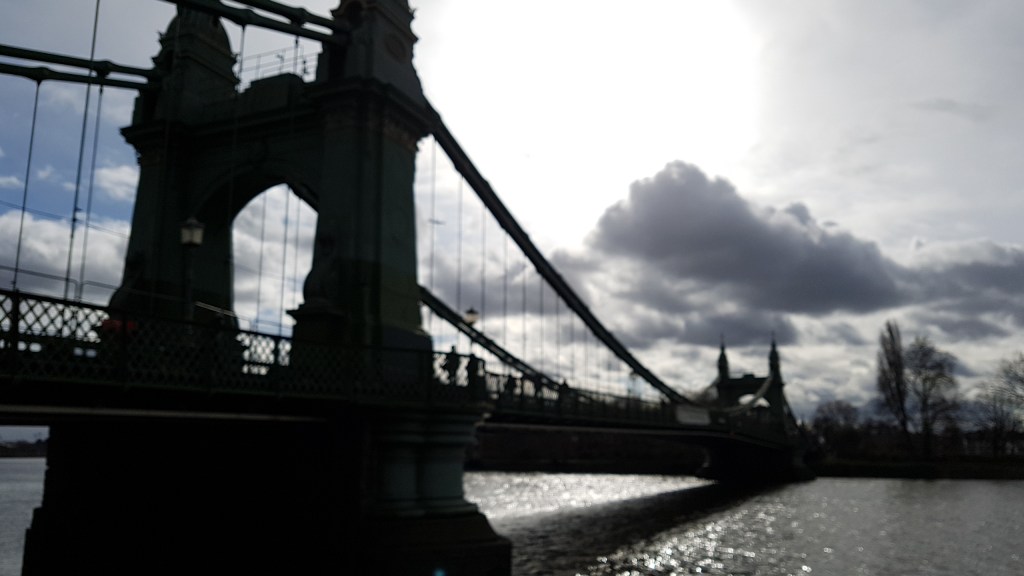
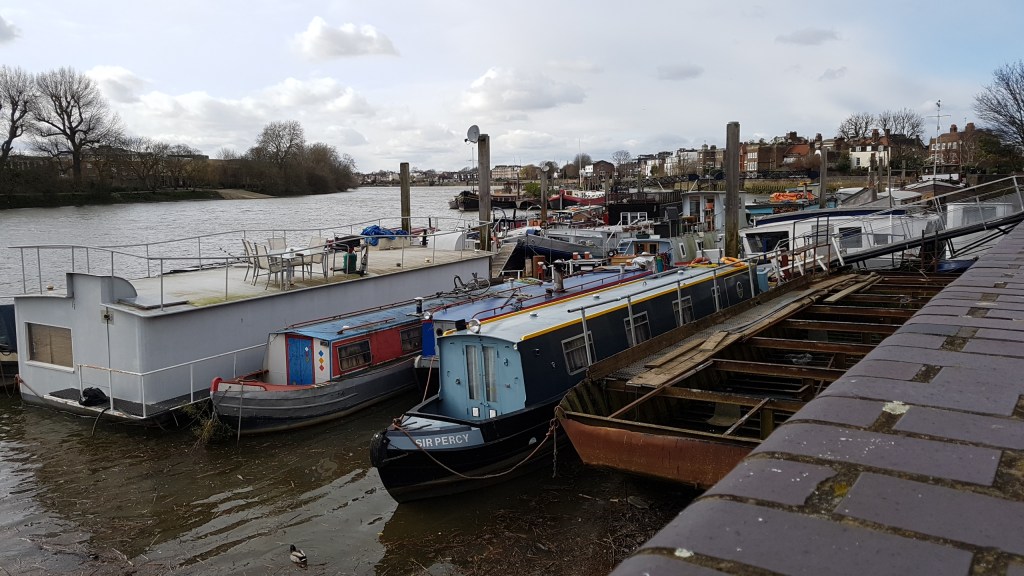
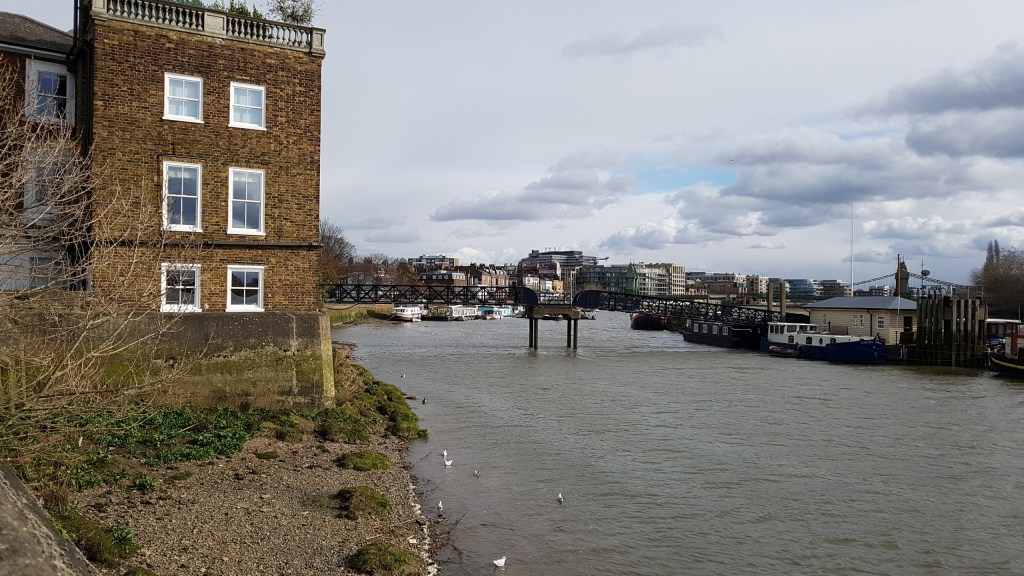
Every Tuesday I go along to a writing group meeting in a cafe in Hammersmith. Today I arrived early so I took a short stroll along part of the Thames Path, a path I know quite well. Above is a photo of Hammersmith bridge designed by Joseph Bazalgette and opened in 1887. Currently the bridge is closed to traffic as major repairs are required, but pedestrians can still access it.
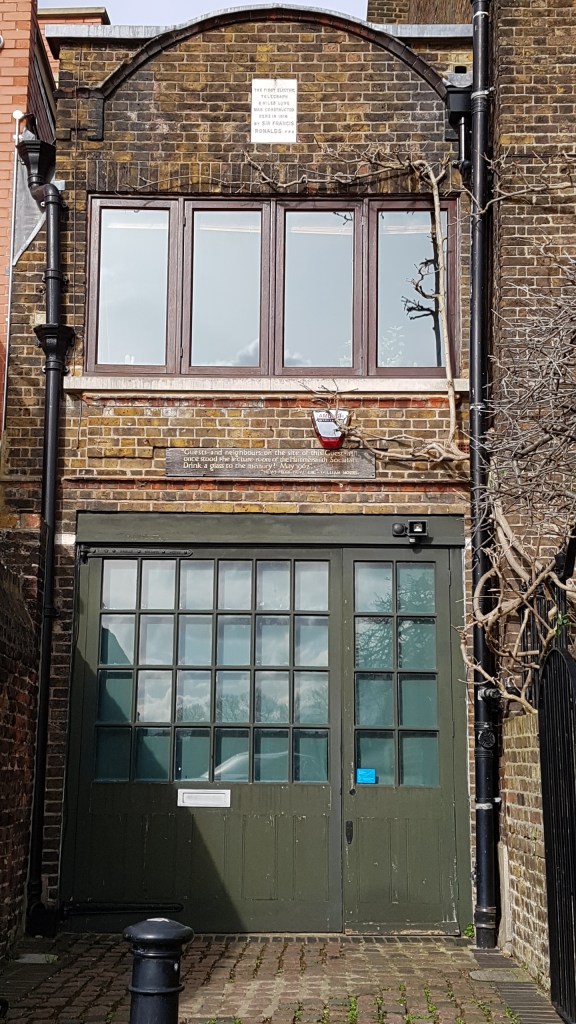
The Coach House
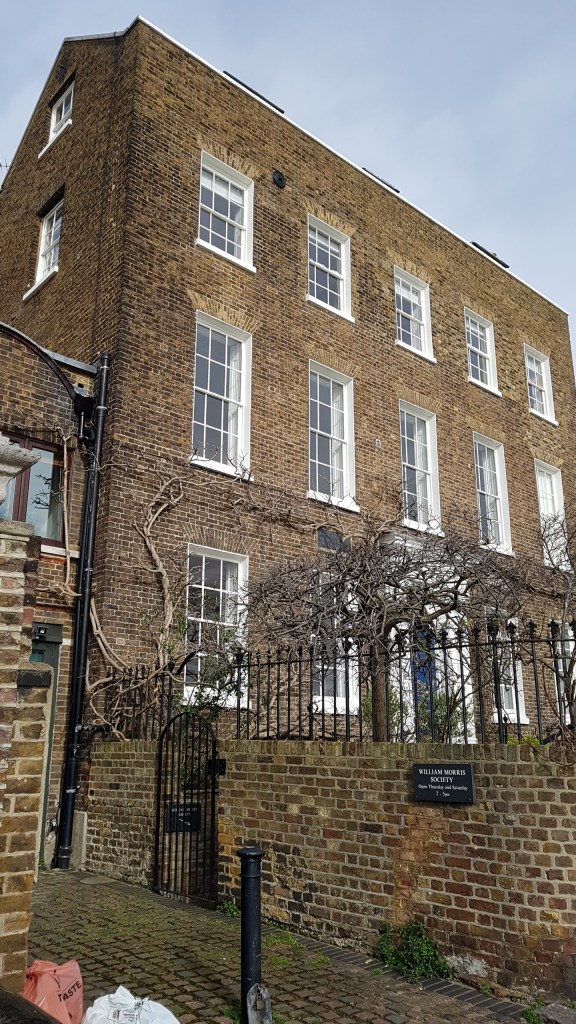
I walked just a little way along the pathway until I came to Kelmscott House where William Morris (a major influence in the Arts & Craft Movement and founder member of the Pre-Raphaelite Brotherhood) lived from 1778 to 1896. The house is privately owned but The Coach House is home to the William Morris Society and open on certain days of the week. It is well worth a look. I visited several years ago. The Coach House is where the Hammersmith branch of the Socialist League met. There you will see a printing press used by William Morris, as well as tiles and furniture.
The main house
The house is just a stones throw from Emery Walker’s House, which is presently closed, but I aim to visit when it re-opens. Emery Walker was a good friend of William Morris and they often met together.


 My London+